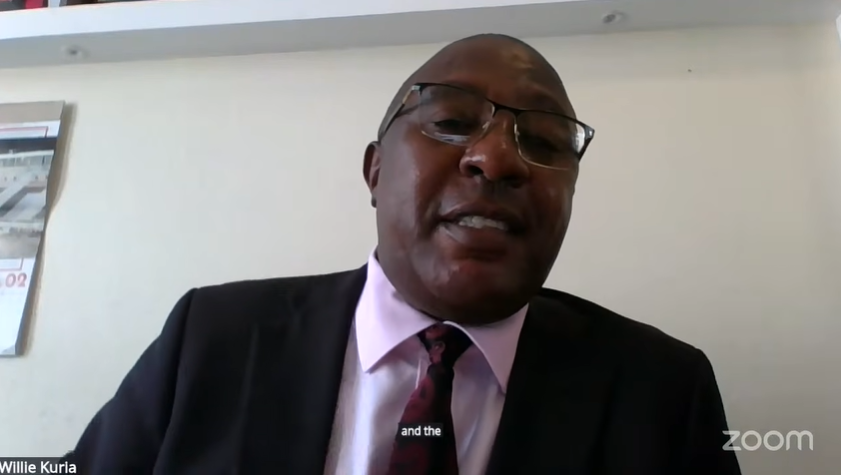
 Willie Kuria, chairperson of the Kenya Secondary Schools Heads Association and principal of Murang'a High School during the virtusl meeting, March 11, 2026.
Principals of public secondary schools have mounted a spirited defence over governance and financial management weaknesses flagged by the Auditor General over the past four financial years.
The audit flagged 218 schools in the 2023–24 financial year that had weaknesses requiring corrective action and improved controls after their financial statements were found to be generally accurate but contained unsupported items.
Over the same period, the auditor found serious governance and financial management problems in two schools and issued an adverse opinion after the institutions’ financial statements were found to contain significant misstatements and did not reflect their true financial positions.
This marked an improvement from previous years. In the 2020–21 financial year, seventeen schools were found to have serious governance and financial management problems, compared with 16 in 2021–22 and 14 in 2022–23.
Whereas financial statements in six schools presented a true and fair view and complied with financial regulations in 2020–21, and five each in 2021–22 and 2022–23, no school met that threshold in the 2023–24 financial year.
The audit reports became a key talking point during a virtual meeting convened on Wednesday by Head of Public Service Felix Koskei with boards of management, principals and senior administrative officers in secondary schools across the country.
The meeting, convened in collaboration with the State Department for Basic Education and the Teachers Service Commission, focused on policy and governance frameworks that govern the education sector.
“This is a sample; this is not all the audit scope for the Auditor-General,” said FCPA Susan Oyatsi, a presidential nominee to the National Lands Commission and a former teacher who has been working as an adviser to the Head of Public Service.
In her presentation, Oyatsi said some of the thematic areas found most wanting included inaccuracies in capitation grants, irregular transfer of funds to the Kenya Secondary Schools Heads Association, failure to hold board meetings, unapproved fees under parents’ association support programmes, procurement irregularities, unbudgeted and unsupported revenue and expenditure, and overdrawn bank accounts.
“Most of you wake up and it’s like you’re running your house, but even running your house you need to organise yourself in terms of revenue and expenditure,” she said.
Willie Kuria, chairperson of the Kenya Secondary Schools Heads Association and principal of Murang'a High School, said the meeting had enlightened school leaders on prudent financial management that would help them promote transparency in their institutions going forward.
However, he said some of the flagged challenges stem from perennial financial constraints that often limit service delivery.
“You find that because of the little capitation coming, it becomes so difficult for schools to operate,” Kuria said, adding that the approved fee structure does not adequately meet student needs.
Kuria said the current fee structure was developed in 2014 and remains in place despite rising inflation.
“The fees now charged in secondary schools is Sh53,000, but during our forums when we try to calculate how the students spend money in schools per day, we have arrived at a budget of Sh95,000 in boarding schools,” he said.
Kuria added that schools expect to receive Sh22,244 annual capitation per student but often receive only about Sh14,000.
Last year, for instance, he said there was a Sh6,860 deficit per child, translating to more than Sh22 billion nationally.
In keeping with the 50:30:20 capitation disbursement ratio, Kuria said schools expect Sh11,000 in the first term.
However, this term they received only Sh6,500 from the lump sum of Sh44.24 billion the government released on February 2.
“That shortage of funds is really difficult for us to manage schools,” Kuria said.
He added that other challenges include a lack of financial personnel to offer professional guidance on budgeting, leading to some of the financial problems highlighted by the audit.
Kuria said most schools do not have the financial capacity to employ bursars.
“You find that most of these schools are day schools, and they rely on capitation, so when capitation does not come, they are not even able to pay salaries, let alone employing qualified staff. Some schools even rely on secretaries to manage finances for them.”
The heads’ representative said most schools are also struggling to find teaching staff to handle technical subjects such as electricity under the Competency-Based Education (CBE) system because tutors employed by the Teachers Service Commission who can handle such subjects are scarce.
“To get one you really have to tarmac to get someone to come and teach finance, building, and construction, so something needs to be done.”
Kuria nonetheless said school principals will continue doing their best to run schools.
He defended the transfer of funds to the heads’ association, saying the money consists of contributions by members to run its activities.
“KESSHA is a registered association, and members contribute Sh500 every month to run the association. What comes there is money for activities and there’s no other way other than to put money in that clearance account.”
Koskei warned against all forms of misconduct in schools, issuing a stern caution against inflating school enrollments to attract higher capitation and charging illegal fees.
“If it is found that the fees guidelines that have been given are not adequate to run a school, please have a conversation with the ministry until you agree, so that we do not transfer the challenges we are having in schools to parents,” Koskei said.