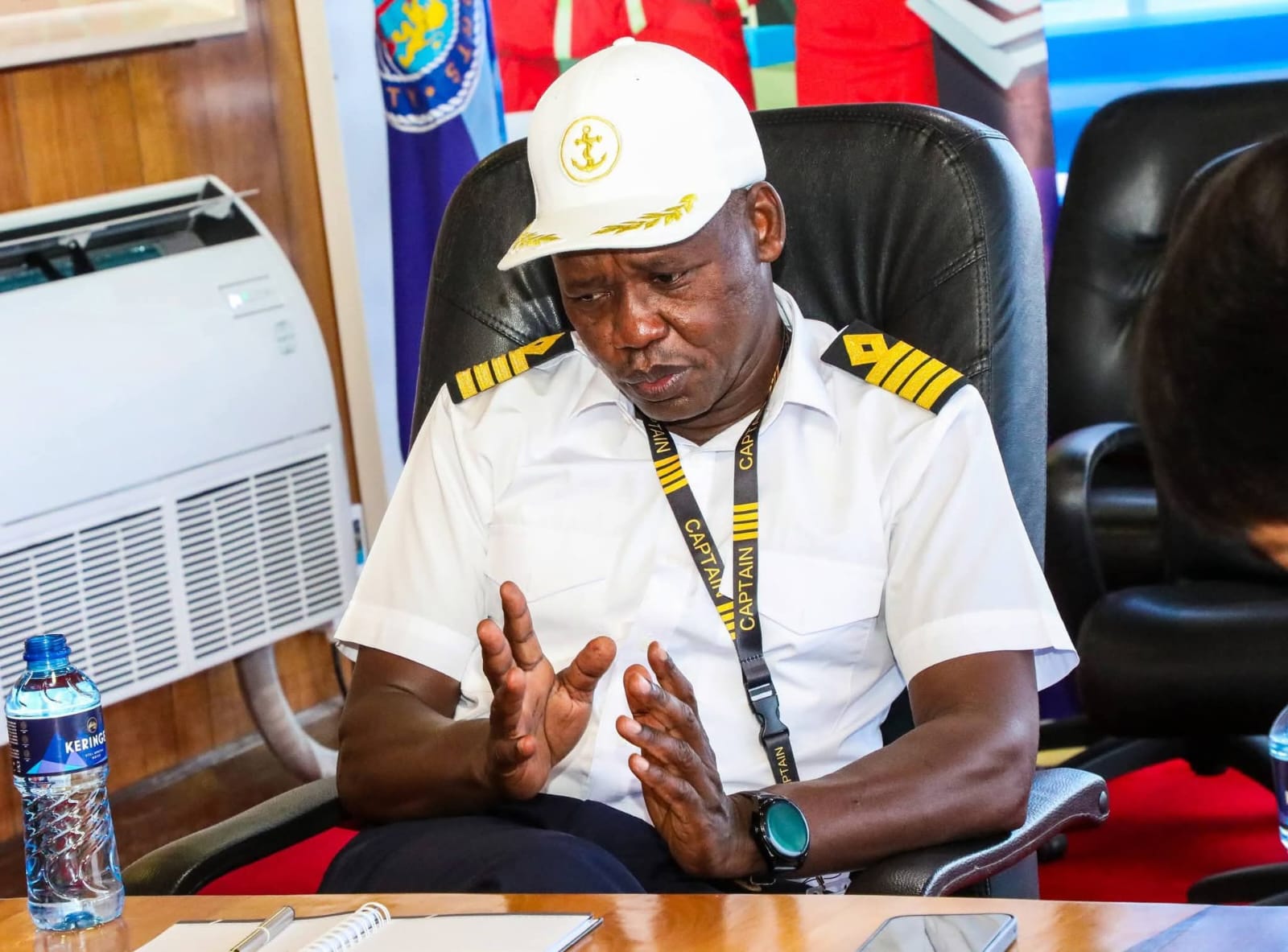
The Kenya Ports Authority has extended the term of managing director Captain William Ruto for another three years.
Captain Ruto was first appointed on March 10, 2023, by then Transport Cabinet Secretary Kipchumba Murkomen for an initial three-year term that expired on Tuesday.
However, credible sources within KPA say the government has opted to retain him for a second term.
Government Spokesperson Isaac Mwaura hinted at the extension on Tuesday during the recording of Sema na Spox, a public engagement programme hosted by his office.
Mwaura hosted the programme at the Mombasa Port’s Cruise Terminal.
While Mwaura did not disclose details, stakeholders present during the session congratulated Captain Ruto, suggesting confirmation of the extension.
Under the KPA Act, a managing director may serve a maximum of two terms.
However, history shows that even completing one full term at the helm of the ports authority is no small feat.
If confirmed through a formal appointment letter, Captain Ruto would become the first KPA managing director in nearly a decade to secure a second term.
A gazette notice confirming the extension is expected later this week, according to insiders.
In recent weeks, there has been intense lobbying both for and against his retention, with some stakeholders pushing for a change in leadership, including calls for the appointment of a coastal native.
However, the KPA board has not indicated any leadership changes.
The office of managing director at KPA has long been considered a political and administrative “hot seat”.
It is influenced by strong commercial interests, labour dynamics and the strategic importance of the Port of Mombasa to Kenya and the wider East and Central African region.
Since the departure of Gichiri Ndua in 2016, no substantive managing director has managed to complete the full six-year tenure allowed under the law.
Ndua, who served from 2010 to 2016, remains the last KPA boss to complete two terms.
His tenure was marked by relative stability and international recognition, culminating in his election as the first African President of the International Association of Ports and Harbours.
Those who followed him faced a far more turbulent environment.
Catherine Mturi-Wairi, the first woman to lead the authority, served from July 2016 to June 2018 before resigning after two years.
Her exit ushered in a period of leadership instability dominated by acting appointments.
Architect Daniel Manduku took over in 2018 and served until 2020 before leaving the position amid corruption allegations.
Manduku is currently the MP for Nyaribari Masaba.
He was succeeded by Engineer Rashid Salim, who served as acting managing director from June 2020 to July 2021.
Ambassador John Mwangemi later held the position in an acting capacity from July 2021 until March 2023, when Captain Ruto, then the operations general manager, was appointed substantive managing director.
Captain Ruto’s first term has largely been characterised by operational stability and improved performance at the ports.
Under his leadership, KPA has recorded notable operational gains, including a 10.9 per cent growth in cargo volumes in 2025, driven largely by improved regional trade flows.
Over the past week alone, the managing director has been involved in a series of diplomatic engagements, vessel arrivals and strategic meetings aimed at strengthening Kenya’s position as a regional maritime and logistics hub.
From high-level diplomatic meetings to milestone vessel calls at the Ports of Mombasa and Lamu, the developments reflect growing global confidence in Kenya’s port infrastructure and logistics ecosystem.
Last week, Captain Ruto met with the Danish Ambassador to Kenya, Stephan Schonemann, who reaffirmed Denmark’s continued commitment to supporting KPA in developing modern, efficient and sustainable port infrastructure.
The ambassador said Denmark remains ready to support key development initiatives through TradeMark Africa, a regional trade facilitation organisation that has partnered with Kenya in several port modernization programmes.
Captain Ruto welcomed the continued collaboration, noting that Danish support has been instrumental in advancing several transformative initiatives at the authority.
Among the projects benefiting from the partnership are the Green Port Policy, the Smart Port Policy and resilient infrastructure development at Kisumu Port.
In another diplomatic engagement, Indonesia’s Ambassador to Kenya, Witjaksono Adji, announced plans to increase exports through the Port of Mombasa.
Speaking during a courtesy call on Captain Ruto, the envoy said Indonesia was impressed by the growth and efficiency of the port, which has increasingly positioned itself as the most reliable gateway for East and Central Africa.
Indonesia remains one of Kenya’s key trading partners, with Kenya exporting commodities such as tea and coffee while importing palm oil and textiles from the Asian nation.
Captain Ruto welcomed the proposal and highlighted opportunities for Indonesian private sector participation in emerging infrastructure projects, including the development of Lamu Port and Special Economic Zones.
KPA has also convened a high-level meeting with public and private sector stakeholders to streamline the movement of horticultural exports through the Port of Mombasa.
The meeting focused on improving logistics systems for perishable exports such as fruits, vegetables and cut flowers—a sector that earns Kenya between USD 1.5 billion and USD 2 billion annually.
Stakeholders discussed ongoing reforms in cold-chain logistics, including expansion of refrigerated container capacity, faster cargo clearance procedures and improved coordination among border control agencies.
The goal is to reduce logistics costs while ensuring Kenyan produce reaches international markets in optimal condition.
Captain Ruto praised the collaboration between government agencies and the private sector, noting that efficient port operations are essential to sustaining the competitiveness of Kenya’s horticulture industry.
The Port of Mombasa also recently marked the maiden call of the vessel MV Nara, deployed under Akkon Line’s East Africa Service.
In a rare gesture reflecting his maritime background, Captain Ruto—a career master mariner—personally navigated the vessel into port before presenting a certificate of first call to the ship’s master, Mustafa Olgun.
The ceremonial recognition is a long-standing maritime tradition marking a vessel’s first visit to a port.
According to the managing director, the deployment of the vessel strengthens shipping connectivity between the Indian Subcontinent and East Africa.
“Every maiden call strengthens regional trade and reflects our strategic vision of making Mombasa a preferred maritime hub,” he said.
Further north, the Port of Lamu also recorded a milestone following the maiden call of the MV Grande Auckland, a 9,000-capacity Pure Car Carrier.
The vessel arrived carrying 469 brand new vehicles manufactured in Europe, which were discharged at Lamu for onward shipment to the Middle East.
The vehicles had initially been scheduled for discharge at Jebel Ali Port before the shipping line opted to utilise Lamu as a transshipment hub.
According to KPA’s 2025 results, container traffic at the Port of Mombasa grew by 5.5 per cent during the year.
Overall cargo throughput rose to a record 45.45 million metric tonnes in 2025, up from 40.99 million tonnes in 2024—representing a 10.9 per cent increase.
Container traffic reached 2.11 million twenty-foot equivalent units (TEUs), compared to 2.00 million TEUs recorded the previous year.
Imports remained the main driver of growth, rising to 36 million metric tonnes from 30 million tonnes in 2024, a 20.1 per cent increase.
Export cargo volumes also grew slightly, increasing by 1.3 per cent to 5.03 million metric tonnes from 4.96 million tonnes.
Transit cargo recorded particularly strong performance, rising by 19.5 per cent to 15.88 million metric tonnes from 13.29 million tonnes in 2024.