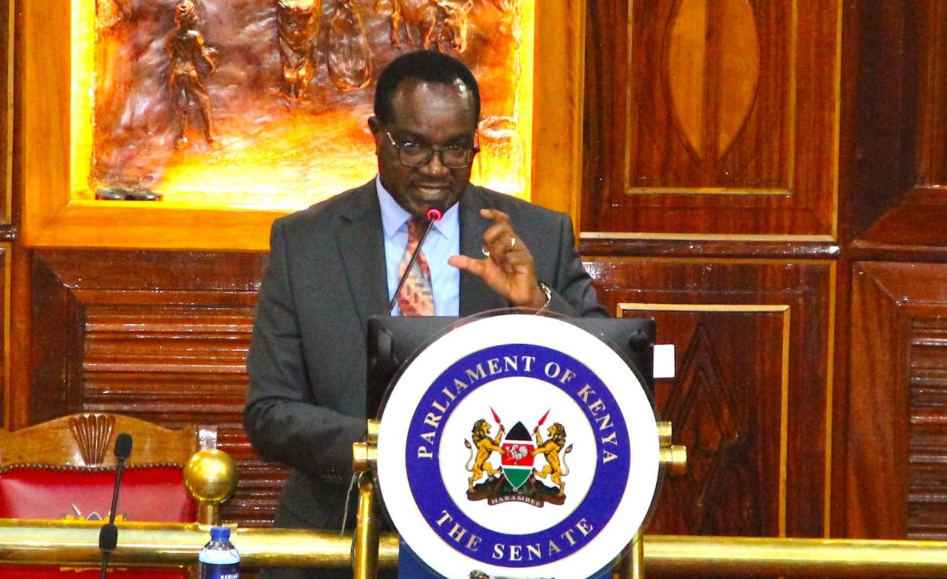
 Education Cabinet Secretary Julius Ogamba answers questions before the Senate plenary on Wednesday, March 11, 2026. /JULIUS OGAMBA/X
Education Cabinet Secretary Julius Ogamba has explained why junior schools are not treated as autonomous institutions separate from primary schools despite having distinct financial accounts and governance structures.
Appearing before the Senate on Wednesday, Ogamba said junior schools continue to operate under the management of primary schools, even as some stakeholders push for autonomy in line with recommendations of the Presidential Working Party on Education Reforms (PWPER).
Ogamba said the reform team recommended that junior schools be domiciled within primary schools mainly because the learners were considered too young and might struggle to adjust in secondary school environments alongside older students.
Cost considerations also informed the decision. He explained that classrooms used by Classes 7 and 8 would otherwise remain unoccupied once the pioneer cohort of the Competency-Based Education (CBE) system transitions to senior school.
The reform team also noted a severe capacity gap in secondary schools. Existing institutions, with about 10,000 schools nationwide, could not accommodate learners drawn from more than 32,000 primary schools.
“Thus it was considered most cost-effective that constructing new classrooms would not be a prudent way of spending government money,” Ogamba said.
He was responding to a question posed by Senator Enoch Wambua on behalf of Nairobi Senator Edwin Sifuna, who was absent from the House.
The CS said the government opted to maximise the use of available classrooms and other facilities in primary schools instead of building entirely new secondary school complexes at taxpayers’ expense.
Under the arrangement, the main additional cost has been the construction of facilities such as laboratories to meet the specialised requirements of junior school education.
Ogamba further explained that keeping junior school learners within primary school environments was intended to ease the transition from Grade 6 to Grade 7 and support the government’s goal of achieving 100 per cent transition.
He said the approach also ensures that learners do not have to travel long distances to access junior school education.
The Presidential Working Party recommended the establishment of comprehensive primary schools catering for learners up to Grade 9.
This proposal informed guidelines issued in January 2023 for implementing junior secondary education. The guidelines outline how junior schools should be governed in terms of administration, infrastructure development and curriculum implementation.
“In line with the policy position and the guidelines in place, primary and junior schools have one head of institution and one board of management that oversee the governance and management of the school.”
Ogamba said the separation of financial accounts between the two levels does not imply autonomy or institutional separation.
He explained that the accounts are kept separate because the two levels receive different capitation funding rates.
Primary school learners receive Sh1,420 per learner per year, while junior school learners receive Sh15,042 per learner annually.
“Thus for purposes of financial planning, accountability and audit, the accounts for junior school and primary school are kept separate,” he explained.
Junior school teachers have been pushing for administrative autonomy from primary schools, citing concerns over alleged mismanagement, poor implementation of the Competency-Based Education curriculum and stalled career progression.
The tutors are seeking clearer and independent career progression guidelines, arguing that the current structure restricts their professional identity and growth as post-primary educators.
Some teachers have also reported cases of discrimination, intimidation and heavy workloads under primary school management.
Parliament is currently considering amendments to the Basic Education Act that would grant junior schools greater autonomy and create a more specialised learning environment for Grade 7, 8 and 9 learners.
Ogamba said primary school teachers are regularly retooled to discharge their roles professionally and effectively.
He added that the curriculum taught in junior school is at secondary school level and can only be delivered by graduate teachers trained for secondary education.
"To this end therefore, all teachers teaching in junior school hold the training skills and competencies and qualifications for secondary school level curriculum delivery.”
He said additional support is provided by the Teachers Service Commission (TSC) and the Ministry of Education to field officers, while teacher induction, mentorship and coaching programmes have been institutionalised across all public basic education institutions to strengthen professional practice.
The CS said the Career Progression Guidelines (CPGs) developed in 2016 by the TSC in consultation with the Salaries and Remuneration Commission (SRC) informed the 2017–2021 Collective Bargaining Agreement (CBA) signed with teachers’ unions to anchor the results of the job evaluation.
The CPGs were reviewed again in 2018 and expanded to cover teachers in basic education, lecturers and special needs educators.
The guidelines outline minimum entry requirements into teacher education, appointment and promotion at different grades.
“To underscore this position, the appointment letters issued to teachers stationed in junior schools clearly state their grades and designations as secondary school teacher 2 as per career progression guidelines 2018.”
Ogamba said junior school teachers are promoted under the same guidelines, dismissing calls to distinguish between their designation and place of work.
“Junior school teachers, regardless of their place of work, are secondary school teachers by training, qualifications, skills and competencies and are treated as such for their career progression.”