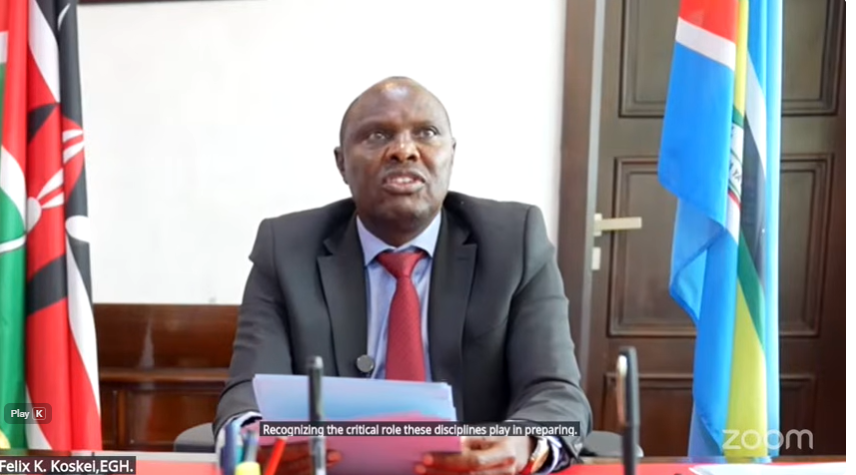
 Head of Public Service Felix Koskei addresses secondary school heads and senior management during a virtual meeting on Wednesday, March 11, 2026. /SCREENGRAB
Head of Public Service Felix Koskei has warned school administrators against inflating student enrolment to attract higher capitation, saying the practice will not be tolerated as it undermines accountability and erodes public trust.
Koskei said recent audit findings raised serious concerns over discrepancies between the number of learners reported in government systems and the actual number present in schools.
“The capitation funds are intended to ensure that every learner has access to quality education within a conducive learning environment. It is therefore imperative that the systems used to plan, allocate and manage these resources are handled with the highest level of integrity,” he said.
The audit conducted late last year by the Ministry of Education revealed discrepancies between the number of learners captured in the National Education Management Information System (NEMIS) and the actual student populations in schools.
It identified 973,634 ghost learners in public primary and secondary schools, pointing to a massive fraud that potentially cost the government billions of shillings in fake capitation claims.
“Such irregularities have serious implications because school capitation is based on learner enrolment data captured on the NEMIS. Where enrolment figures are inaccurately reported, public funds intended to support genuine learners are misallocated.
“Let me therefore be very clear: any manipulation of learner data, misreporting of enrolment figures, or any other irregularities that compromise the integrity of the education system will not be tolerated by the government,” he said.
Koskei spoke on Wednesday during a virtual meeting attended by more than 80,000 school leaders comprising members of boards of management, principals, deputy principals, and heads of finance, accounts, and procurement in secondary schools across the country.
He emphasised that the credibility of Kenya’s education system depends on accurate reporting and responsible management of public funds.
“The credibility of our education system depends on the reliability of the information provided through these systems and on the integrity with which public resources are managed,” he said.
Koskei told the school heads that his office is actively driving a “Zero-Fault Audit Campaign” aimed at promoting transparency and prudent use of public resources across government institutions, including schools.
This initiative, he explained, promotes prudent, responsive, transparent and effective use and management of public resources.
“It is particularly important at a time when we are operating within a constrained fiscal environment,” he said, encouraging secondary schools to align themselves with the principles of the campaign by strengthening compliance with financial and administrative regulations.
“Those entrusted with leadership within our schools, together with the governance structures that oversee them, must ensure that all data submitted through official systems is verified and consistent with the actual situation on the ground,” he added.
Koskei noted that school leadership and boards of management serve as custodians of public resources and must therefore safeguard the integrity of systems used for planning and managing education funds.
“Public funds allocated to education are meant to directly support the learning and development of our children. It is therefore imperative that these resources are managed with the utmost integrity and responsibility,” he said.
The Head of Public Service also announced plans to strengthen the internal audit framework in public schools in order to improve financial oversight and accountability.
He cited the Constitution and the Public Finance Management (PFM) Act, which mandate the National Treasury to establish financial controls and internal audit arrangements across public institutions.
Koskei said the current structure of school-based auditing mechanisms, established under the Basic Education Act, 2012, has presented operational and structural challenges.
“These challenges include concerns relating to the independence of internal audit functions, the standardisation of audit practices, and alignment of school-level financial oversight with the broader national public finance management system,” he said.
To address the gaps, Koskei directed the National Treasury to initiate legal and administrative measures to align internal audit arrangements in schools with national public finance management frameworks.
“Secondly, the National Treasury shall put in place the necessary financial and audit committees in public schools to enhance transparency, accountability, and prudent management of public resources,” he said.
Koskei also raised concerns about procurement irregularities in schools, warning that poor compliance with procurement laws has contributed to financial mismanagement in some institutions.
He said reports indicate that procurement adherence in certain schools remains below 23 per cent, highlighting the need for stronger oversight.
“We have realised there are many challenges in the management of public resources in secondary schools, particularly in procurement processes and record keeping,” he said.
Koskei warned against conflicts of interest where members of school boards of management supply goods and services to the same institutions they oversee.
“Sometimes members of boards of management are the same suppliers of what is required in schools. This must stop. Procurement must strictly follow the law and involve qualified and independent suppliers,” he said.
He urged school administrators to revive procurement procedures and ensure full compliance with public procurement laws.
Beyond financial management, Koskei pointed to poor maintenance of school infrastructure as another area of concern.
“In some institutions, you find buildings falling apart despite the presence of boards of management and school leadership. There must be accountability in how resources allocated for maintenance are used,” he said.
He urged school principals and infrastructure committees to closely monitor construction and maintenance projects to ensure quality and transparency. Koskei also cautioned against misuse of school assets, such as buses, for private purposes without proper accounting.
“School facilities such as buses should not be used for private purposes without clear guidelines and proper accounting for any proceeds,” he said.
Koskei further urged school leaders to maintain discipline and order within learning institutions, warning against external interference in school management.
“Principals must not sit back and allow our children to run amok or allow outsiders to interfere with school management. Discipline in schools must be firmly upheld,” he said.
He also warned against irregular hiring practices within schools and emphasised the need to safeguard public assets.
Koskei described teachers and school leaders as critical pillars of the public service, noting that their work shapes the values and future of the nation.
“Teachers and school leaders are the frontline of the Public Service. They shape discipline, nurture excellence, and instil accountability in our learners every day.”
He said Kenya has more than 9,500 secondary schools serving millions of learners, making the education sector one of the largest components of the public service.
“Upholding strong governance and professional standards in our schools is essential to sustaining public confidence and delivering quality education,” Koskei said.
The meeting was also attended by Basic Education Principal Secretary Julius Bitok, acting chief executive officer of the Teachers Service Commission Eveleen Mitei, TSC chairman Jamleck Muturi, and Kenya Secondary Schools Heads Association chairperson Willie Kuria.
Koskei will convene a similar meeting with heads of public schools and their support staff on Thursday.