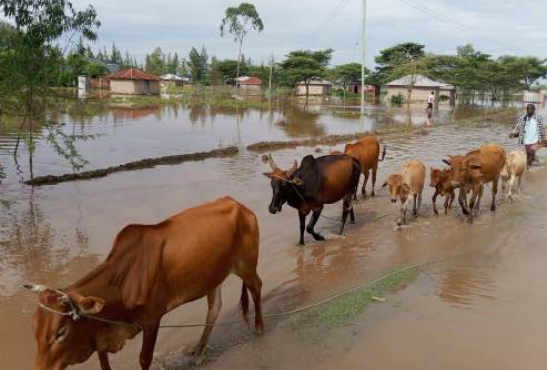
 Flooded Sango Rota in North Nyakach, Kisumu county, following heavy
rainfall across the country /FAITH MATETE
Flooded Sango Rota in North Nyakach, Kisumu county, following heavy
rainfall across the country /FAITH MATETE
Heavy rains being experienced in the country have destroyed
farms, killed livestock and displaced hundreds of people.
The aftermath of the rain has raised concerns about food production
during the current planting season.
According to the Kenya Red Cross Society (KRCS), at least
381 households have been affected and about 56 hectares of farmland destroyed
in parts of Kisumu and Homa Bay counties following flooding that began in early
March.
The humanitarian agency reported that the Sondu-Miriu River burst its banks in Wang’chieng ward in Kisumu county, submerging farms and homes in Kobala and Kobuya locations.
“Approximately 56 hectares of farmland have been destroyed in the Wang’chieng area alone after floodwaters submerged farms and homesteads,” the Red Cross said in its situation update released between March 7 and March 9, 2026.
Farmers in the affected areas say maize and vegetable crops
have been wiped out, while topsoil has been washed away, leaving fields
waterlogged and difficult to replant.
In Mai Mahiu and nearby areas, some farmers reported losing
greenhouse investments after floodwaters submerged the structures during the
heavy rains.
The flooding has also damaged rural access roads, making it
difficult for farmers to transport produce to markets, increasing the risk of
post-harvest losses.
In Othaya, Nyeri county, residents are counting losses after
a water trench overflowed, destroying homes and crops following days of heavy
rainfall.
Several households in low-lying sections of the area
reported that floodwaters swept through farms and homesteads at night.
This damaged houses, submerged vegetable gardens and fields
of young maize.
Residents said the overflowing trench, which channels runoff
water during heavy rains, burst its banks after continuous downpours, sending
water into nearby homes and farms.
“I woke up to find water flowing into the house and the farm
completely flooded,” said one resident whose quarter-acre farm was affected.
“My vegetables were washed away and the maize crop is now
lying flat.”
The Kenya Meteorological Department (KMD) had earlier warned
that the onset of the March–April–May (MAM) long rains would be accompanied by
heavy downpours in several regions.
This is particularly in the Lake Victoria Basin, parts of
the Rift Valley and Central Kenya.
According to KMD and National Drought Management Authority
(NDMA), the heavy rains came after the October–December 2025 short rains failed
in many parts of the country.
This left more than two million people food insecure and
increasing farmers’ vulnerability to sudden weather changes.
Agriculture officials say excessive rainfall at the start of
the season can be just as damaging as drought.
Waterlogging prevents proper root development, while heavy
rains also cause nutrient leaching, soil erosion and delays in land preparation
and planting.
Livestock farmers have also reported losses, particularly in
parts of the North Rift and western Kenya, where animals were swept away by
floodwaters or exposed to disease outbreaks linked to stagnant water.
Veterinary experts warn that flooding increases the risk of
water-borne and vector-borne diseases, including Rift Valley Fever, due to
increased humidity and mosquito breeding.
Crop and livestock insurers say the situation could lead to
increased claims if the heavy rains continue.
The Agriculture and Climate Risk Enterprise (ACRE Africa),
one of the leading agricultural insurance providers in Kenya, said extreme
weather events such as floods are increasingly affecting farmers.
“Flooding can destroy crops, wash away seeds and affect
pasture for livestock,” the organisation said in a recent update on climate
risks in agriculture.
“In seasons with excessive rainfall we normally see an
increase in insurance notifications from farmers.”
ACRE Africa notes that climate variability is becoming one
of the biggest risks facing smallholder farmers and has been encouraging
farmers to adopt weather-indexed crop insurance and climate-smart farming
practices.
Meanwhile, the European Civil Protection and Humanitarian
Aid Operations reported that the heavy rainfall has also caused wider
disruption across the country.
This includes fatalities, destruction of houses, road
closures and transport disruptions, including traffic interruptions near Jomo
Kenyatta International Airport in Nairobi as of March 9, 2026.
The Kiambu county emergency committee has urged residents
living in flood- and landslide-prone areas, especially near riparian land, to
remain on high alert and move to safer ground where necessary.
The Kenya Red Cross says it is continuing with rapid
assessments and emergency response operations in affected counties including
Nairobi, Kisumu, Homa Bay and parts of Central Kenya.
With soils already saturated and more rainfall expected, the
humanitarian agency has warned that the risk of further flooding remains high.
It urged farmers and residents in low-lying areas to take
precautionary measures.
MET forecast showed that showers and thunderstorms are
expect in Nairobi and parts of south-eastern Kenya over the next 48 hours.
This raises fears that the damage to farms and rural livelihoods could worsen if the rains persist.