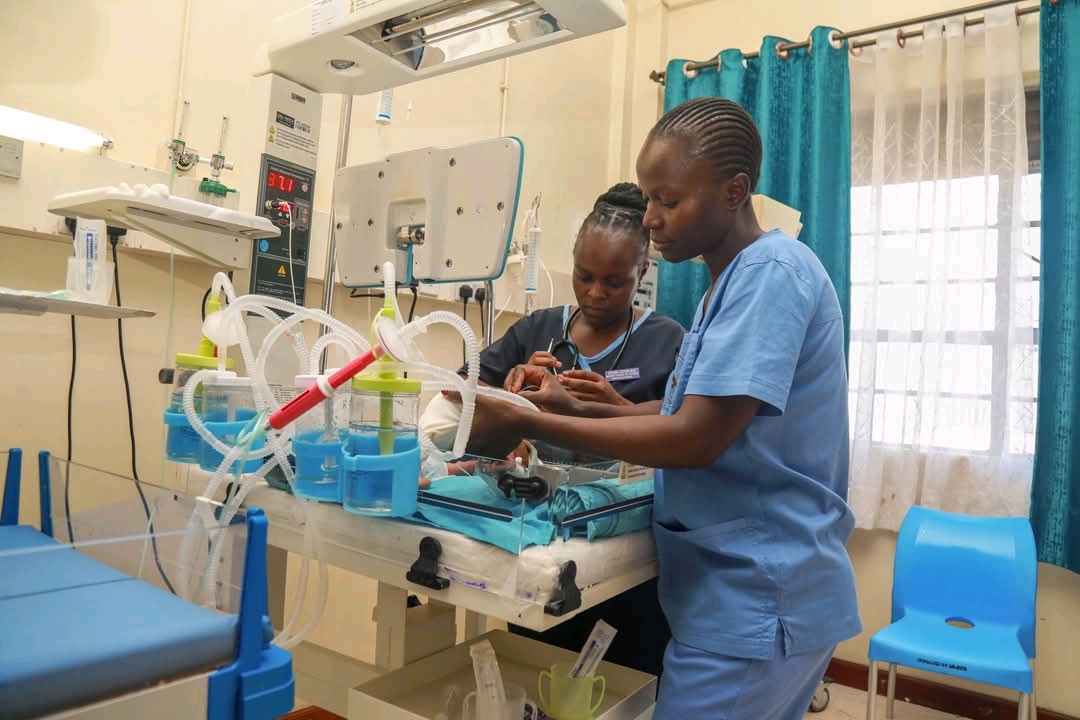
 JOOTRH medics at the facility's newborn unit./KNA
A new international study has raised concern over persistent maternal and newborn health risks in Western Kenya, with researchers reporting high rates of anemia among expectant women and a growing burden of pregnancy-related complications.
Preliminary findings from the Pregnancy Risk, Infant Surveillance and Measurement Alliance (PRISMA) study show that nearly a third of expectant mothers in Kisumu and Siaya counties suffer from anaemia, exposing them and their babies to serious health complications.
The research, conducted by the Kenya Medical Research Institute (KEMRI) in partnership with George Washington University and funded by the Bill & Melinda Gates Foundation, followed more than 2,700 women from early pregnancy through one year after delivery to better understand the causes of maternal and infant illness and death.
Researchers tracked women from before 20 weeks of pregnancy and monitored them across six health facilities in Kisumu and Siaya counties, including the Jaramogi Oginga Odinga Teaching and Referral Hospital (JOOTRH).
The interim findings point to several health challenges affecting pregnant women in the region, including HIV, malaria, parasitic worm infections and syphilis.
Anaemia emerged as one of the most common conditions, affecting about 32 per cent of the women enrolled in the study.
Researchers also recorded worrying levels of pregnancy-related hypertension disorders.
Gestational hypertension had a prevalence of 6.6 per cent, while pre-eclampsia stood at 2.2 per cent and chronic hypertension at 1.3 per cent.
“These conditions significantly increase the risk of serious complications such as preterm birth, postpartum haemorrhage and early neonatal death,” the researchers noted in the interim report.
Postpartum haemorrhage (PPH), a leading cause of maternal death globally, affected 5.0 per cent of the women in the study, while antepartum haemorrhage (APH) was recorded in 1.6 per cent of cases.
Gestational diabetes was also identified in 2.8 per cent of the participants.
The study further revealed gaps in early infant care practices.
Researchers found that breastfeeding within the first hour of birth—an important step for improving infant survival—was initiated in only slightly more than half of births in most of the monitored facilities.
Beyond documenting health risks, the PRISMA project is also working with county health authorities to strengthen maternal and newborn care.
The initiative has already supported hospitals with key medical equipment, including ultrasound machines, blood pressure monitors and devices used to measure oxygen levels in newborns.
Researchers say the next phase of the project, scheduled for 2026 and dubbed PRISMA v3, will expand the scope of the study by incorporating artificial intelligence–enabled imaging technologies, assessing environmental risk factors and testing new digital tools to help doctors better predict pregnancy complications.
Among the innovations under evaluation is a point-of-care blood pressure application designed to improve early detection and management of maternal health risks.
The researchers say the findings are expected to guide health policy and improve care for mothers and newborns in high-risk regions of Kenya.