The government has begun transitioning orphaned and vulnerable children (OVC) from Charitable Children’s Institutions (CCIs) to family and community-based care.
The move is part of the 10-year National Care Reform Strategy (2022–2032) for children.
The Directorate of Children Services in Nakuru said 2,878 orphaned and vulnerable children are under the care of 78 CCIs in the county. Of these, 1,393 are girls and 1,485 are boys across all 11 sub-counties.
County Children’s Director Mr Pilot Khaemba said 97 per cent of children in CCIs are registered in the government’s Child Protection Information Management System (CPIMS). He added that 60 per cent of CCIs in the county are willing to register as Child Welfare Programmes to support community-based care.
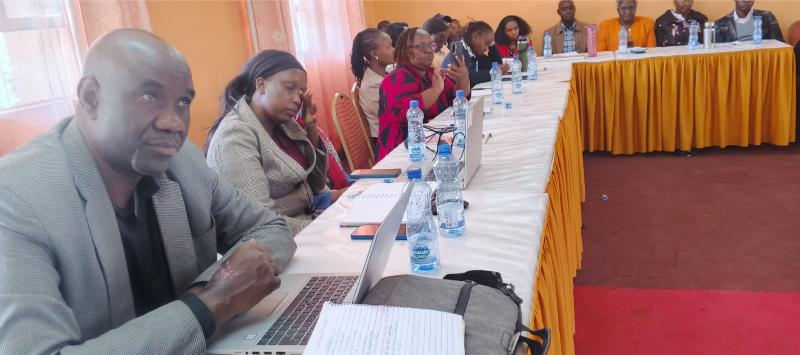
Khaemba spoke during the presentation of a situational analysis report on children in Nakuru and the cost of care reform action.
He said the government will ensure that children transitioning to the new system receive all required social benefits and support. He added that the reform aligns with Kenya’s international commitments, including the United Nations Convention on the Rights of the Child, the African Charter on the Rights and Welfare of Children, the UN Convention on the Rights of Persons with Disabilities and the UN Guidelines for the Alternative Care of Children.
Khaemba said the shift to family-based care places the best interests of children first.
The report shows that about 50 per cent of CCIs in Nakuru are in Gilgil and Naivasha sub-counties, which have 20 and 19 institutions respectively. Nakuru East has 11, while Rongai and Molo have nine each. Other CCIs are in Nakuru West (7) and Nakuru North (2).
He said the County Children Advisory and Care Reform Committee will help develop county plans, mobilise resources, support advocacy for family-based care, and monitor compliance.
“Chapter 141 Laws of Kenya, Section 54 (2-3), provides for establishment and operationalization of County Children Advisory Committees composed of state and non-state actors in Children Services space. In addition, the Care Reform Strategy establishes a county level committee for the purpose of advising on implementation of the strategy for child care,” the Director explained.
He said the strategy aims to strengthen family ties, promote community development and reduce reliance on institutional care.
Khaemba said no CCI will be closed. Instead, residential care will be transitioned to family care, with resources redirected to support children within families and communities.
He added that donors and CCIs are expected to redirect funds to welfare programmes that support children within their families and communities.
Khaemba said the transition will be implemented in three phases: learning and decision-making, preparing CCIs, and implementing the transition.
“To holistically, systematically and sustainably transition 2816 children to either biological families or alternative family options or supported independent living, it will cost about Sh 87,614,000.00.
In addition, it will cost about Sh36,613,500.00 to carry out other care reform activities that are outside the case management process plan, according to the county roadmap,” the official stated.
The strategy seeks to ensure children live in safe and supportive family and community settings. It also focuses on preventing separation by addressing poverty and lack of access to basic services, and by strengthening options such as kinship care, foster care and adoption.
This comes as a report shows 3.6 million children in Kenya are orphans and face risks of poverty, neglect and abuse. Khaemba said board members of CCIs in Nakuru are being trained on how to implement the transition to child welfare programmes.
He said phase one focuses on helping CCI leaders understand the reasons and benefits of the transition.
“In phase two, the leaders of CCIs are required to develop strategies, plans, activities and budgets to ensure a smooth and successful transition towards family and community-based care services," he highlighted.
He said the ministry envisions CCIs supporting vulnerable children within family and community care by 2030.
“We are committed to bringing on board all stakeholders in the children’s sector and we anticipate the complex transition from CCIs to child welfare programmes will be successfully done,” stated Khaemba.
The official added: “As we focus on transition, we also urge the financiers and supporters of CCIs to now have a different structure of supporting these children while at family and community-based system care.”
"The amount of money spent on a child in a CCI per month is sufficient to meet the monthly needs of a family of four," said the official, referring to a joint study by the ministry and other organisations.
Khaemba said 55 per cent of CCI placements lack court orders, posing a child protection risk. He added that only 27 per cent of children are in the Child Protection Information Management System (CPIMS) through sub-county children offices.
He said the transition includes preventing separation through family strengthening.
He added that family-based alternative care includes kinship care, foster care, adoption and Kafalaah, an alternative care option practised by Muslims, for children who cannot live with their biological parents.
Khaemba said poverty, gender-based violence and marriage break-ups are among factors that push children to leave home and end up in children’s homes.
The care reform strategy, spearheaded by the National Council for Children’s Services (NCCS), is based on evidence that children in institutional care may face developmental challenges compared to those raised in families and communities.
“This approach can ultimately lead to a more sustainable and effective system of care and protection for vulnerable children and families, “Khaemba added.
According to the United Nations Children’s Fund (UNICEF) and other global studies, at least eight out of ten of these children have biological or extended families who could care for them with proper support.