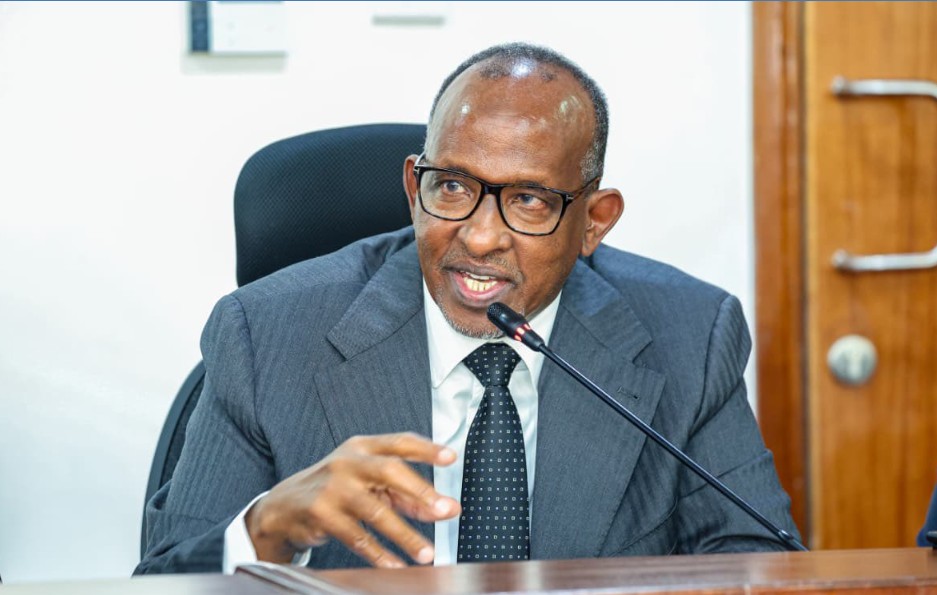
 Health Cabinet Secretary Aden Duale. /ADEN DUALE/X
Health Cabinet Secretary Aden Duale has dismissed claims that Sh50 billion was lost at the Social Health Authority, saying figures cited in a story appearing in one of the local dailies were misrepresented.
He said the misreporting stems from a misunderstanding of statutory accounting provisions and transitional financial processes.
In a detailed statement responding to the report, Duale said the figures highlighted as suspicious payments actually represent standard accounting estimates, legally authorised benefits and routine bank transfers conducted during the transition from the now-defunct National Hospital Insurance Fund (NHIF) to SHA.
“To categorically set the record straight: no billions have been lost or misappropriated,” Duale said.
“The figures being summed up represent standard accounting provisions and legally sound payments, not missing cash.”
One of the claims cited in the report relates to what it described as an “irregular transfer” of Sh1.3 billion and an “untraced” Sh3.3 billion from the Social Health Insurance Fund (SHIF) to SHA.
Duale rejected the characterisation, saying it was logically flawed to suggest a fund had transferred money irregularly to the authority mandated to manage it.
“How can a fund transfer money to itself or its own managing body in a way that constitutes an irregular loss?” the CS posed.
Duale explained that SHA is the statutory authority mandated to administer three funds, including SHIF, meaning the funds do not exist independently from the authority overseeing them.
He said what occurred was the legally required transfer of assets and cash from NHIF accounts into SHA accounts as part of the transition under the Social Health Insurance Act, 2023.
“What actually occurred was the legally mandated transfer of assets and cash from the bank accounts of the defunct NHIF to the new SHA accounts during the transition,” Duale said, adding that moving public funds between government accounts during an institutional transition “is not ‘untraced’ — it is compliance”.
The CS also addressed the Sh26.8 billion described as “unsupported claims”, saying the money had neither been paid out nor lost.
Instead, he said it represents an accounting provision required under international insurance standards.
According to Duale, the amount is an Outstanding Claims Reserve, which includes Incurred But Not Reported claims — funds set aside to settle hospital bills for treatments already provided but whose paperwork had not been submitted by the close of the audit period.
“The Sh26.8 billion is simply the money SHA has responsibly set aside to pay hospitals for patients they treated, but for which the hospitals had not yet submitted the final paperwork by the close of the audit period,” he said.
Duale added that under International Financial Reporting Standard 17 (IFRS 17), failing to set aside such reserves would itself be unlawful because insurers are required to recognise future liabilities in their accounts.
Another figure cited in the report — Sh7.3 billion allegedly paid for “unauthorised services” — was attributed to a misunderstanding of the different benefit schemes administered by SHA.
Duale said the payments were linked to services provided under the Public Officers Medical Scheme Fund (POMSF), which covers teachers and civil servants and offers benefits beyond the standard SHIF package.
“The Public Officers Medical Scheme Fund has a broader, enhanced benefit package negotiated separately,” he said, noting that services such as advanced surgeries and air evacuation fall within that scheme.
He added that the claims were flagged because they were assessed using the standard SHIF rulebook rather than the separate POMSF regulations under which they were legitimately provided.
The CS also addressed claims that Sh1.56 billion was paid to uncontracted facilities. He said the payments were made during the transition period in October 2024, when hospitals previously contracted under NHIF were temporarily allowed to continue treating patients while their SHA digital contracts were being processed.
“Flagging these facilities as ‘uncontracted’ because they were in the middle of signing their new digital paperwork ignores the reality that turning patients away would have been catastrophic,” he said.
Duale added that for a small portion of the claims — amounting to Sh92.4 million — where genuine contracting anomalies were detected, SHA suspended payments immediately.
On another issue raised in the report involving Sh2.4 million in alleged overpayments, the CS said the SHA digital claims system automatically corrects clerical input errors to match the official government tariff rates.
“The law dictates exact gazetted tariffs for specific treatments,” Duale said. “If a hospital clerk manually keys in an amount lower than the legally prescribed tariff by mistake, the SHA digital system automatically corrects it to match the legal gazetted rate.”
He said this mechanism ensures fairness and compliance with legally prescribed pricing rather than constituting a fraudulent payment.
Duale urged responsible reporting on complex financial and insurance accounting processes, warning that sensational interpretations risk misleading the public during what he described as the largest health financing transition in Kenya’s history.
“Responsible media reporting demands that all facts are presented objectively and that headlines accurately reflect the substance of the story, rather than driving unwarranted panic,” he said.