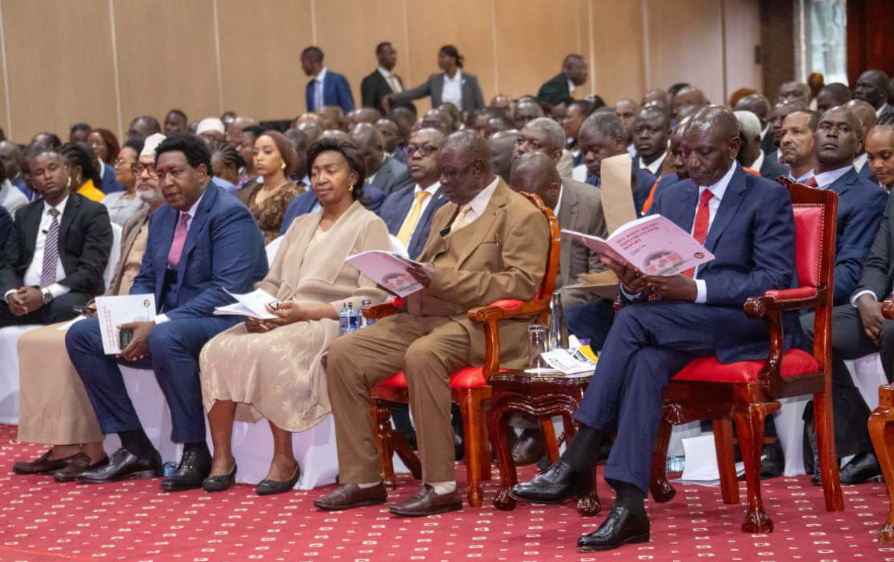
 President William Ruto and ODM party leader Oburu Oginga during the release of the report on the 10-point agenda on March 10, 2026. /ODM
The five-member committee on the implementation of the 10-point agenda agreed upon by Presidet William Ruto and the late ODM leader Raila Odinga has released its report, making a wide array of recommendarions on policies, legislative and institutional issues that require further action.
The committee led by former nominated senator Agnes Zani arrived at the recommendations after extensive stakeholder consultation across the country through public forums and submissions through memoranda.
"Based on these engagements, the committee notes that there is progressive implementation of the 10-point agenda although several policies, legislative and institutional issues require further action to enhance effectiveness and delivery," the committee said.
Key among its 11 overall recommendations is the formation of a broad-based mediation committee between the Senate and the National Assembly to fast-track outstanding Bills as well as enhance protection of protesters by enacting new laws that guarantee respect of Article 37 of the constitution.
"The National Police Service should be resourced and supported to strengthen continuous training and re-tooling of the police for effective crowd management in accordance with the rule of law," the report notes.
Progress made under each agenda item is outlined below.
NADCO Report Implementation
Progress on full implementation of the NADCO Report includes enactment of three key Bills: the Independent Electoral and Boundaries Commission (Amendment) Bill, 2023; the Statutory Instruments (Amendment) Bill, 2023; and the Ethics and Anti-Corruption Commission (Amendment) Bill, 2023.
Two Bills remain under mediation—the Elections (Amendment) Bill, 2023, and the Election Offences (Amendment) Bill, 2023—while four others, including the Constitution of Kenya (Amendment) Bill, 2023, await parliamentary consideration.
The IEBC Amendment Act enabled reconstitution, with new commissioners sworn in on July 11, 2025, initiating by-elections, voter registration, and boundary delimitation processes; outstanding matters like the two-thirds gender rule Bill and funds entrenchment are advancing.
Public Life Inclusivity
Inclusivity efforts feature the launch of the National Policy on Ethnic Minorities and Marginalised Communities 2025-2035, a Sh500 million scholarship for marginalised children, and Sh200 million annual education infrastructure funding.
Team noted that already, fertiliser prices dropped from Sh7,000 to Sh2,500 per bag, cut fuel prices by 14 per cent, and boosted funds like the Equalisation Fund from Sh5 billion to Sh9.6 billion.
Health coverage expanded to 29.8 million under the Social Health Authority, with 107,831 Community Health Promoters deployed; education recruited 100,000 teachers, improving ratios from 1:45 to 1:29, while infrastructure includes 260,000 housing units and 6,000 km of roads.
Devolution Strengthening
Devolution received an equitable share rising from Sh385 billion in FY 2024/2025 to Sh415 billion in FY 2025/2026, projected at Sh450 billion for FY 2026/2027, with timely disbursements and no carry-overs by June 30, 2025.
The County Public Finance Laws (Amendment) Act, 2025, assented August 13, 2025, grants assemblies financial autonomy; the County Wards (Equitable Development) Bill, 2024, awaits Senate action.
Youth Livelihoods
The NYOTA programme has engaged over 820,000 youth across 1,450 wards with 50:50 gender parity, providing skills, prior learning recognition for 20,000, on-the-job training for 90,000, and Sh25,000 start-up grants for 121,000 plus 10,000 refugees.
Jitume Digital Labs span 290 constituencies, with 600,000 trained under AGPO for procurement; jobs total 640,000 from housing, 200,000 from ClimateWorX, and 547,000 abroad via Kazi Majuu.
Leadership Integrity
The Conflict-of-Interest Act, 2025, assented July 30, 2025, now regulates officials' private interests against duties, bolstering ethical leadership.
Peaceful Assembly Rights
Sh2 billion was allocated for protest victims, with identifications complete via IPOA and KNCHR; IPOA resolved 820 cases from 2023-2025, securing 35 convictions. The Demonstration Bill was withdrawn, and Interior directives limit force while enhancing police training.
National Debt Management
A forensic debt audit verifies funds since independence; Eurobond buybacks in February 2024, 2025, October 2025, and February 2026 smoothed repayments.
Moody’s upgraded Kenya to B3 on January 27, 2026; the National Infrastructure Fund and PPPs like Rironi-Mau Summit reduce borrowing reliance.
Anti-Corruption Fight
EACC filed 143 recovery cases worth Sh22.9 billion, disrupted Sh27.4 billion schemes, recovered Sh9.8 billion, and secured 86 convictions.
E-procurement and 23,000 eCitizen services curb graft; the Anti-Money Laundering Act, 2025, aids FATF exit.
Resource Efficiency
Austerity cut budgets for spouses' offices, suspended non-essential travel, and froze vehicle purchases; the Government-Owned Enterprises Act, 2025, assented November 21, 2025, streamlines assets.
Zero-Based Budgeting and Single Treasury Account enhance oversight; passports now issued in one week.
Rule of Law Promotion
Judiciary added 11 Court of Appeal judges, 20 High Court judges; new benches in Nakuru, Mombasa, Eldoret, plus mobile courts and e-filing. Women comprise 47 per cent of the bench, nearing two-thirds compliance.
Overall, the team urged Parliament to conclude pending NADCO Bills in 90 days, tasked KNCHR to legislate Article 37 to safeguard protesters and called for fast-tracking of the Natural Resources Benefit Sharing Bill, 2022.
The Zani team also wants teams for victim reparations established under the Victim Protection Act.
Kenya's recurrent political crises prompted President Ruto and the late Prime Minister to development the collaboration framework.
It was building on the National Dialogue Committee (NADCO), which was adopted by Parliament in August 2023, producing a report adopted in February 2024 that pinpointed governance challenges.
On March 7, 2025, UDA and ODM signed the MoU outlining the 10-Point Agenda, leading the principals to create a five-member oversight committee on August 6, 2025.
Agnes Zani serves as chairperson of the implementation committee, with Fatuma Ibrahim, Kevin Kiarie, Gabriel Oguda, and Javas Bigambo as members. The executive directors of UDA and ODM act as joint secretaries.