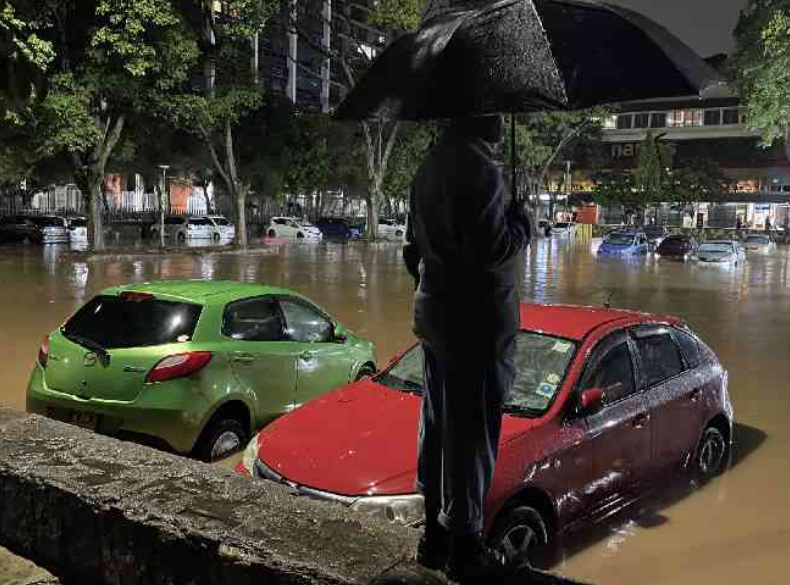
Severe flash floods that struck Nairobi over the weekend have reignited debate about urban planning, drainage systems and environmental management.
Speaking to Citizen TV, experts and officials have pointed to years of unchecked development, blocked waterways and pressure on the city’s ageing infrastructure.
As of March 9, the floods had caused more than 40 deaths nationwide, with about 30 fatalities reported in the capital alone after days of intense and continuous rainfall.
The downpour submerged major roads, swept away more than 70 vehicles, displaced hundreds of residents and caused widespread destruction in low-lying neighbourhoods including Mukuru, Mathare and parts of the city centre.
Urban planners say the scale of flooding reflects a growing mismatch between rapid development and stagnant infrastructure.
Architect and urban development expert Alfred Omenya said flooding has steadily worsened across Nairobi, affecting not only informal settlements but also high-end neighbourhoods that historically experienced fewer drainage challenges.
“Even high-end areas like Kilimani now flood, and every year it gets worse,” Omenya said.
He explained that the city’s drainage infrastructure has remained largely unchanged for decades while the amount of water runoff has dramatically increased due to rapid construction and densification.
“Every year it gets worse and the reason is that our drainage infrastructure is the same while the run off has been increased several times because of housing developments,” he said.
According to Omenya, urban development approvals should include clear calculations on how new buildings affect surface water runoff and the capacity of existing drainage systems.
“When allowing buildings, officials should look at how much the development is likely to contribute to the water run off and how to deal with it,” he said.
“It is a basic calculation. It is easy to do a calculation of run offs in the neighbourhoods and then decide what is needed to carry the water to the bigger system.”
He warned that approving developments without factoring in water flow creates inevitable flooding.
“We cannot approve structures and increase run off and we do not know where that water will go,” Omenya said.
Urban planners, he added, must start flood management at the level of individual developments by capturing and managing storm water before it overwhelms the wider drainage system.
“You start dealing with the problem of floods from the single development, you start to arrest water there and drain the water there and only direct the excess to bigger system,” he said.
Omenya also pointed to deeper structural issues linked to settlement patterns in informal neighbourhoods.
“The reason informal settlements are usually hit again is due to planning failure,” he said.
“Those areas are not meant to be settled in the first place, but when people have nowhere to go, they move into them. They end up occupying waterways, rivers, open spaces, parks and so forth. We therefore have both a planning issue and a governance issue that we need to deal with.”
At the Nairobi government, officials say the problem is complex and tied to natural drainage systems that have deteriorated over time.
The county’s chief officer for disaster management Bramwel Simiyu said while heavy rainfall contributed to the crisis, the city is working to improve its water and sanitation infrastructure.
“There is room for improvement in our water and sanitation infrastructure and there is work ongoing,” he said.
Simiyu natural rivers within the city carry the majority of storm water and must be restored to function effectively.
“You cannot deal with a natural phenomenon using artificial solutions,” he said.
“The rivers in the city — Nairobi River, Mathare River and the Ngong River — take 70 per cent of run off water.”
Simiyu said the county is implementing a large-scale regeneration programme aimed at restoring the rivers’ capacity to drain storm water.
“We must restore and regenerate the rivers,” he said.
“The Nairobi regeneration project is on going and it encompasses deepening, widening and dredging the rivers to allow the natural drainage system to work.”
According to Simiyu, the project is already underway and is expected to significantly reduce flooding once completed.
“We have done 40 per cent of the project and it will go a long way in curbing floods,” he said.
The official also defended the city’s development approval processes, saying planning decisions are made through a multi-agency review system.
“City Hall does not operate as a one-man show,” Simiyu said.
“I would not want to engage in finger-pointing or blame. When it comes to the approval system in the city for development, there is a committee that sits to review applications.”
He said that committee includes professionals from various sectors including the Architectural Association of Kenya.
“In that committee, there is representation from the Architectural Association of Kenya. So it is a stakeholder-driven initiative that considers these applications for development,” he said.
“So whatever developments are undertaken, it is not fair to say City Hall decided; it is a multi-sectoral engagement.”
Humanitarian agencies responding to the disaster say the floods highlight long-standing environmental and social vulnerabilities.
Kenya Red Cross Society secretary general Ahmed Idris said the causes of the flooding are straightforward.
“The science is not complicated; you block the movement of water then water will build up and cause flooding upstream and that is what is happening to the city,” Idris said.
“We have built on waterways and blocked water channels.”
He said the city must urgently address blocked drainage systems caused by waste and illegal construction.
“We really have to deal with drainage system. Water is blocked by garbage and illegal structures,” he said.
Idris said authorities have already identified flood-prone zones that require urgent intervention.
“The county has identified the areas that need to be addressed and they are across the city,” he said.
He also noted that the impact of floods disproportionately affects low-income communities living in vulnerable areas.
“Poor people are bearing the brunt, people who cannot protect themselves from the waters,” Idris said.
“But the others are building wall, artificial channels.”