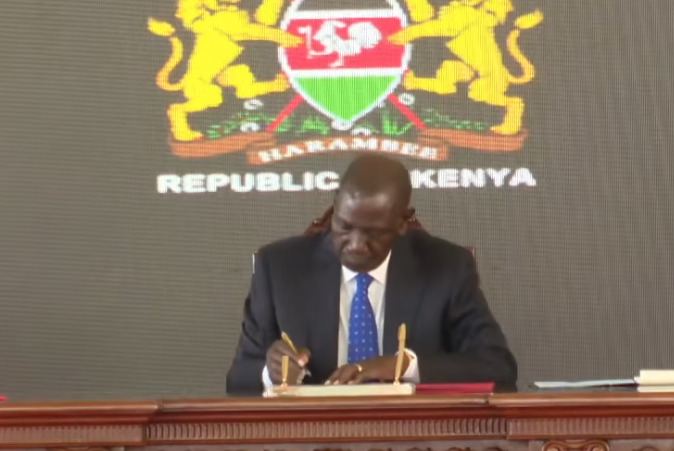
President William Ruto has signed into law the Judges’ Retirement Benefits Act, establishing a comprehensive statutory framework to govern the pension and post-retirement benefits of judges serving in superior courts.
The new legislation seeks to strengthen judicial independence by guaranteeing predictable, secure and fiscally sustainable retirement benefits for judges, in line with constitutional provisions that protect the Judiciary from undue influence.
The law originates from the Judges’ Retirement Benefits Bill (National Assembly Bill No. 27 of 2025), which was sponsored in Parliament by the Leader of the Majority Party.
The Bill was designed to address long-standing concerns about the absence of a dedicated framework governing retirement benefits for judges of superior courts.
According to a dispatch from State House, the primary objective of the Act is to operationalise constitutional guarantees relating to judicial independence and security of tenure under Article 160 of the Constitution.
The formulation of the Bill was spearheaded by an inter-ministerial taskforce that was gazetted by Chief Justice Martha Koome.
The taskforce brought together representatives from the Judiciary, the National Treasury, the Directorate of Pensions and the Office of the Attorney General.
The proposed law was later tabled before the National Assembly of Kenya, which debated and passed it with amendments on February 25 in accordance with Article 109(3) of the constitution.
State House said the new law is aligned with the constitutional protections under Article 160(4), which prohibits any variation of a judge’s remuneration or benefits to their disadvantage while in office.
As a result, judges who are currently serving at the time the law comes into effect will remain under the existing defined benefits pension regime administered through the Pensions Act (Kenya).
This arrangement ensures continuity and safeguards benefits already accrued by judges during their tenure.
However, judges appointed after the commencement of the Act will join a newly established contributory retirement benefits scheme.
Under the framework, newly appointed judges will contribute 7.5 per cent of their basic salary towards the retirement fund, while the government will contribute 15 per cent of the judge’s basic salary.
A Board of Trustees tasked with overseeing the fund and ensuring it operates within a structured and transparent framework will administer the retirement scheme.
Authorities say the contributory model is designed to enhance long-term fiscal sustainability while ensuring judges continue to enjoy secure retirement benefits.
The Act also provides a clear dispute resolution mechanism for matters related to retirement benefits. Any disagreements arising from the scheme will be referred to the Retirement Benefits Appeals Tribunal, providing an independent avenue for resolving disputes and strengthening the enforceability of judges’ entitlements.
Beyond pension provisions, the law introduces a range of non-pension benefits intended to preserve the dignity and welfare of judges after retirement.
These include medical cover, diplomatic passports and access to government airport lounges, privileges that officials say recognise the critical role judges play in upholding the rule of law and the constitution.
Retired judges of the Supreme Court of Kenya will receive additional enhanced benefits reflecting the responsibilities associated with service at the country’s highest court and the administrative roles they often continue to perform for the Judiciary after retirement.
The legislation also seeks to ensure fairness for judges who served during the early years of the current constitutional dispensation.
Under the Act, specified post-retirement benefits will be extended to judges who retired after the promulgation of the Constitution of Kenya 2010 but before the commencement of the new law.
While their pension entitlements will remain governed by the Pensions Act, these retired judges will now become eligible for enhanced benefits such as medical cover and diplomatic privileges.