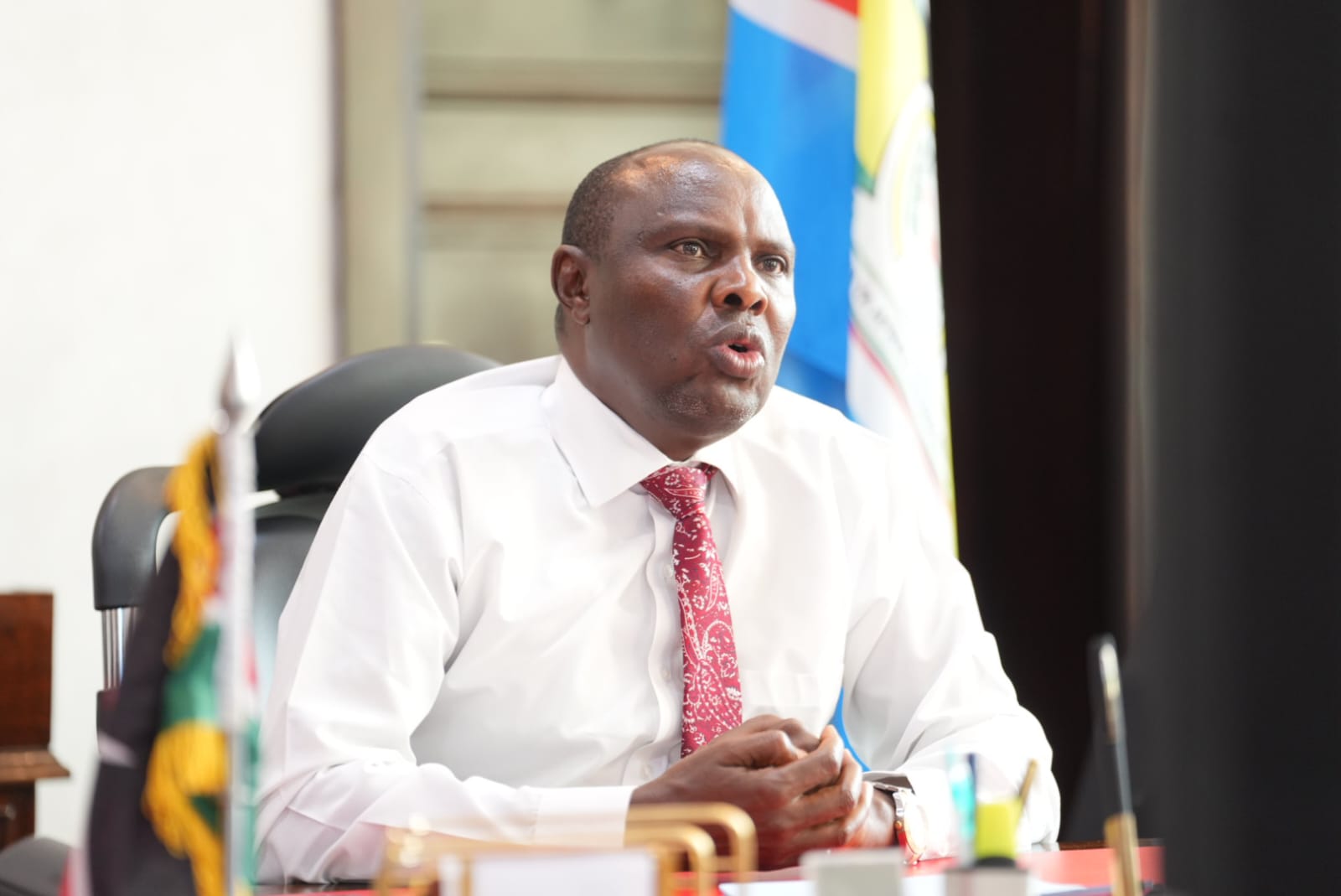
 Chief of Staff and Head of Public Service Felix Koskei in a virtual meeting with Principal Secretaries, board chairpersons, CEOs and corporation Secretaries on February 26, 2026. /FELIX KOSKEI/X
Chief of Staff and Head of Public Service Felix Koskei will this week convene twin meetings with heads of public primary and secondary schools.
The meeting signals a direct government push to align education management with state policy, strengthen management, and enforce accountability in basic education institutions.
The consultative engagements come at a time when schools across the country are registering candidates for the second-last Kenya Certificate of Secondary Education (KCSE) examination as well as Grade 6 Kenya Primary School Education Assessment (KPSEA) and Grade 9 Kenya Junior School Education Assessment (KJSEA) candidates.
In a notice issued by the Teachers Service Commission (TSC), the meetings will be held virtually on Wednesday, March 11, and Thursday, March 12.
"These engagements will focus on the role of teachers as members of the public service and as custodians of the constitutional values and principles that guide public service delivery," the notice reads in part.
According to the communication, Koskei will first engage secondary school principals on Wednesday from 9am before holding consultative talks with public primary school head teachers the following day from 11am.
"All participants are required to consult their respective county directors for the virtual link, registration, and further details," the notice states in what the commission described as an important meeting.
Public primary and secondary schools have recently come under sharp focus after an audit conducted in late 2025 revealed that schools had inflated enrolment by more than 900,000 learners.
The school data verification report released on February 12 by the Ministry of Education exposed the scale of what it described as carefully choreographed fraud in some public schools, resulting in the loss of billions of shillings through false capitation claims.
The report established that 973,634 learners were non-existent, yet the government had been sending capitation to support their education based on data captured in the National Education Management Information System (NEMIS).
The audit flagged 885,904 ghost learners in public primary schools and 87,730 in secondary schools. It also revealed that 10 secondary schools and 17 primary schools were non-operational but continued to appear in NEMIS, receiving capitation.
The irregularities cost the government more than Sh3.2 billion annually, excluding capitation that may have been disbursed to 14 institutions that did not submit learner enrolment data.
The ministry said it had initiated action to hold responsible officials accountable, including cases of criminal negligence involving school heads and sub-county directors of education in whose jurisdictions the fraud occurred.
Speaking during the launch of the 2026 examination registration exercise on February 13, Education Cabinet Secretary Julius Ogamba warned that disciplinary action will be taken against school heads who make registration-related errors.
He said last year some learners suffered greatly after their heads of institution uploaded erroneous data, for example, indicating the wrong gender or, in some cases, failing to register learners entirely.
"These errors unduly and unfair disenfranchise learners, and also expose the government to serious legal risks. We have to avert them at all costs," he said.
KPSEA registration runs from February 16 to March 16, 2026. KJSEA registration started on March 2 and will end on March 31, while KCSE registration began on February 16 and will also close on March 31, 2026.
The Kenya National Examinations Council is expected to open the portal for the registration of Grade 10 learners in readiness for School Based Assessments.
School-based assessments constitute the formative evaluation that will contribute to reporting at the end of senior school in Grade 12, when the pioneer Competency Based Education cohort will sit the inaugural Kenya Certificate of Basic Education (KCBE).
Ogamba said the ministry will enhance engagement with parents and guardians through existing structures during the registration process to ensure schools upload accurate details, including contact information, to facilitate communication when confirming the registration status of learners and ensuring their School Based Assessment scores are properly captured.
The examinations council expects to register about 3,700,000 candidates in 2026, reflecting an anticipated increase in the number of candidates sitting the KCSE examination.
The figure is 270,317 more than the combined candidature of 3,429,683 learners who sat KPSEA, KJSEA, and KCSE in the previous cycle.
The council has also warned that late registration will not be allowed this year after 5,743 requests were received from both public and private schools following the closure of examination portals in 2025.
"In some of the cases, the heads of institutions did not declare their unregistered candidates until pressure mounted from parents and media," KNEC chief executive officer David Njegere said.
He reminded heads of institutions that registration forms part of the assessment and examination process, warning that any oversight could be detrimental to both the ministry, the council, and the affected learners.
"For instance, when a school indicates the wrong gender for a learner and the error goes uncorrected from Grade 3, through KPSEA, to KJSEA, such a learner will be placed in a school of the opposite gender," he said.
Learners are captured in the council’s system from Grade 3 onwards, with each learner issued with a Unique Personal Identification (UPI) number that will be used up to the end of Grade 12.
While the notice on Koskei’s meetings with heads of institutions did not outline specific agenda items, the issues highlighted above are expected to feature prominently during the discussions.
Earlier, on March 3, Koskei held an in-person meeting with principal secretaries, board chairpersons and chief executive officers overseeing research institutions, where he emphasised that government decisions must be anchored in solid evidence from the outset.
"Too often, research comes in after policies have already been rolled out and challenges have begun to surface. That approach is costly. If we are to govern responsibly, research must shape policy at conception," Koskei said.
He stressed that clear feasibility assessments, sound fiscal projections, and structured pilot programmes that test assumptions in real conditions must precede the launch of major government initiatives.
"Findings must be distilled into clear, practical briefs that inform implementation frameworks," Koskei said, adding that public institutions must institutionalise a culture where science, innovation, and data guide governance.
There must be discipline in decision-making," he added, to protect public resources, improve execution, and ensure that every policy intervention contributes meaningfully to national productivity and economic growth."