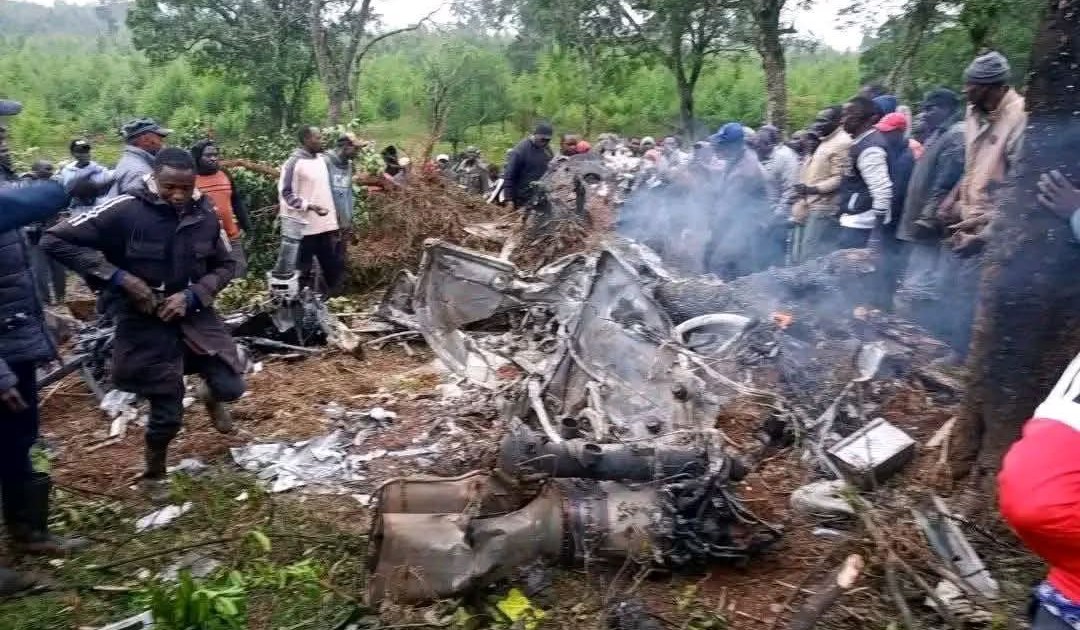
 The Nandi crash has drawn attention to longstanding safety concerns and the heavy human cost that aviation disasters continue to impose on the country.
The February 28 helicopter crash in Mosop, Nandi county, which killed six people, revived memories of Kenya’s serious aviation accidents, which have, over the decades, claimed more than 120 lives within the country’s borders since the 1970s.
Investigations into many of these tragedies have repeatedly pointed to a familiar set of factors: poor weather, low visibility, and pilot error in the difficult flying conditions.
In the Nandi accident, all six occupants died on the spot as the helicopter burst into flames on impact.
Those who died included Emurua Dikirr MP Johana Kipyegon Ng’eno, Retired Colonel and pilot George Were, and four other passengers: Robert Kipkoech Keter, Amos Kimwetich Rotich, Nicholas Kosgei and Wycliffe Kiprotich Rono.
Preliminary reports indicated that the aircraft encountered heavy mist and rain shortly after takeoff from a makeshift landing site at Chekiep village.
Investigators believe the helicopter struck trees before crashing, suggesting the crew was flying in extremely poor visibility.
A review of major aviation accidents in Kenya reveals a recurring pattern. In many cases, the aircraft involved were technically airworthy but ended up flying into terrain due to limited visibility, navigational challenges or pilot judgement in adverse weather.
One of the earliest and most devastating accidents occurred on November 20, 1974, when Lufthansa Flight 540 crashed shortly after takeoff from Nairobi during the Nairobi–Johannesburg leg of its Frankfurt–Nairobi–Johannesburg route.
The aircraft, a Boeing 747-130 carrying 157 people, had departed from Embakasi Airport, now Jomo Kenyatta International Airport.
Moments after liftoff, it failed to gain sufficient lift and crashed. Fifty-nine people — 54 passengers and five crew members — died, making it the deadliest aviation accident ever recorded on Kenyan soil.
Investigators determined that the aircraft’s leading-edge high-lift devices had not been extended during takeoff, resulting in insufficient lift.
Investigators noted that despite warning signs in the cockpit, the crew did not identify the configuration error in time. The crash later became the first fatal accident involving a Boeing 747.
More than three decades later, another crash involving senior government officials occurred on April 10, 2006, when a Kenyan Air Force Harbin Y-12 aircraft carrying a government peace delegation crashed on the slopes of Mount Marsabit.
The crash killed 14 of the 17 people on board, leaving only three survivors.
Among those who died were several prominent leaders: Dr Bonaya Godana, North Horr MP and former Minister for Foreign Affairs; Mirugi Kariuki, Nakuru Town MP and Assistant Minister for Internal Security; Titus Ngoyoni, Laisamis MP and Assistant Minister for Regional Development Authorities; Abdi Sasura, Saku MP; Guracha Galgalo Boru, Moyale MP; and Bishop William Waqo, Anglican Bishop of Kirinyaga Diocese.
Investigators attributed the crash to poor visibility and adverse weather conditions, which caused the aircraft to fly into terrain while attempting to approach Marsabit.
Marsabit had witnessed another fatal aviation accident a decade earlier. On July 27, 1996, Ishmael Chelang’a, then Eastern Provincial Commissioner, died when a helicopter crashed shortly after takeoff during an official tour of the province.
Chelang’a, who was 40 at the time and had just been transferred from the Rift Valley, was on his first official visit to the region.
The crash killed nine people, including six senior civil servants. An inquiry later found that the police aircraft involved had not been fully serviced.
On June 10, 2008, Roads minister Kipkalya Kones and assistant Home Affairs minister Lorna Laboso were killed in a plane crash in the Enoosupukia area of Narok county, near the Maasai Mara game reserve, leaving no survivors.
The small aircraft had departed Wilson Airport in Nairobi and was headed to Kericho. It crashed roughly 20 minutes after takeoff, killing all four people on board.
Five years earlier, on January 24, 2003, a 24-seater Gulfstream aircraft carrying senior members of the NARC government crashed in Busia.
The plane snagged a power line shortly after takeoff and plunged into a house. Labour minister Ahmad Mohammed Khalif died shortly after being admitted to a hospital following the crash.
The two pilots also died, while three ministers and several Members of Parliament sustained serious injuries.
They included: Raphael Tuju (Minister for Information and Tourism); Martha Karua (Minister for Water Resources); Linah Kilimo (Minister of State in the Office of the President); George Khaniri (Hamisi MP); Robinson Githae (Assistant Minister for Constitutional Affairs); and Martha Koome, then-chairwoman of the Kenya chapter of the International Federation of Lawyers, now Chief Justice.
The leaders were returning from a homecoming party for then-Vice President Moody Awori.
Wanjiru Kihoro, activist and head of Abantu, suffered severe head injuries and remained in a coma. She died on October 12, 2006, aged 54, nearly four years after the Busia plane crash.
Another helicopter crash occurred on June 10, 2012, when Internal Security Minister Professor George Saitoti and his assistant minister Joshua Orwa Ojode died in a helicopter crash in the Kibiku area of Ngong Hills.
The police helicopter had taken off from Wilson Airport and was bound for Homa Bay when it went down approximately 10 minutes later, bursting into flames.
A commission of inquiry chaired by Lady Justice Kalpana Rawal later concluded that the crash resulted from a combination of poor visibility caused by bad weather, pilot error, and the pilots’ limited experience in instrument flying.
The inquiry also identified serious shortcomings in training, safety oversight, and maintenance within the police air wing.
Pilots Luke Oyugi and Nancy Gituanja were among those who died, alongside the ministers and their bodyguards, Inspector Joshua Tonkei and Sergeant Michael ole Tanchu.
Kenya has also experienced fatal crashes involving civilian commercial operators in recent years. On June 5, 2018, Fly-SAX Flight 102 disappeared shortly after departing Kitale for Nairobi before wreckage was later located on Elephant Hill within the Aberdare Range.
Authorities determined that the Cessna 208B Grand Caravan had descended below the minimum safe altitude while flying through mountainous terrain.
The aircraft struck the hillside in what investigators classified as controlled flight into terrain, killing all 10 people on board — eight passengers and two crew members.
Another crash occurred on October 28, 2005, when Mombasa Air Safari Flight 203, also a Cessna 208B Grand Caravan, crashed in Kwale county shortly after departing from Diani en route to the Maasai Mara.
The aircraft was carrying 10 passengers, most of them tourists, in addition to the pilot. All 11 on board died.
Preliminary investigations pointed to severe weather conditions, with the aircraft striking terrain at high speed in a steep nose-down attitude.
Kenya has also recorded several serious aviation incidents that did not result in major passenger casualties but nonetheless highlighted safety risks in the country’s airspace.
One such incident involved a mid-air collision near Nairobi National Park between a Cessna training aircraft and a Safarilink Dash-8 passenger plane shortly after departure from Wilson Airport.
The Cessna crashed, killing the instructor and trainee, while the Dash-8, carrying 44 passengers, landed safely.
The collision underscored concerns about air traffic management and flight operations around the busy Wilson airspace.
Even earlier, on May 18, 1955, a Douglas DC-3 aircraft crashed into Mount Kilimanjaro while flying from Dar es Salaam to Nairobi.
The accident killed all 10 people on board and was attributed to controlled flight into terrain caused by navigational error.
Beyond Kenya’s borders, accidents involving Kenyan airlines have also left a heavy toll. On January 30, 2000, Kenya Airways Flight 431 crashed into the Atlantic Ocean shortly after takeoff from Abidjan in Ivory Coast while operating an Abidjan–Lagos–Nairobi route.
The Airbus A310-304 went down after a false stall warning was activated shortly after takeoff. Investigators found that the pilots responded by pitching the aircraft downward, which caused it to descend rapidly into the sea.
Out of the 179 people on board, 169 died while 10 survived.
Another crash occurred on May 5, 2007, when Kenya Airways Flight 507 went down shortly after departing Douala in Cameroon on an Abidjan–Douala–Nairobi service.
All 114 passengers and crew members aboard the Boeing 737 were killed.
Investigators concluded that the aircraft entered a steep bank shortly after takeoff in poor weather conditions; the pilots were unable to recover from spatial disorientation, leading to a loss of control and the eventual crash into swampy terrain.
More recently, on August 7, 2025, an AMREF Flying Doctors aircraft crashed in a residential area of Mwihoko in Kiambu county shortly after departing Wilson Airport in Nairobi.
The aircraft, a Cessna Citation XLS, had taken off on a medical evacuation mission bound for Hargeisa in Somalia.
The crash resulted in six fatalities — four crew members, comprising two pilots and two medical staff, as well as two people on the ground.
Across decades of aviation incidents within Kenya, investigators have repeatedly highlighted a combination of challenging terrain, rapidly changing weather conditions, and operational decision-making as critical risk factors in many of the accidents.
The latest tragedy in Nandi has once again drawn attention to those longstanding safety concerns and the heavy human cost that aviation disasters continue to impose on the country.
On Friday, President William Ruto joined thousands of mourners, family members and leaders at Emurua Dikirr in Narok county to bid farewell to the late Emurua Dikirr Member of Parliament Johana Ng’eno and the five who died along with him.