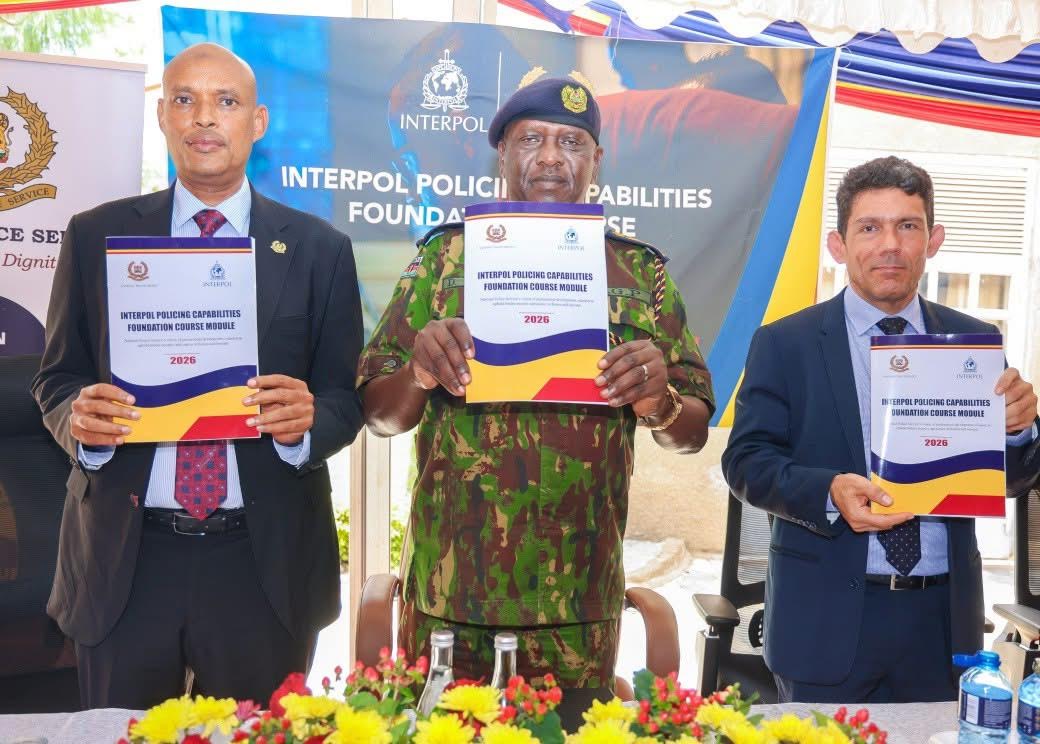
Police authorities have launched a new training initiative aimed at equipping officers with direct access to INTERPOL’s global law enforcement systems, in a move expected to strengthen the country’s response to transnational crime.
The INTERPOL Policing Capabilities Foundation Course Module is designed to provide practical instruction on the use of INTERPOL’s global databases, secure communication platforms and investigative tools.
The programme seeks to enhance the operational capacity of Kenyan officers to identify, investigate and respond to cross-border crimes, including sexual and gender-based violence, in collaboration with international partners.
Inspector-General of Police Douglas Kanja said the initiative comes at a time when criminal networks are increasingly exploiting technological advancements and jurisdictional gaps.
“We live in an era where crime has no respect for borders or territorial boundaries. Criminals exploit the gaps between law enforcement agencies, the gaps between national crime databases, and the gaps in our knowledge of how to use international policing tools. This training module helps close those gaps by equipping officers with practical knowledge of INTERPOL’s policing capabilities,” he said.
The Director of the Directorate of Criminal Investigations (DCI), Mohamed Amin, who also serves as a member of INTERPOL’s Executive Committee, described the launch as part of Kenya’s long-term strategy to modernise policing and deepen international collaboration.
“As crime evolves and increasingly crosses borders, we must ensure our officers are prepared not only to respond locally, but to collaborate confidently at regional and international levels. By institutionalizing this training, we are investing in lasting capability, strengthening trust among our partners, and reinforcing Kenya’s leadership in advancing security across the region,” Amin said.
The course was developed with technical and financial support from INTERPOL’s Project Soteria, funded by the United Kingdom’s Foreign, Commonwealth and Development Office (FCDO).
INTERPOL’s Director of Organized and Emerging Crime David Caunter said the programme builds on Kenya’s record in addressing cross-border criminal activity.
“By integrating our databases, secure communications, and investigative tools into Kenya’s existing training framework, we are enabling officers to operate even more efficiently within international networks, ensuring their local expertise is fully connected to global responses,” he said.
The Head of the INTERPOL Regional Bureau in Nairobi, Apollo Africa, said the module is a key step in closing the knowledge gap surrounding international cooperation in investigations and ensuring officers are equipped with the skills and awareness needed to engage effectively in cross-border policing efforts.
The launch of the Foundation Course Module sets a regional benchmark in integrating international policing capabilities into national training systems.
Through interactive approaches — including real-world case studies, group analysis and hands-on simulations — officers are expected to gain both theoretical knowledge and practical skills to effectively apply INTERPOL resources in everyday policing and complex transnational investigations.
Eighteen INTERPOL-certified trainers drawn from various services, who were trained and participated in developing the programme, will serve as resource persons supporting the rollout and sustainability of the training.