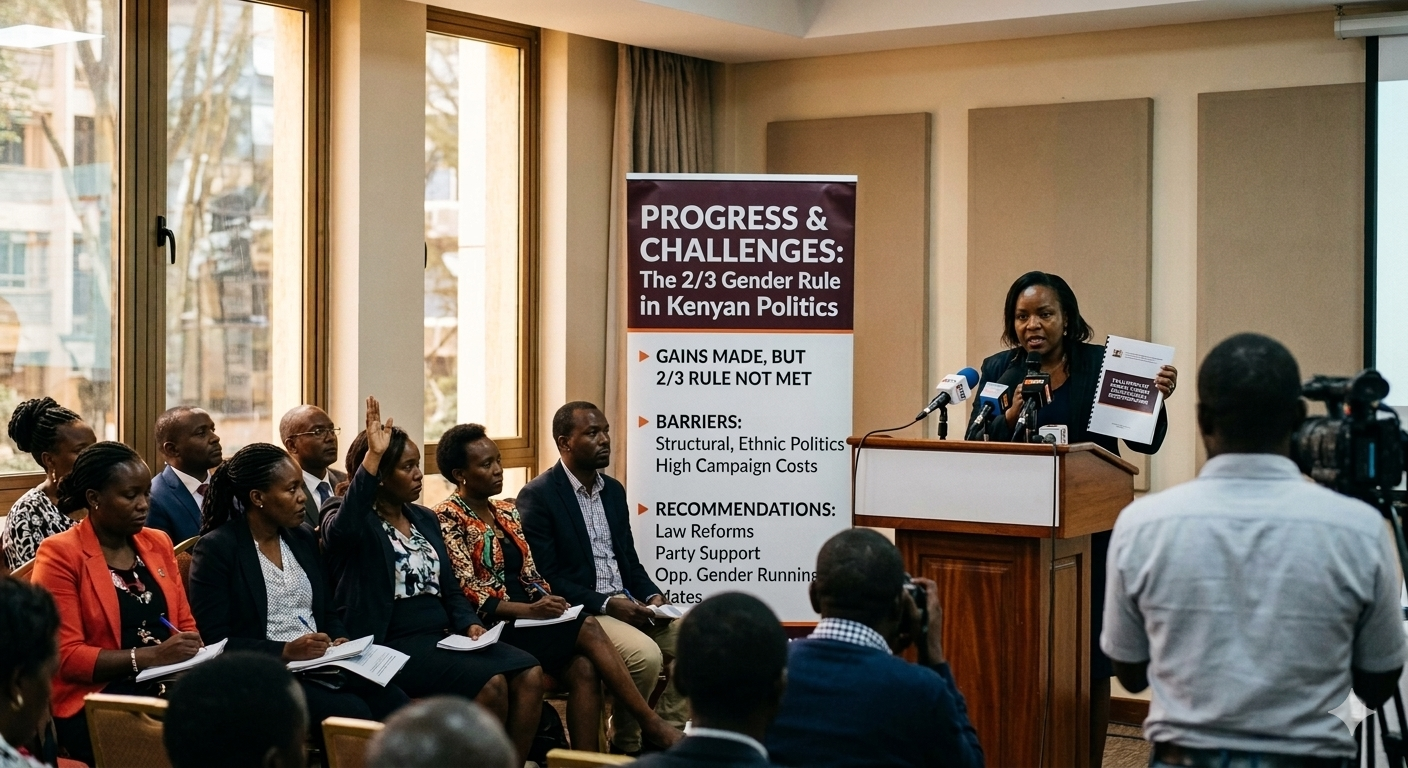
Kenya has made modest gains in women’s political representation since the promulgation of the Constitution of Kenya 2010, but the country remains far from achieving the constitutional two-thirds gender rule, a new report released on Thursday shows.
The report titled “Fifteen Years On: An Evaluation of Kenya’s Women Political Representation in Relation to the Two-Thirds Gender Rule”was commissioned by the Association of Media Women in Kenya (AMWIK) with support from the Friedrich Naumann Foundation for Freedom (FNF) Kenya.
The study provides a critical assessment of the progress made since the 2010 Constitution introduced the principle that no more than two-thirds of members in elective or appointive bodies should be of the same gender.
While acknowledging improvements compared to the period before the new constitutional order, the report concludes that structural, political and cultural barriers continue to prevent women from accessing elective positions.
“Kenya has made progress when compared to the pre-2010 constitutional period, but the country still faces unique challenges that limit women’s leadership,” the report notes.
According to the study, the obstacles are both structural and symbolic.
Structurally, the report argues that Kenya’s political system, including the way parties nominate candidates, creates barriers that disadvantage women seeking elective office.
“Structural gaps arise from the way the political conveyor belt is designed in Kenya, with strong influence from socio-cultural patterns and the organization of multiparty democracy,” the report states.
Symbolically, the report highlights the role of ethnic politics in shaping electoral outcomes.
Political competition, it says, often revolves around powerful ethnic leaders or “kingpins” who influence party nominations and voter preferences.
“The political arithmetic and electoral democracy are effectively underpinned by ethnic kingpins or party leadership seen as holding briefs on behalf of ethnic communities,” the report says.
Researchers also point to the high cost of campaigns, entrenched cultural norms, and violence against women candidates as major obstacles.
To address these challenges, the report proposes sweeping reforms targeting Parliament, political parties, electoral institutions and the media.
Among its key recommendations, the report calls on Parliament to enact laws introducing multi-layered approaches to women’s representation, combining direct elections with proportional or reserved seats.
It also recommends legislation requiring presidential and gubernatorial candidates to select running mates of the opposite gender to promote balanced leadership.
“Parliament should enact legislation requiring gender-balanced presidential and gubernatorial tickets, compelling candidates to select a running mate of the opposite gender,” the report states.
The study further calls for stronger action against gender-based violence during elections, urging the justice system to respond swiftly to such cases.
“Strengthening the institutional response mechanism to gender-based violence during the political process is critical to dissuade perpetrators and send a strong warning,” it says.
Political parties were also singled out as key actors in advancing women’s representation.
The report urges parties to reform their internal nomination processes and actively support women candidates in competitive seats.
“Political parties must strengthen and enforce gender-responsive internal structures to ensure women candidates are supported in competitive elective positions,” the report recommends.
The Independent Electoral and Boundaries Commission (IEBC) is also urged to tighten electoral regulations and enforce compliance with gender equality provisions during nominations and campaigns.
Among the proposed measures are disqualification and prosecution of candidates found to have perpetrated violence against women contestants.
“Individuals identified to have perpetrated violence against women candidates should face disqualification from elections and prosecution,” the report says.
The commission is further encouraged to integrate the two-thirds gender principle into party nomination rules and ballot composition to compel political parties to submit gender-balanced lists before participating in elections.
The Office of the Registrar of Political Parties (ORPP) is also tasked with enforcing gender-responsive party structures and linking compliance to funding allocations.
“Political parties should be legally required to institutionalise gender-responsive nomination rules and leadership structures as a condition for registration and continued operation,” the report suggests.
The media and civil society organisations were also challenged to play a more active role in promoting gender equality in politics.
The report recommends continuous civic education to encourage voters to evaluate candidates based on leadership ability rather than gender stereotypes.
It also calls for binding media guidelines to ensure fair and balanced coverage of women candidates.
Beyond Kenya, the report draws lessons from neighbouring East African countries, including Rwanda, Uganda and Tanzania, which have embedded gender quotas and affirmative action mechanisms in their governance systems.
In particular, Rwanda’s multi-layered representation model, combining direct elections with reserved seats, is highlighted as a possible approach Kenya could adopt to accelerate progress.
“Lessons from the region show that gender quotas, structured representation systems and strong institutional enforcement can significantly improve women’s participation in governance,” the report states.
The study says that achieving the constitutional threshold will require stronger political will, legal reforms and sustained support for women aspiring to leadership.
“Kenya’s vibrant democracy and progressive constitution provide a strong foundation, but deliberate actions by political leaders, parties and institutions are needed to fully realize the two-thirds gender principle,” the report states.