Opposition leaders have declared their opposition to legislative and policy proposals before Parliament seeking to establish a National Infrastructure Fund and allow the partial divestiture of the government’s stake in Safaricom PLC.
Under the umbrella of the United Alternative Government, the leaders announced their rejection of the National Infrastructure Fund Bill, 2026, and Sessional Paper No. 3 of 2025 on the Partial Divestiture of the Government of Kenya’s Stake in Safaricom PLC.
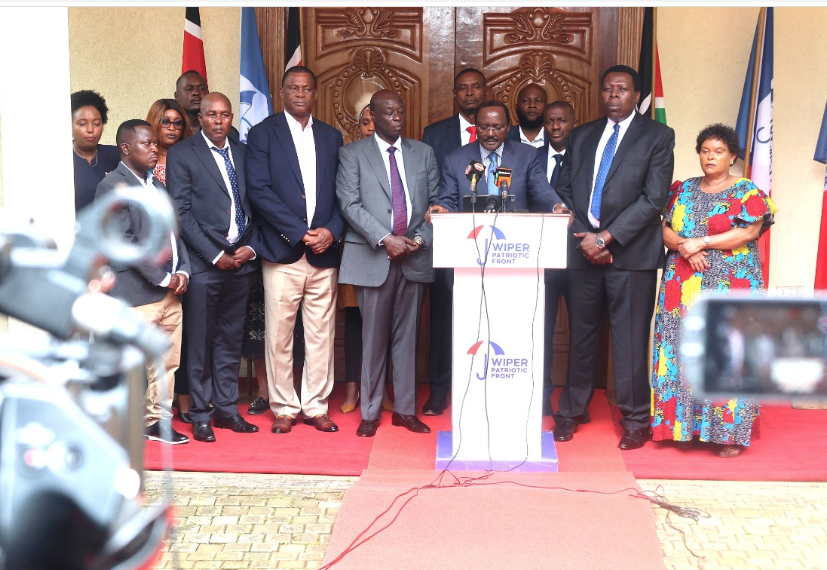
Addressing a press conference, the leaders argued that the two proposals, taken together, pose a threat to Kenya’s public finance management system and the integrity of key national assets.
In a joint statement, the opposition figures said the proposals were being advanced at a time when public trust in government financial management is already strained.
“Taken together, these instruments represent a dangerous and coordinated assault on Kenya’s constitutional framework of public finance management, the long-term integrity of strategic national assets, and already battered public trust in state stewardship,” the leaders said.
They also warned that the proposals were emerging at a time when Kenya’s fiscal credibility is under pressure.
“They are being advanced at a moment when Kenya’s fiscal credibility is under acute stress, and when the Kenya Pipeline Company IPO has demonstrated what happens when government asset transactions are conducted without transparency, competitive process, or genuine public buy-in,” the statement read.
The opposition team included Kalonzo Musyoka of the Wiper Patriotic Front, Eugene Wamalwa of Democratic Action Party–Kenya, Rigathi Gachagua of Democracy for the Citizens Party, and Justin Muturi of the Democratic Party.
The National Infrastructure Fund Bill, 2026, sponsored by National Assembly Majority Leader and Kikuyu MP Kimani Ichung’wah, seeks to create a special fund to mobilise financing for major infrastructure projects, including roads, railways, ports, irrigation and energy.
However, the opposition leaders argued that Kenya’s infrastructure challenges are not due to the absence of funding institutions but rather weaknesses in governance and implementation.
“Kenya’s infrastructure deficit is not a product of institutional scarcity. It is a product of execution failure, procurement corruption, and fiscal opacity,” the leaders said.
They warned that establishing another public fund could worsen governance challenges rather than resolve them.
“Adding a new fund to broken systems adds another layer of dysfunction with reduced oversight,” the statement read.
According to the opposition, Kenya already operates numerous public funds whose mandates overlap and whose oversight remains weak.
They said that by 2024, the country had more than 60 public funds operating outside the Consolidated Fund, many of which have been flagged by the Office of the Controller of Budget as a governance risk due to poor reporting and limited oversight.
Instead of creating a new fund, the opposition leaders proposed alternative approaches to financing infrastructure development.
These include expanding the infrastructure bond market, reforming the public-private partnership framework and strengthening fiscal discipline by rationalising the recurrent budget.
They also raised concerns about the government’s plan to partially divest its stake in Safaricom, describing the company as a strategic national asset that plays a key role in Kenya’s digital and financial systems.
“Safaricom is not simply a telecommunications company. It is a national infrastructure utility, the backbone of Kenya’s digital payments architecture through M-PESA, host of critical government service delivery channels, and one of the most consistently profitable public assets on the continent,” the leaders said.
They said Safaricom’s network supports several government systems, including the National Integrated Identity Management System (NIIMS), Huduma Namba services, Lipa na M-PESA government payments, the eCitizen platform and communication systems linked to national security.
According to the opposition, reducing state ownership in the company without clear safeguards on who may acquire the divested shares could create national security risks.
The leaders called on the National Assembly of Kenya to reject the National Infrastructure Fund Bill, arguing that it is constitutionally defective and institutionally redundant.
They also demanded an independent constitutional review of the bill’s compatibility with Article 206 of the Constitution of Kenya 2010 before any further consideration.
On the Safaricom divestiture plan, the opposition leaders urged Parliament to reject Sessional Paper No. 3 of 2025 and withdraw it pending a comprehensive independent review of the strategic value of the state’s shareholding.
They also called for an independent actuarial and strategic valuation of the Safaricom stake, a national security assessment of reduced state ownership, and full public participation hearings in line with Article 118 of the Constitution before any divestiture plan proceeds.