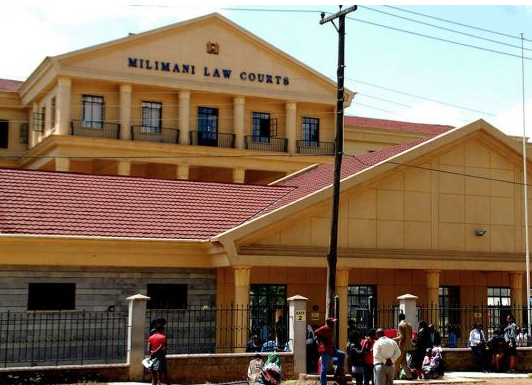
The Judicial Service Commission (JSC) has told the High Court that it was wrongly sued in a case seeking urgent improvements to accessibility for persons with disabilities at the Milimani Law Courts.
In a replying affidavit filed in court, JSC Secretary Winfridah Mokaya argued that the commission had been improperly named as a respondent because it does not have the legal mandate to undertake infrastructure works within court buildings.
The case was filed by public interest group Sheria Mtaani and lawyer Shadrack Wambui, who accuse the judiciary of failing to provide disability-friendly facilities at the Milimani Law Courts.
The petitioners say the absence of essential amenities such as ramps, functional lifts, guiding rails and accessible washrooms has made it difficult for persons with disabilities to attend court proceedings or access judicial services.
Through their lawyer Danstan Omari, the applicants contend that the barriers amount to a violation of the constitutional right of access to justice and have asked the court to compel the installation of disability-friendly facilities.
"There is a serious impediment to access to justice, contrary to the provisions of Article 159 of the Constitution of Kenya 2010, for reasons that persons with disabilities have no physical amenities, including but not limited to ramps and washrooms, to enable them attend physical matters at Milimani Law Courts,” they state in their court documents.
However, the JSC says the petition is based on a misunderstanding of the structure of the judiciary and the distinct roles played by the commission and the administrative arm of the courts.
In her response, Mokaya said the commission is a constitutional body established under Article 171 of the Constitution with specific functions outlined in Article 172 and the Judicial Service Act.
She said the commission’s responsibilities are largely limited to human resource management, policy formulation and advising the national government, and do not extend to the day-to-day administration of court infrastructure.
“The respondent (JSC) is wrongly sued, and there is a fatal misjoinder of the respondent and a corresponding non-joinder of the correct party,” Mokaya said in the affidavit.
According to the commission, the responsibility for maintaining court buildings, repairing lifts, constructing ramps and installing other facilities lies with the Chief Registrar of the Judiciary, who is designated under Article 161(2)(c) of the Constitution as the chief administrator and accounting officer of the judiciary.
Mokaya further argued that the commission does not control the funds used for maintenance or civil works in court stations, including the Milimani Law Courts.
As a result, she said an order compelling the commission to install or repair such facilities would be legally untenable.
"Consequently, an order of Mandamus directed at the Commission to perform engineering and maintenance tasks is legally untenable as the Commission lacks the statutory mandate to execute such works, and it does not own the impugned buildings," she says.
Mokaya told the court that the commission’s budget is separate from the judiciary’s development and maintenance budget and is mainly allocated to personnel costs, policy work and capacity building.
Despite disputing its inclusion in the case, the commission said it recognises the rights of persons with disabilities under Article 54 of the Constitution and supports efforts to make courts accessible to all users.
Mokaya explained that achieving accessibility in older court buildings, such as Milimani, requires significant capital investment and is subject to the principle of progressive realisation, which depends on budget allocations from Parliament.
She added that the judiciary has been undertaking gradual improvements in different court stations and has incorporated accessibility goals in its Social Transformation through Access to Justice (STAJ) blueprint.
According to the commission, ramps have already been completed at Murang’a Law Courts and Butali Law Courts in recent months.
This comes as the judiciary seeks additional funding in the 2026/2027 financial year for the restoration of lifts and construction of disability-compliant washrooms at the Milimani Law Courts.
The petitioners are seeking orders to compel the installation of disability-friendly facilities and a declaration that the rights of persons living with disabilities to access justice at Milimani Law Courts have been violated.
Justice John Chigiti had earlier certified the application as urgent and directed the JSC to file their responses before the matter proceeds for further directions.