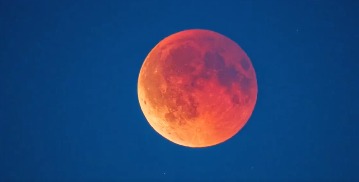
Astronomy enthusiasts across Africa will miss the total lunar eclipse, also known as a blood moon, on March 3, 2026.
According to NASA, the main reason comes down to the Moon’s position, Earth’s rotation, and the timing of the eclipse.
Lunar eclipses occur only at night when the Earth passes directly between the Sun and the Moon, casting its shadow on the lunar surface.
For observers to witness the spectacle, the Moon must be above the horizon. During this eclipse, however, totality will occur over the Pacific Ocean, parts of the Americas, and eastern Asia, while the Moon is below the horizon for Africa, either in daylight or close to moonset.
According to NASA, during a total lunar eclipse, the Sun, Earth, and Moon are perfectly aligned, causing the Moon to turn a striking reddish-orange colour, earning it the nickname “blood moon.”
The hue is caused by sunlight being filtered and refracted through Earth’s atmosphere, scattering blue light and leaving the red and orange tones to illuminate the Moon.
This eclipse will be visible from eastern Asia and Australia in the evening, across the Pacific at night, and from most of North and Central America, as well as western South America, in the early morning.
NASA noted that this month will be full of celestial events: Venus and Saturn will form a close conjunction in the evening sky on March 8, coinciding with the vernal equinox.
Even though Africa will miss this blood moon, skywatchers elsewhere will get a chance to see one of nature’s most striking lunar displays.
According to NASA, w
hile this is colloquially known as the first day of spring in the northern hemisphere and the first day of autumn in the southern hemisphere, astronomically this equinox occurs when the Sun crosses above Earth's equator while travelling from south to north.On this day, northern and southern hemispheres experience roughly equal amounts of sunlight and day and night are also about equal, each lasting almost exactly 12 hours.
During a lunar eclipse, which can only happen during a full Moon, Earth passes between the Sun and the Moon, casting a shadow on the lunar surface.
NASA reported that during a partial lunar eclipse, the Moon moves only partially into the dark shadow, or umbra, cast by Earth.
But, during a full lunar eclipse, the Sun, Earth, and Moon are exactly aligned, leaving the Moon completely enveloped in Earth's shadow. When this happens, the Moon turns blood red.