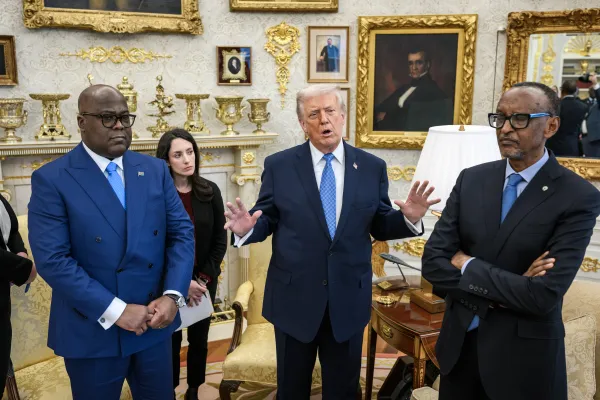
 US President Donald Trump with Rwanda's Paul Kagame and DRC's Felix Tshisekedi at the White House last December
 The United States government has sanctioned the Rwandan military and four commanders over alleged support for M23 rebels in eastern DRC.
Last evening, the U.S. Department of the Treasury’s Office of Foreign Assets Control (OFAC) imposed sanctions on the Rwanda Defence Force (RDF) and four of its senior officials.
The US accused the RDF of actively supporting, training, and fighting alongside the March 23 Movement (M23) rebels.
The rebel group is a U.S.- and United Nations (UN)-sanctioned armed group accused of human rights abuses and fueling a mass displacement crisis in the Democratic Republic of the Congo (DRC).
The RDF has allegedly supported M23 as it seized territory in eastern DRC, including the provincial capitals of Goma and Bukavu, along with strategic mining sites.
According to the US, M23’s offensives would not have been possible without the active support and complicity of the RDF and key senior officials.
“President Trump is the Peace President, and Treasury will use all tools at its disposal to ensure that the parties to the Washington Accords uphold their obligations,” said Secretary of the Treasury Scott Bessent.
“We expect the immediate withdrawal of Rwanda Defence Force troops, weapons, and equipment.”
Those sanctioned include Army Chief of Staff Vincent Nyakarundi, a senior commander of the Rwandan Army’s land forces, which the US claims have conducted military operations in support of M23.
Also sanctioned is Major General Ruki Karusisi, commander of the RDF’s 5th Infantry Division. He was previously a Special Operations Force Commander and is accused by Washington of allegedly overseeing military operations in support of M23.
RDF Chief of Defence Staff Mubarakh Muganga was also sanctioned. The US said that before being appointed to the role in June 2023, he served as Army Chief of Staff, during which time he allegedly played a key role in planning operations and commanding RDF forces in eastern DRC.
The fourth official sanctioned is Stanislas Gashugi, the RDF Special Operations Force Commander appointed on March 15, 2025, replacing Karusisi.
However, Rwanda has criticised the sanctions, calling them unjust and one-sided amid escalating tensions over the conflict in eastern DRC.
In a statement issued Tuesday, President Paul Kagame’s administration said the US action “misrepresents the reality and distorts the facts” surrounding the conflict, while accusing the Congolese government of repeatedly violating ceasefire agreements through drone strikes and ground offensives.
“Consistent and indiscriminate drone attacks and ground offensives constitute clear violations of ceasefire agreements by the DRC and continue to cost many lives,” the statement said, adding that “Rwanda is fully committed to disengagement of its forces in tandem with the DRC implementing their obligations.”
The US said the RDF was designated pursuant to Executive Order 13413, as amended by Executive Order 13671, for being responsible for or complicit in actions or policies that threaten the peace, security, or stability of the DRC.
The RDF and its chiefs are also accused of materially assisting, sponsoring, or providing financial, material, logistical, or technological support to M23.
As a result of the sanctions, all property and interests in property of the designated persons within the United States, or in the possession or control of U.S. persons, are blocked and must be reported to OFAC.
The US Treasury added that any entities owned, directly or indirectly, 50 percent or more by one or more blocked persons are also blocked.
Unless authorised by a general or specific license issued by OFAC, US regulations generally prohibit all transactions by U.S. persons, or within or transiting the United States, that involve property or interests in property of blocked persons.
Days after President Donald J. Trump hosted DRC President Felix Tshisekedi and Rwandan President Paul Kagame for the signing of the Joint Declaration on the Washington Accords for Peace and Prosperity, M23 captured Uvira, a strategic city along the DRC-Burundi border.
The offensive resulted in civilian deaths and forced thousands of residents to flee their homes.
Despite its subsequent withdrawal from Uvira, M23’s continued presence near the Burundi border—and the alleged continued support from the RDF—raises concerns about a broader regional escalation.
In a joint statement, the International Contact Group for the Great Lakes condemned M23 and RDF military operations and called on the RDF to withdraw from eastern DRC.