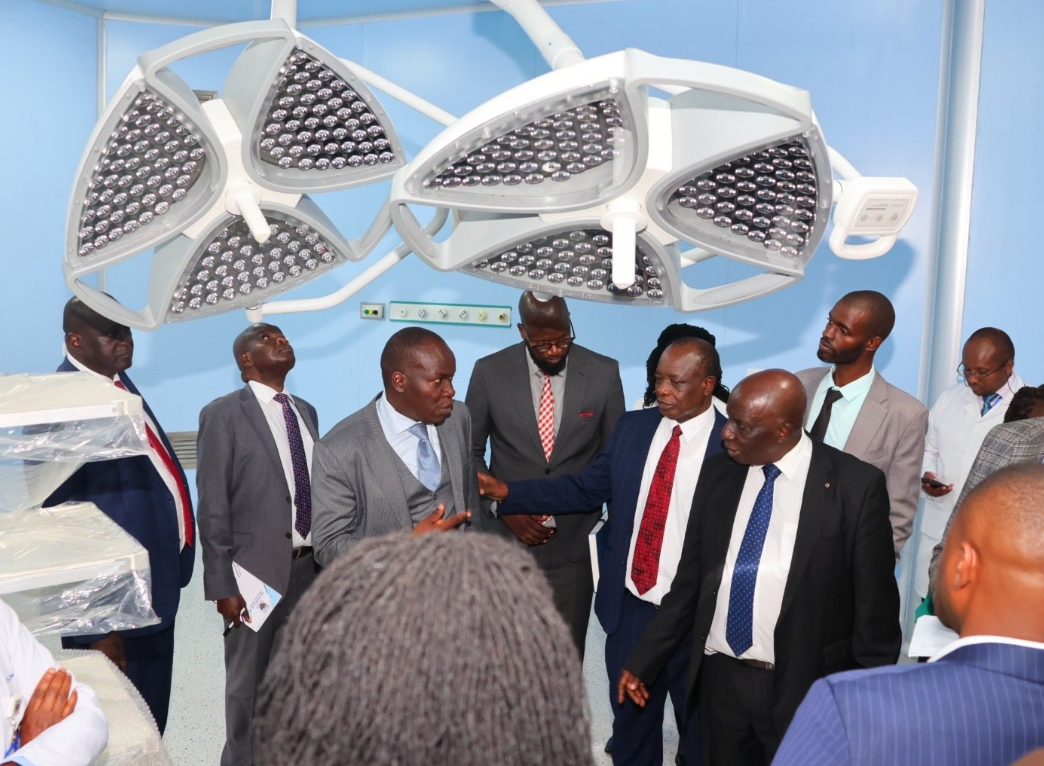
 Members of the National Assembly’s Departmental Committee on Health during a fact-finding tour of Kenyatta National Hospital/HANDOUT
The National Assembly’s Departmental Committee on Health has raised concerns over critical service gaps at the Kenyatta National Hospital following a fact-finding visit to the facility.
Led by Seme MP Dr James Nyikal, the committee toured key departments at the hospital and acknowledged ongoing improvements but warned that congestion, equipment breakdowns and a non-functional oxygen plant are straining service delivery and putting patients at risk.
Nyikal said the committee was particularly disturbed by the state of the hospital’s oxygen plant, which he confirmed is not operational.
“This oxygen plant is actually a major issue. It is not operational. It is not functional. It is not producing even a litre of oxygen in a day,” he said. “The truth is, as of now, Kenyatta does not have an oxygen plant. The plant is not producing any oxygen.”
He described the situation as unacceptable, noting that significant public funds had been spent on the project.
“It does appear that there were problems all the way from procurement, the design, the tender process, what was awarded, supervision and even the payment process,” he said.
“It is something the committee must take up with the ministry and other government agencies to establish what went wrong and who did what.”
KNH Acting Chief Executive Officer Dr Richard Leyisampe told the committee that the hospital currently serves about 700 patients daily who require oxygen support.
“We are procuring that oxygen for our patients. Occasionally, we also get oxygen from our sister institutions such as KU Teaching and Referral Hospital and Mama Lucy Kibaki Hospital,” he said. “Therefore, we do not have shortages of oxygen.”
However, he emphasised the urgent need for the hospital to have its own reliable supply system.
“What is very important is that we need to have our own oxygen plant, and I think the committee will assist us in that direction,” Dr Leyisampe said.
The committee also raised concerns over disruptions in cancer care services following the breakdown of a Linear Accelerator (LINAC) machine at the hospital’s oncology unit.
Nyikal confirmed that the LINAC, used for advanced radiotherapy treatment is currently not operational, forcing the hospital to rely on a cobalt machine.
“They are improvising with what is called cobalt treatment. But really, the truth is some patients are missing the services they deserve,” he said.
He disclosed that the hospital management had assured the committee that repairs on the LINAC would be completed within a week. In addition, the committee is exploring budgetary allocations to support procurement of an additional machine.
“We are in the budget process and are going to get them some funds to at least get another LINAC or two, depending on availability of funds,” Dr. Nyikal said.
Leyisampe confirmed that the hospital normally treats about 100 cancer patients daily. With the LINAC out of service, only 50 patients are currently being treated using the cobalt machine.