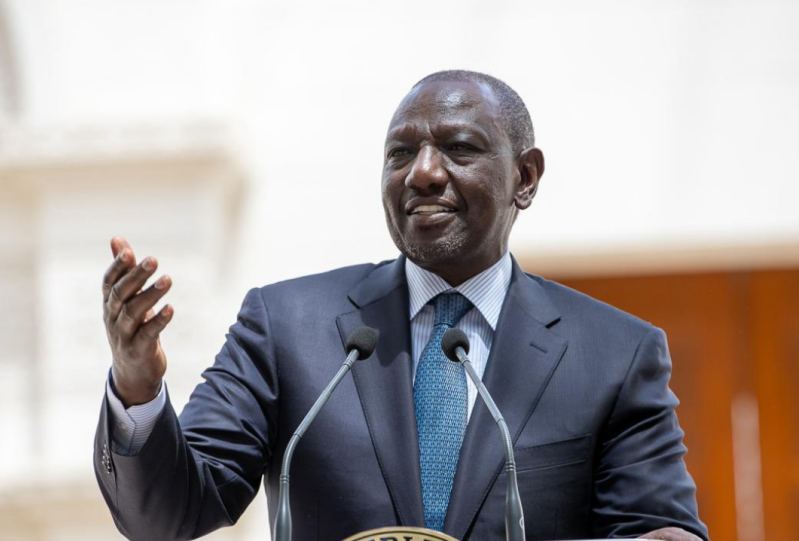
President William Ruto has called for urgent multi-stakeholder engagement to de-escalate the rapidly intensifying conflict in the Middle East following the killing of Iran’s Supreme Leader Ayatollah Ali Khamenei.
In a statement issued on Monday, Ruto warned that the unfolding crisis threatens not only regional stability but also global peace and economic security.
“At this defining and perilous moment in global history, longstanding multilateral institutions remain indispensable frameworks for the resolution of the current crisis in the Middle East,” the President said.
Ruto said Kenya strongly condemns the strikes on the United Arab Emirates, Qatar, Saudi Arabia, Iraq, Oman, Kuwait, Jordan and Bahrain in the evolving conflict in the Middle East.
“It is evident that the regionalisation of this conflict poses a grave threat to international peace and security,” the President said in a message posted on X.
Ruto’s remarks come in the wake of a dramatic escalation of tensions after Khamenei was confirmed killed in coordinated military strikes by the US and Israel, marking one of the most significant confrontations in the region in decades.
Khamenei, Iran’s highest authority since 1989, died alongside other senior officials as part of what US leaders described as operations targeting Iran’s military and nuclear infrastructure.
The strikes triggered swift and wide-ranging retaliation by Tehran, with Iran launching missiles and drone attacks against Israeli and US bases in the Gulf, declaring its intention to avenge Khamenei’s death.
Iranian President Masoud Pezeshkian described the assassination as a “declaration of war against Muslims,” signaling that Tehran views the attack as a broader act of aggression rather than a limited military strike.
Iran’s Foreign Minister Abbas Aragchi has denied targeting neighbouring Gulf states directly, telling Al Jazeera: “We are not attacking our neighbours in the Persian Gulf countries, we are targeting the presence of the US in these countries. Neighbours should direct their grievances to the decision-makers of this war.”
However, several Gulf countries have reported damage to civilian infrastructure, some of which officials say resulted from debris falling from intercepted missiles. Iran has previously warned that it would retaliate against any country it considers complicit if attacked.
On the internal political front, Iran has established an interim leadership council to govern as the constitutional process of selecting a new supreme leader starts. The leadership vacuum has heightened uncertainty within the Islamic Republic and raised fears of further instability.
Beyond Iran’s borders, Israel has conducted strikes against Hezbollah positions in Lebanon, widening the theatre of conflict. Protests have also erupted globally, both condemning and supporting the military action, underscoring the polarising nature of the crisis.