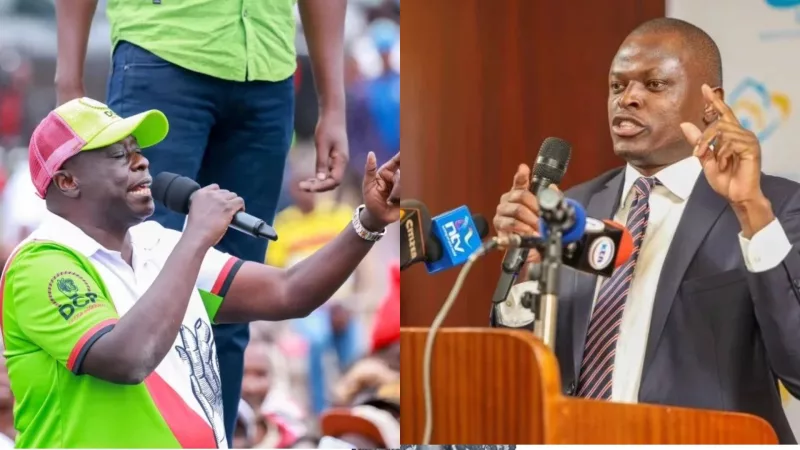
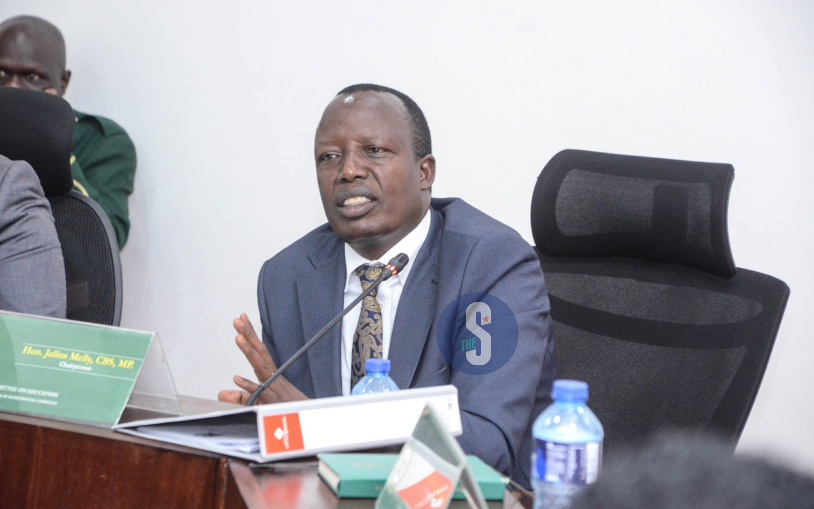
 National Assembly Committee on Education chairperson Julius Melly speaks on February 19, 2026. /PARLIAMENT
Education sector funding for the 2026–27 financial year could rise to Sh1 trillion if the Budget and Appropriations Committee adopts recommendations by the National Assembly’s Education Committee.
In the 2026 Budget Policy Statement (BPS), currently under consideration in the House, the National Treasury proposed an overall resource ceiling of Sh767 billion from the projected Sh4.7 trillion budget for the 2026–27 financial year.
The proposed allocation represents a 9.1 per cent increase from the Sh702.7 billion baseline in the 2025–26 fiscal year.
However, the ministry noted that the share is lower than the 27.6 per cent of the total budget allocated to the sector last year.
Budget Policy Statements are largely anchored on ceilings set by the National Treasury, informed by submissions from ministries, departments and agencies.
Appearing before the education committee on Tuesday, February 24, Basic Education PS Julius Bitok said the State Department, with a proposed allocation of Sh134.77 billion, faces a funding deficit of Sh111.07 billion against a requirement of Sh245.85 billion in the 2026–27 financial year.
He warned that the shortfall threatens the full implementation of primary, junior and senior secondary education as well as teachers’ training colleges.
Of the proposed Sh767 billion, Sh737 billion is earmarked for recurrent expenditure while Sh30 billion is allocated to development.
Bitok told the committee that both allocations fall short of departmental projections.
"Under the recurrent budget, the department has a proposed allocation of Sh118.7 billion against a requirement of Sh216.5 billion. Similarly, under development, the proposed allocation for the 2026-27 financial year is Sh16 billion against a requirement of Sh29.4 billion," the PS said, adding that the gap translates to a 45 per cent shortfall.
In its report to the Budget and Appropriations Committee, the Education Committee chaired by Tinderet MP Julius Melly recommended an additional Sh284 billion for the sector to enable the ministry to meet its obligations fully.
The proposed increase would address financing gaps in higher education, including collective bargaining agreements for lecturers, medical cover for teachers under SHA, students’ scholarships and loans, and pending bills owed by public universities.
Among the specific proposals are Sh1.1 billion for lecturers’ Collective Bargaining Agreement (CBA), Sh29.4 billion for university scholarships, and Sh67 billion for university and TVET student loans under the student-centred funding model.
The committee further proposed Sh22 billion for TVET scholarships, Sh10 billion for teachers’ SHA cover, Sh85 billion to clear universities’ pending bills, and Sh46 billion for students placed in private universities.
It also highlighted shortfalls in basic education funding. The BPS allocated Sh7 billion for free primary education against a demand of Sh15 billion, leaving a gap of Sh8.6 billion.
For junior and senior schools, the committee proposed an additional Sh47.2 billion in capitation. Of this, Sh23.5 billion would raise capitation for 3.5 million senior school learners to Sh78.4 billion, up from Sh54.8 billion.
Without the increment, 1.1 million learners would miss out on capitation or receive a flat rate of Sh15,780 instead of Sh22,244.
An additional Sh23.8 billion was recommended for junior schools to increase funding to Sh54.7 billion from the Sh30.9 billion proposed in the BPS.
The shortfall would leave 1.6 million out of 3.6 million junior school learners without capitation or reduce funding to Sh8,536 instead of Sh15,042 per annum.
Examinations and invigilation would receive an additional Sh4.8 billion, raising the total to Sh14.7 billion from the proposed Sh9.9 billion.
The committee also recommended Sh850 million on top of the Sh3 billion proposed for the school feeding programme targeting 2.8 million vulnerable learners.
School infrastructure would receive an extra Sh1.5 billion to meet a Sh2.8 billion requirement.
"These critical resource gaps in the sector need to be addressed to ensure that what the BPS envisages in terms of scaling up investment in people through education, skills development, scientific training and innovation is realised," the committee said in its report.
Speaking during the Senate Assessment and Planning Retreat in Naivasha, Bitok said adequate funding would enable timely disbursement of capitation to schools and prevent disruption of learning.
"Now that we have expunged ghost learners in the recently concluded student enrolment verification exercise, we are confident that we have reliable data to inform better planning and resource allocation in our schools."
He added that disciplinary action was being taken against teachers suspected of inflating enrolment figures and sub-county directors of education believed to have been complicit.