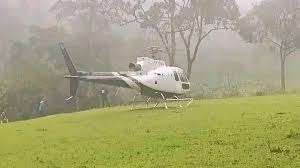
 The aircraft, formerly known as the Eurocopter AS350 B3e./FILE
The helicopter that crashed in Nandi County, killing Emurua Dikirr MP Johana Ngeno and five other occupants, was an Airbus H125, registration 5Y-DSB.
The aircraft, formerly known as the Eurocopter AS350 B3e, is a light single-engine helicopter widely used around the world for charter services, VIP transport, and aerial operations.
Flight tracking data from Flightradar24 shows that the helicopter departed Wilson Airport at 11:02 am on Saturday, February 28. Publicly available tracking records indicate that its previous logged flight had taken place on February 22, also originating from Wilson Airport.
However, the available data does not clearly show when the aircraft landed at its intended destination on the day of the crash or when it was scheduled to depart again.
Preliminary reports indicate that the helicopter encountered heavy rainfall and poor visibility while flying over parts of Nandi County from Endebess in Trans Nzoia. The worsening weather conditions are said to have forced the pilot to make a precautionary emergency landing. After a brief stop, and once conditions appeared to improve, the aircraft reportedly attempted to resume its journey.
One of the first responders said the pilot, after stopping due to bad weather, consulted someone on the ground about how long the mist would take to clear before taking off. It is during this second takeoff that tragedy struck. Reports suggest the helicopter hit a tree before crashing and bursting into flames, leading to the deaths of all on board.
The Airbus H125 is not an ordinary helicopter. It belongs to the Ecureuil family, a series known globally for performance and versatility. The model holds the world record for the highest altitude landing and takeoff, achieved on Mount Everest, a feat that underscores its engineering strength and capability in extreme environments.
Designed to perform efficiently in what aviation experts call “hot and high” conditions, the H125 has earned a reputation for reliability in mountainous and high-temperature regions. Typically configured to carry one pilot and up to five or six passengers, the H125 is powered by a single turboshaft engine that delivers strong lift and steady performance.
It can reach speeds of approximately 287 kilometres per hour, or about 155 knots, and has a range of roughly 630 kilometres on a full tank. Its spacious cabin, large windows, and adaptable interior layout make it suitable for a wide range of missions, from executive travel to tourism flights, rescue operations and aerial surveys.
In Kenya, the aircraft type is popular among private charter operators and government agencies alike. The ill-fated 5Y-DSB was operated by a Nairobi-based private charter firm headquartered at Wilson Airport. The helicopter was conducting a charter flight at the time of the accident.
The aircraft had frequently been leased for official and high-profile travel. As investigations continue, aviation authorities are expected to examine multiple factors, including weather conditions, flight decisions, aircraft performance and possible mechanical issues.
While the Airbus H125 is widely regarded as a dependable and capable aircraft, experts caution that adverse weather and low visibility can significantly increase operational risks, particularly in areas with trees and uneven terrain.
The crash of 5Y-DSB has once again drawn attention to the challenges of air travel during the rainy season and the critical importance of weather assessment and flight planning.