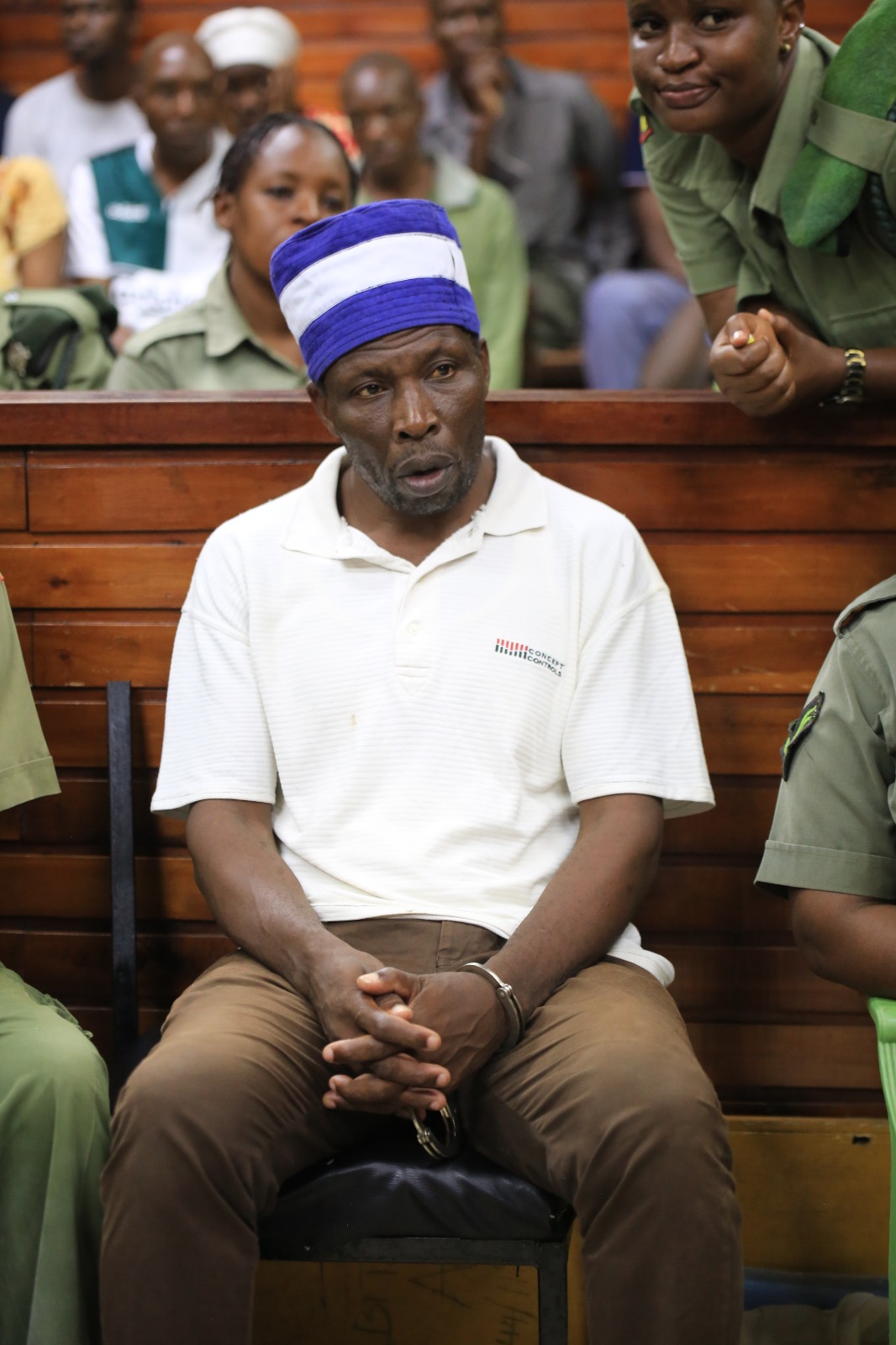
 Self-confessed Shakahola suspect Enos Amanya Ngala, also known as Hallelujah, in a Mombasa court /JOHN CHESOLI
A self-confessed suspect has given a chilling account of how 900 followers of controversial preacher Paul Mackenzie were lured into Shakahola forest.
Suspect Enos Amanya Ngala, alias Hallelujah, also revealed how a bitter land dispute sparked the deadly fasting that shocked the nation.
Testifying as a state witness after striking a plea bargain with the Office of the Director of Public Prosecutions (ODPP), Amanya revealed how the journey began in Nairobi and ended in mass graves beneath maize and bean farms in Kilifi county.
Amanya said Mackenzie drew followers with promises of cheap land.
At least 650 adults and more than 300 children eventually settled in the forest, forming isolated villages such as Galilaya, Samaria, Bethlehem, Tironi and Judea.
The majority of the 900 church members are believed to have died, with 436 bodies exhumed from Shakahola.
Amanya said he first went to the church in 2019 at the Makongeni branch in Nairobi.
After the branch was closed that year, congregants met in homes and travelled across towns for seminars.
With the onset of Covid-19, Amanya withdrew his children from school and relocated with his family to western Kenya.
Through Mackenzie’s Nairobi pastor, George Mwaura, Amanya learned of land parcels in Shakahola and, with his brother David, purchased property.
They travelled with their families to Malindi and then on to the forest villages, initially staying in tents.
Disputes soon emerged over land allocation, with Mwaura claiming Mackenzie had leased, rather than owned, the property.
Amanya was later relocated to another area after paying additional fees, only to face tension with the alleged landowner.
Amanya said Mackenzie’s contradictory directives created confusion. Villagers complained about loud prayers and church leaders warned them against preaching.
Eventually, local elders declared their tenure was over and demanded payment or eviction.
Mackenzie allegedly responded with a fatal instruction, “All followers should fast to death so that the land would be ‘cleared’ by the time the elders returned.
Fasting began immediately, first with those who had no food, then reluctantly by others, including children. Some resisted, and a few quietly left the forest.
Amanya described a militarised enforcement system: teams guarded water sources, farms, adult men and forest perimeters to ensure compliance. He served as a grave digger and security member, working in shifts, planting crops over graves to hide them.
He testified that Mackenzie presided over burial rites, including those of his own daughter, Snyder, whose body was later exhumed and moved to another village.
Amanya lost four other children, whose burials he never witnessed; his wife later confirmed their deaths.
Breaking down in court, Amanya recalled that even members of Mackenzie’s family were not spared.
He said a “last supper” meeting was held for roughly 900 followers, after which some fled while others obeyed the directive.
Under a plea agreement dated February 18, 2026, prosecutors withdrew 195 of 238 charges against Amanya and 94 co-accused persons.
He pleaded guilty to 43 counts of manslaughter and agreed to testify in related cases, including the Kwa Bi Nzaro matter.
The deal followed his earlier admission to 191 counts of murder before the High Court in Mombasa in another Shakahola-related case.
Amanya’s testimony paints a harrowing picture of a closed, militarised religious commune — a community born of disputed land, rigid control and apocalyptic directives that transformed fasting into fatal obedience.