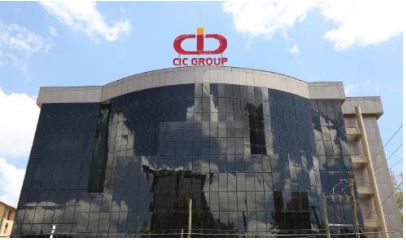
Investors trooped back to the CIC Insurance Group Plc counter at the Nairobi Securities Exchange (NSE) following a dramatic sell-off triggered by a surprise profit warning.
On Wednesday, the insurer posted a volume of 5.2 million, the second highest in the year, to 6.45 million achieved on January 27.
The
insurer’s share price, which plunged sharply after the announcement, has begun
to attract bargain hunters and cautious long-term holders, even as market
participants digest the implications of the company’s earnings outlook and the
broader impact of tech-driven trading platforms.
A spot check
of the Nairobi bourse by the Star via Ziidi App on Wednesday afternoon shows
that CIC share trading at Sh5.26, having gained nearly five per cent after
plunging to an all-time low on Tuesday.
The
Insurer’s CIC stock closed at Sh5.04 on
Tuesday, marking a 17.9per
cent plunge from the previous close of Sh6.14 — the largest single-day
decline in recent months.
Market data
show the counter traded as low as Sh4.59 during the session, underscoring the
volatility that gripped the insurer’s share.
The steep
fall wiped out significant market value in a single day. With roughly 2.88 billion shares issued, the near-18
percent decline translated into billions
of shillings in paper wealth evaporating as traders rushed for the
exits.
Analysts
estimate that investors collectively saw upwards of Sh3.5 billion wiped off CIC’s market capitalisation on
the profit-warning day alone.
An
unexpected profit warning issued late last week triggered the sell-off. In a
regulatory filing, CIC disclosed that its net profit for the year ended December 31, 2025, is now expected to fall
by at least 25 per cent to around Sh2.14 billion, down from Sh2.85
billion in 2024.
Management
cited two key drivers behind the profit downgrade: the non-recurrence of a one-off Sh1 billion gain from land revaluation booked
in 2024, and elevated insurance
claims across its portfolio, which have squeezed core underwriting
margins.
“The absence
of significant fair value gains, coupled with rising claims costs, materially
alters the earnings landscape for 2025,” the directorate said in a statement to
shareholders.
The
decline came just a week after the firm announced it had made a Sh1.8 billion capital injection into its balance sheet
following two major land sales, which have boosted its cash position.
It had sold a 50-acre block
neighbouring Tatu City and 100 acres in Kajiado, with proceeds aimed at
enhancing the insurer's capital position, as the Insurance Regulatory Authority
(IRA) heavily discounts land assets, preferring liquid assets for claim
settlements.
The announcement saw the share price
rise by close to 10 per cent on the eve of Valentine’s Day, hitting Sh5.52,
recording a 9.1 per cent gain over its previous closing price of Sh5.06.
Market
watchers say the plunging price was compounded by the proliferation of the Ziidi Trader app — a new mobile-based
trading platform integrated into M-Pesa
that allows users to buy and sell NSE
shares in real time without a traditional brokerage account.
Launched in
early February, Ziidi has dramatically lowered barriers to entry for retail
investors, enabling quick access to listed equities and real-time settlement.
“With the
click of a button on Ziidi, retail investors were able to exit their positions
as soon as the profit warning hit the wires,” said Michelle Otieno, a
Nairobi-based equities strategist.
“This immediacy — combined with fear of
further losses — accelerated the sell-off more than traditional broker-mediated
trades would have.”
Another
analyst, John Kamau of a local brokerage, noted: “Ziidi has shifted the
psychology of trading. Investors used to the slower, broker-facilitated process
now react instantly to news, which can magnify volatility — for better or
worse.”
Indeed,
market data show that Ziidi accounted for a large portion of NSE deal counts in
the days following its rollout, with daily trades reaching record highs as
first-time investors joined the market.
Despite the
sell-off, some institutional players and long-term holders see the price dip as
an opportunity.
“CIC’s
fundamentals outside the one-off items are intact,” said a senior analyst at a
Nairobi fund management firm who spoke on condition of anonymity. “The profit
warning was more about accounting recognition than operational collapse.”
He adds that
shareholders can be optimistic about CIC, knowing the stock has accrued 16 per
cent over the past four-week period—15th best on NSE. “It is the 12th most
traded stock on the bourse over the past three months.”