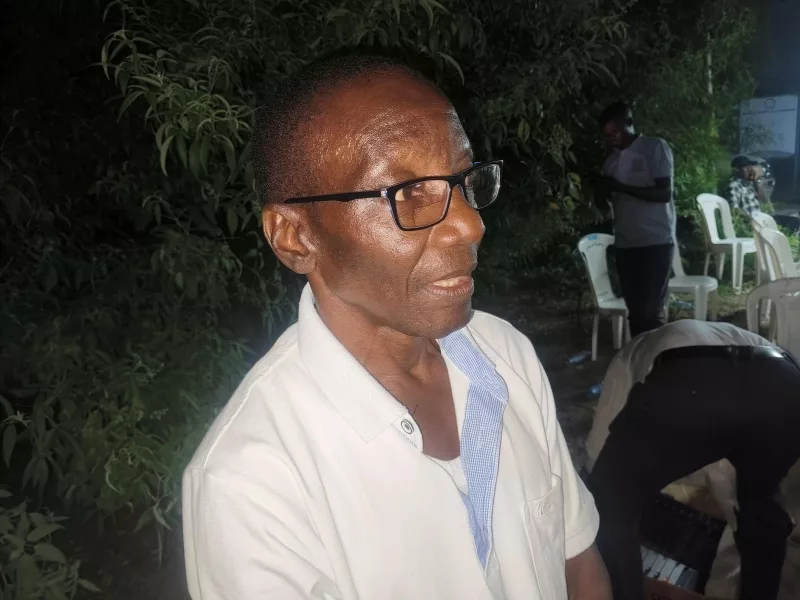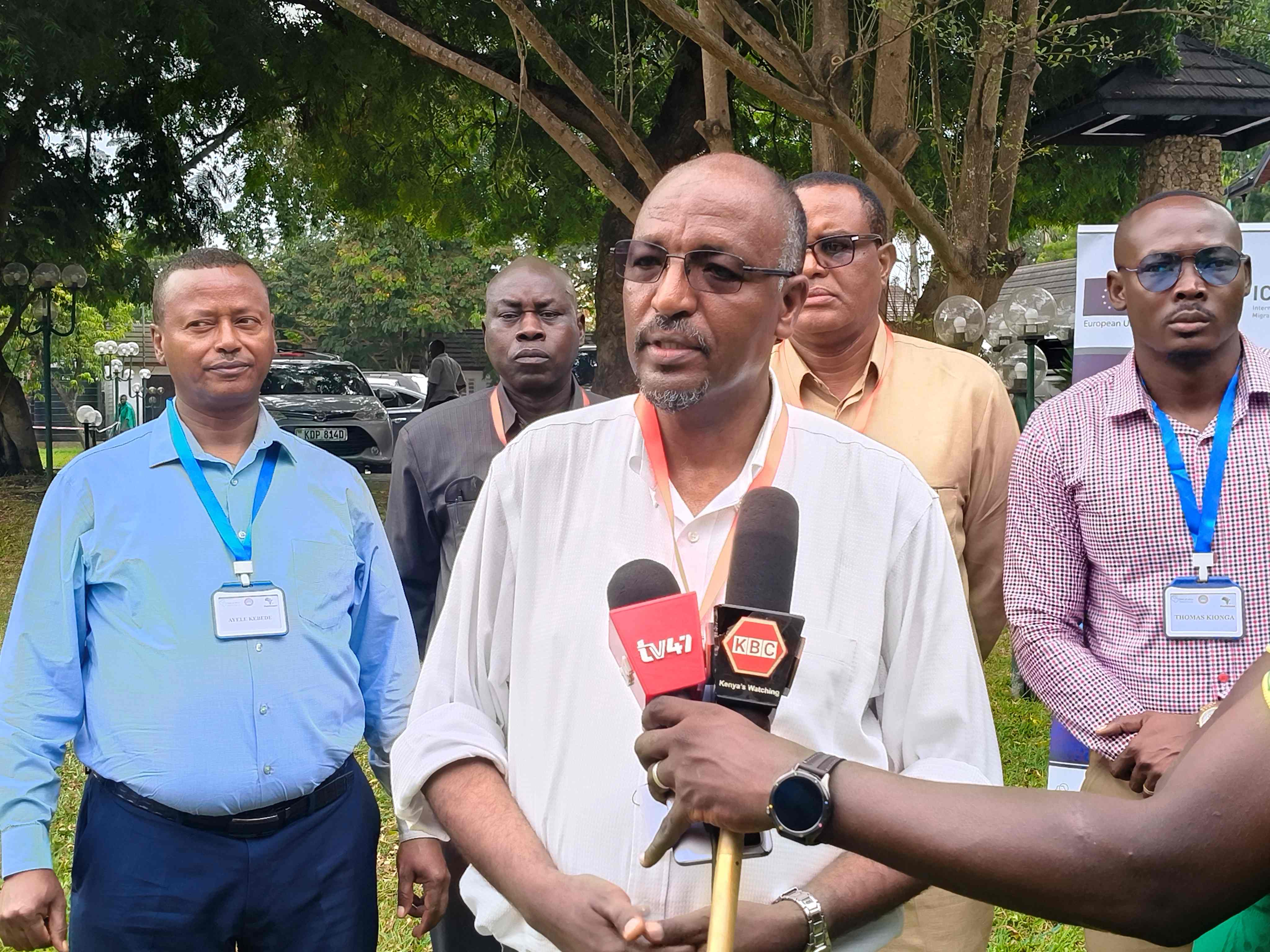
Swedish International Development Agency program manager Ayele Kabede, Mecmea program coordinator John AjjugoJohn Ajjugo, Horn of Africa Regional Environmental Centre and Network (Hoarec)’s Prof Mekuria Argaw, PanAfricare country director Dominic Godana and Turkana county director in charge of climate change Thomas Kiong’a Kiong’a in Mombasa on Monday / BRIAN OTIENO
Kenya is among countries projected to experience serious migration of communities as early as 2030 due to climate-related factors.
A new report released by Groundswell shows that between 6.9 and 10.1 million people in the Eastern Africa region maybe force to relocate.
It cited Turkana where communities are already being forced into neighbouring Ethiopia, South Sudan and Uganda as a result of droughts, floods, and colonisation of farms by weeds and foreign species.
Turkana county director in charge of climate change Thomas Kiong’a said counties are the governance structures that are directly linked to the people at the grassroots.
He said the mobile population has been ignored for a very long time to an extent they were being portrayed as rebels and terrorists as they moved across borders in search of water, pasture or safety.
"For a very long time, these are populations that have been moving without laws that bind their movements or laws that protect them even as they cross borders,” Kiong’a said.
Other countries expected to be affected include Tanzania, Uganda, Rwanda, and Burundi. These have already started seeing internal displacements.
“These movements are fuelled by escalating climate impacts and socio-economic vulnerabilities,” the report says.
Horn of Africa Regional Environmental Centre and Network (Hoarec)’s Prof Mekuria Argaw on Monday said migration in this context serves dual roles; adaptive response to changing conditions and as a reaction to life-threatening risks.
Both occur within borders and across countries.
It is for this reason that stakeholders are calling for policy changes and adaptability efforts that will cushion the environmental impacts of climate change.
The stakeholders are holding a five-day capacity building workshop on environmental change, climate-induced migration and conflict in the Eastern Africa sub-region in Mombasa. The meeting began on Monday.
Argaw on Monday said the training is aimed at fostering the understanding about the dynamic between climate and the environment and how that triggers conflicts in the sub-region.
The training is part of the Managing the Impacts of Environmental Change and Conflict on Mobility in Eastern Africa (Mecmea) project which seeks to address how climate change, environmental disasters, and conflict influence migration patterns across Eastern Africa.
The project is funded by the European Union, contracted by the International Centre for Migration Policy Development and implemented by various actors including Hoarec, PanAfricare, Mixed Migration Centre, among others.
“We want to see how actions and policies can be informed in addressing or managing this climate-related human mobility in the region,” Argaw said.
He said sudden-onsets like droughts and floods and the long term impacts related to land degradation should be addressed both through policies and practical efforts.
Argaw noted that for the last six years, there have been consistent droughts which have had significant impacts socially, economically and environmentally.
“So, we need to really act as quickly as possible in managing this environmental and socio-economic disaster in our region,” he said.
He said migration is beneficial but can have negative consequences in fuelling conflicts if not properly managed through policies and strategies and both national, regional and continental levels.
Ayele Kabede, the Swedish International Development Agency program manager on environment and climate, said it is encouraging that the African Union has introduced a very supportive manual that gives direction relating to climate-induced migration.
The manual, developed through a participatory process that involved governments, is now being tested.
PanAfricare country director Dominic Godana said they are working to avoid a repeat of the 2022 and 2024 when drought killed over 80 per cent of livestock in northern Kenya.
“We are seeing this cycle repeating itself because of climate change and environmental vulnerability in those areas. As PanAfricare, we work with farmers to ensure that they prepare themselves,” Godana said.
He said counties like Turkana and Marsabit in Kenya, which they support, are some of the major benefactors of climate-induced migration.
He said such communities need to be enlightened so as to understand the nexus between environmental change, climate change and migration.
“For example, Marsabit neighbours Ethiopia. So when the rains are on the other side, communities move to the other side. So, we need really to understand so there are no conflicts between the different communities as they move across,” Godana said.
He said PanAfricare works with governments, ensuring they have the right policies as they come up with measures to mitigate effects of climate change.
He said the communities need to be brought along because that is where the action takes place.
Mecmea program coordinator John Ajjugo said for a long time, migration had been majorly influenced by economic opportunities.
However, today, migration is being forced by environmental factors more often than not.
“So we want to bring that to the fore. That is why this training is key. We will then move to the policy dialogue where the governments will come in,” Ajjugo said.
He said the governance aspect of migration is key when addressing migration so as to avoid conflicts.
He said countries have different policies on migration hence the need to harmonise them.
“If you look at the policy mismatch between regional and national governments, then you will see there is need to harmonise them,” Ajjugo said.