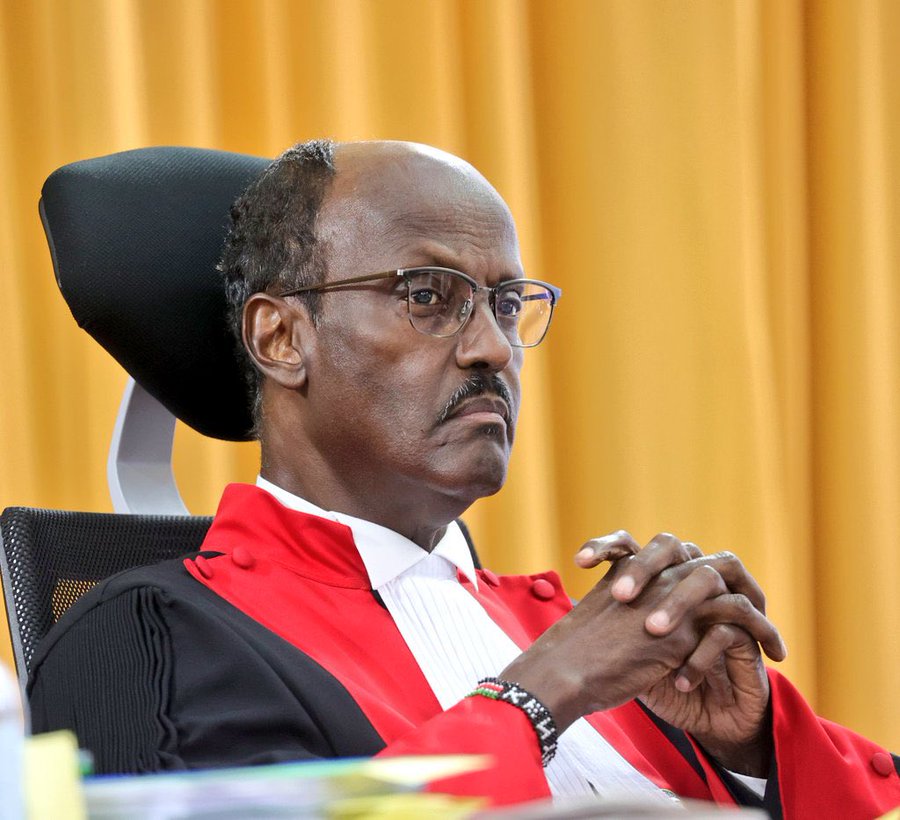
The Judiciary has invited Judges, Judicial Officers, members of the Bar and the general public to submit tributes in honour of Mohamed Ibrahim ahead of special file-closing proceedings scheduled for March 9, 2026.
According to the notice, Chief Justice Martha Koome will preside over the tribute session.
Justice Ibrahim served on the court’s inaugural bench from August 26, 2011, until his death on December 17, 2025.
The Judiciary described the tribute process as an opportunity for colleagues in the justice sector and members of the public to honour his legacy and contribution to the development of Kenya’s jurisprudence.
To facilitate participation, the Supreme Court has created an online platform where interested individuals can submit their tributes ahead of the commemorative sitting.
Members of the public have been urged to use the provided link to share their messages of remembrance.
Kenyans can access the link via supremecourt.judiciary.go.ke/tributes-for-hon-mr-justice-mohammed-ibrahim/
Justice Ibrahim was appointed to the Supreme Court of Kenya on June 16, 2011, becoming one of the court’s founding judges following the promulgation of the 2010 Constitution.
From the outset, he played a central role in shaping the jurisprudence, institutional culture, and public-facing mandate of the country’s apex court during a formative period for constitutional democracy.
Within the Supreme Court, Justice Ibrahim held extensive administrative and governance responsibilities.
He served as Chairperson of the Judiciary Committee on Elections, a role that placed him at the heart of judicial preparedness and oversight during electoral cycles, an especially sensitive and consequential area in Kenya’s constitutional order.
He also oversaw the establishment of the Court’s ad hoc Committee on Elections, strengthening internal coordination and accountability.
His portfolio further included liaison with internal judicial stakeholders such as the Kenya Magistrates and Judges Association (KMJA), the Kenya Women Judges Association (KWJA), and the Judiciary Staff Association.
Through this work, he was instrumental in fostering cohesion across the Judiciary and amplifying institutional dialogue on judicial welfare, independence, and professional standards.
Justice Ibrahim also coordinated the Supreme Court’s engagement with non-state actors, with particular reference to civil society and marginalised groups.
This role reflected a broader commitment to accessibility, inclusion, and public confidence in the administration of justice.
He additionally oversaw Supreme Court publications, annual reports, and library management, ensuring that the Court’s work was documented, accessible, and grounded in robust legal scholarship.
As part of the Court’s leadership team, he contributed to the development, monitoring, and evaluation of the Supreme Court Strategic Plan, embedding feedback mechanisms to strengthen institutional performance and responsiveness.
He also served as the critical link between the Supreme Court and the Judiciary Committee on Elections, reinforcing coordination across judicial structures.
Justice Mohammed Ibrahim will be remembered as a jurist who combined administrative rigour with a quiet commitment to inclusion and institutional integrity.
His legacy endures in the structures he helped build, the standards he upheld, and the communities that saw in him both representation and service at the highest level of justice.