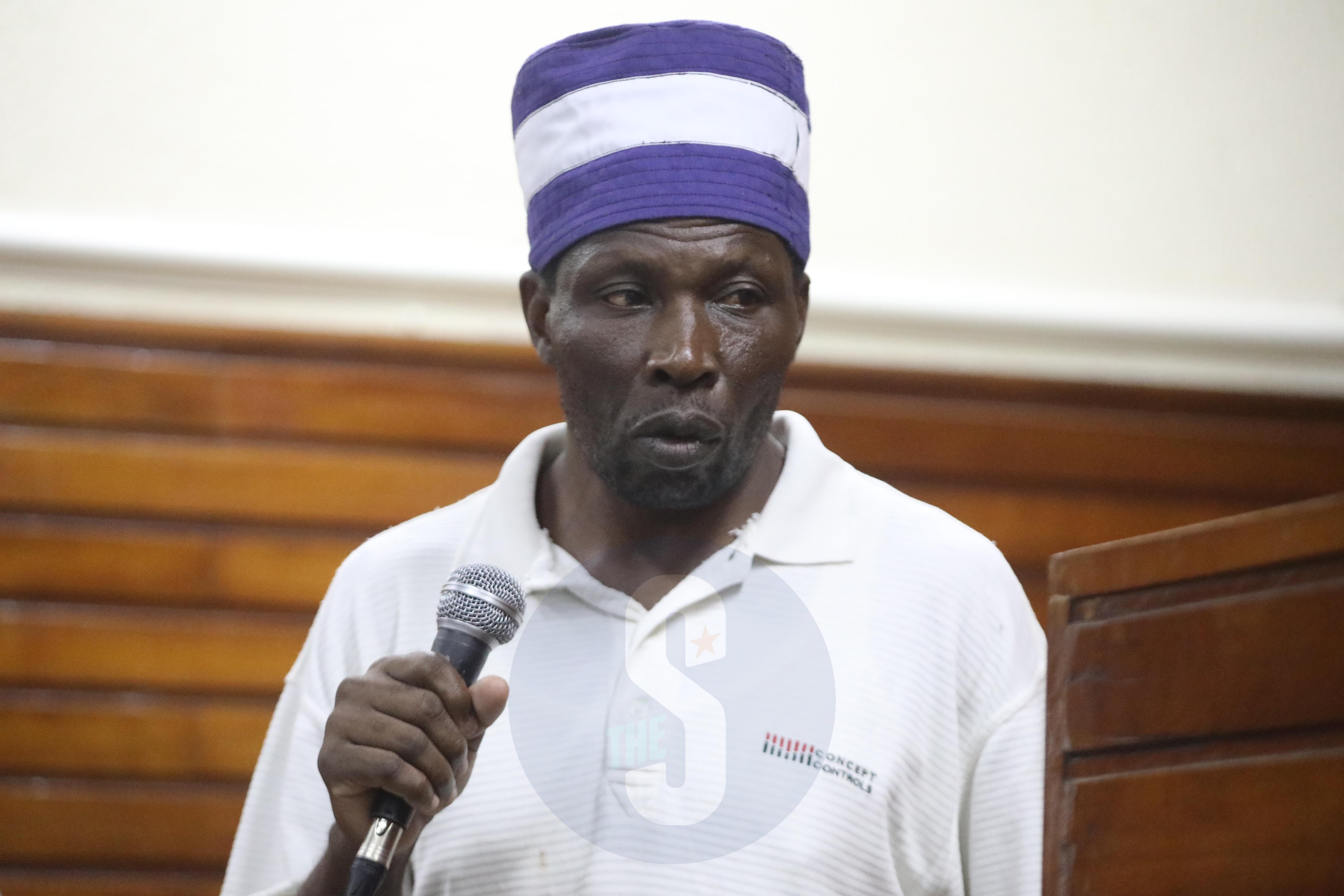
 Self-confessed Shakahola suspect Enos Amanya Ngala, also known as Hallelujah speaks in court on February 24, 2026. CHARLES MGHENYI
Self-confessed Shakahola suspect Enos Amanya Ngala, also known as Hallelujah, on Tuesday laid bare a chilling account of how he sold his land in Nairobi, uprooted his seven children, and followed controversial preacher Paul Mackenzie into the depths of Shakahola forest.
Testifying as a State witness after striking a plea bargain with the Office of the Director of Public Prosecutions (ODPP), Amanya detailed a journey that began with sermons in Nairobi and ended in the now-infamous forest settlement linked to hundreds of deaths.
Under a plea agreement dated February 18, 2026, the prosecution withdrew 195 out of 238 charges initially filed against him and 94 co-accused persons before the Chief Magistrate’s Court.
Amanya pleaded guilty to 43 counts of manslaughter and agreed to testify in related cases, including the Kwa Bi Nnzaro matter connected to Mackenzie.
The deal came barely a month after he admitted to 191 counts of murder before the High Court in Mombasa in yet another Shakahola massacre-related case.
On Tuesday, Amanya told the court he had lived in Nairobi’s Kasarani area, whereas Mackenzie’s church operated in Makongeni before being shut down in late 2019.
Mackenzie’s Good News International Church also ran Times TV and the Times TV Hall in Malindi, said Amanya.
He recalled how Mackenzie preached that a time was coming when Christians would not be allowed to worship freely.
The sermons, he said, railed against formal education, Western culture, healthcare and other religions.
After authorities closed the Makongeni church, the congregation briefly relocated to Shauri Moyo, he told the court.
Sunday services were later cancelled and replaced with home visits and seminars.
They transversed Busia, Luanda and Kakamega, and plans were in place to also travel to Tanzania for seminar, but the Tanzania trip stalled when the Covid-19 pandemic struck and travel restrictions were imposed.
By then, Amanya had begun withdrawing his children from school.
In Kasarani, he was summoned by the chief for failing to keep two of his children in school but said he managed to explain his position.
“I told the area chief that because of Covid 19, I had decided I would not live in an urban area again. I decided to sell my plot and move back home,” he said.
Through Mackenzie’s Nairobi church pastor, George Mwaura, Amanya learned that Mackenzie had land in Malindi.
He contacted his brother, David, and they agreed to purchase property together.
They traveled to Malindi with his wife, seven children, and his brother.
They stayed in Malindi at Mackenzie’s house for a week.
From Malindi, they were taken deep into Shakahola forest.
The journey from the main road to the first village, Galilaya, took about 15 minutes further into the interior.
He described finding only tents pitched in the wilderness.
“We were allowed to put up a tent. George Mwaura was the one allocating land for Nairobi and Western region members,” he said.
Because he had no money at hand, he had plans to go back to Nairobi and sell his land before now coming back to Shakahola.
He stayed in Shakahola for about a month before leaving behind his children and brother to travel back to Nairobi to look for a client to sell his land.
In December 2020, Amanya got a client and sold his Nairobi plot for Sh700,000.
He sent Sh100,000 directly to Mackenzie; Sh70,000 for land, Sh16,000 for 200 recorded sermons on a flash disk, and Sh14,000 for food items, including supplies for Mackenzie’s family.
He also gave Mwaura Sh100,000 to facilitate logistics and purchase food items and building materials.
Amanya said because of travel restriction, Mwaura convinced them to travel by air to Malindi.
I travelled with my wife from Wilson Airport aboard a Jambojet flight that made a stop in Lamu before landing in Malindi.
They stayed in Malindi for about two weeks.
However, disputes soon emerged.
Amanya said he was surprised to learn that Mackenzie had delegated land allocation to Mwaura.
Days turned into weeks without being shown his parcel of land.
He claimed Mwaura later accused Mackenzie of leasing, not owning, land and proposed relocating them (Amanya and his brother) to Chakama instead.
In March 2021, Amanya and his brother were taken to Chakama, where they temporarily occupied a dilapidated structure.
They later cleared an acre in a forested area and built a six-room house, only for the alleged landowner, Samuel Ngala, to confront them and demand answers.
“George Mwaura became very angry. He accused us of being criminals for telling the owner the truth,” Amanya testified.
When he demanded a refund from Mwaura, he was told to reclaim the money from Mackenzie.
Mackenzie allegedly acknowledged that Mwaura may have conned him and referred him to another associate, Alex wa Mashamba, who showed him alternative land in Tironi, a place allegedly owned by Mackenzie.
He said he was surprised that Mackenzie and his assistant Mwaura were giving contradicting information, each accusing one another of fraud.
After being shown an area by Mackenzie in a village, Amanya built again.
However, tensions persisted. Villagers reportedly complained about Amanya and his brother’s loud prayers.
Church leaders were dispatched to warn them.
“I was surprised why Mackenzie was restricting us from praying. He warned us against preaching and loud prayers,” he said.
Internal village structures, Galilaya, Samaria, Judea, had their own leaders, he said, creating an isolated and tightly controlled community.
Over time, the settlement became more restrictive.
Amanya is supposed to continue testifying before Mombasa Chief Magistrate Alex Ithuku.
Last month, Amanya told the High Court that he served as a grave digger and security provider in Shakahola forest.
He admitted witnessing the deaths of some of his own children.
One child survived after leaving the area.
INSTANT ANALYSIS
Amanya’s testimony exposes how religious extremism, economic vulnerability and charismatic authority combined to entrench control within the Shakahola settlement. His decision to liquidate property, withdraw children from school and relocate reflects the depth of ideological influence exerted by church leadership.