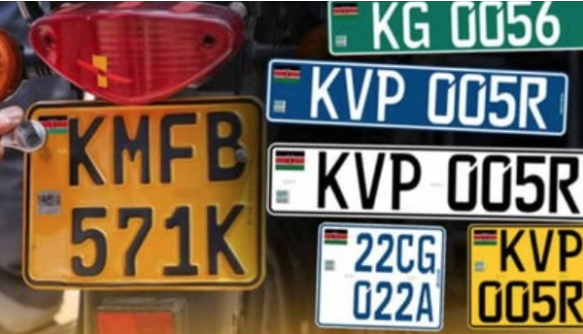
Over the years, car number plates in Kenya have evolved from being simple vehicle identifiers to symbols of status, prestige and even investment value.
Today, motorists not only use registration plates to identify vehicles but also to gauge how new or old a car is.
Buyers often rely on the plate series to estimate a vehicle’s year of registration, with cars bearing the latest series generally commanding higher resale prices because they are perceived as newer.
Under the Traffic Act (Registration Plates) Rules, registration plates must meet strict legal requirements.
The law states that registration plates shall, “except for diplomatic vehicles, bear a national flag with the security hologram at the left hand side and optical recognisable characters.”
It further provides that “a motor vehicle, other than a motor cycle or trailer, shall have a general registration plate on the front elevation and another on the back elevation fixed thereon in a horizontal position at right angles to the longitudinal axis of the vehicle.”
In Kenya, number plates are issued by the National Transport and Safety Authority (NTSA).
Since late 2022, the country transitioned to a new-generation design featuring a white oblong or square plate with black lettering, a Kenyan flag and an embedded security QR code aimed at curbing fraud and enhancing traceability.
Kenyan vehicle registration plates follow a sequential format, typically structured as LLL NNNL — where ‘L’ denotes a letter and ‘N’ denotes a digit. For example, the country has moved from early series such as KAA in the 1980s to more recent sequences like KDD and beyond.
Once the last possible combination in a series is exhausted, NTSA rolls out the next one, ensuring every vehicle registered in the country has a unique and traceable identity.
Motorists in Kenya have the option of applying for different categories of number plates depending on preference and budget.
An ordinary number plate costs Sh3,050 and can be applied for through the eCitizen platform.
A special number plate, which allows a motorist to select a preferred combination of letters or numbers — such as matching suffixes across multiple vehicles — costs Sh30,000.
At the top tier is the personalised number plate, which allows applicants to choose a unique pattern, often reflecting their name or company. This option comes at a premium fee of Sh1 million at the application stage.
Several high-profile Kenyans are known to have personalised plates bearing their names.
If a preferred number has already been taken, the NTSA system automatically indicates that it is unavailable, prompting the applicant to either select another option or wait for the next series.
There are five primary types of number plates issued by the Registrar: civilian, Government of Kenya (GK), parastatal, local authority and diplomatic plates.
The most common civilian plates feature black lettering on a white reflective background.
Diplomatic plates, however, are red with white lettering. Diplomatic numbers are assigned in the order that countries recognised Kenya’s independence. Germany (then West Germany), which was the first country to recognise Kenya’s independence, holds the diplomatic plate 1 CD.
An example of a diplomatic registration number is 5 CD 18 K, where the first digit represents the country code, “CD” denotes a chartered diplomat, the following numbers are allocated by the embassy depending on rank, and “K” indicates that the embassy is located in Kenya.
As per the 2008 sequence, the early diplomatic codes included:1 CD – Germany, 2 CD – Russian Federation, 3 CD – Ethiopia, 4 CD – China, 5 CD – Norway, 6 CD – Hungary, 7 CD – Egypt, 8 CD – Serbia, 9 CD – Italy and 10 CD – France among others.
The Traffic Act also provides detailed specifications for other special categories.
For instance, “a registration plate of a United Nations vehicle shall bear ten optical recognisable characters embossed and printed in white on red aluminium reflective with the first three being numerical numbers depicting the UN mission followed by the prefix ‘UN’ and the three numerical registration numbers followed by the prefix ‘AK’ where ‘A’ can vary after every 999 units with the ‘K’ remaining constant.”
State corporation vehicles carry white characters on a blue reflective sheet.
Trailer plates bear six optical recognisable characters with the prefix “Z” printed in black on yellow reflective material.
Motorcycle plates have seven optical recognisable characters with the prefix “KM” on yellow reflective sheets.
Tractors use the prefix “KTC,” heavy machinery vehicles “KHM,” and three-wheeler motorcycles “KTW,” all embossed on reflective sheets as specified by law.
Dealer plates carry the prefix “KD” printed in white on green reflective sheets, while tow truck plates use the prefix “KT.”
Government of Kenya vehicles bear seven optical recognisable characters with the prefix “GK,” printed in black on a white reflective sheet for the front plate and yellow reflective sheet for the rear plate.
The government is also introducing green number plates, a move that is anchored in Kenya’s National Electric Mobility Policy.
The number plates were officially launched on February 3, 2026. All electric vehicles will now be issued with distinctive green number plates.
The directive takes effect immediately and applies exclusively to electric vehicles, marking a key step in the government’s broader climate action agenda.
Under the new system, electric vehicles will display green plates on both the front and rear, making them easily identifiable as zero-emission vehicles.