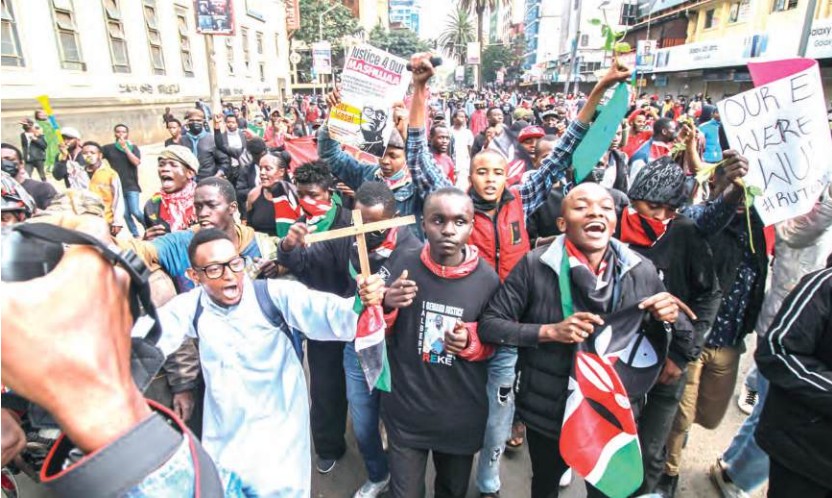
 Youthful protesters march in Nairobi during the one-year anniversary to remember those killed during the June 2024 demos. Multiparty politics has often come with its dangers, argues Alexander Imbenzi in his new book /ENOS TECHE
In Kenya, it’s rare to see former spies come out of the shadows to write books about their professional lives, let alone comment on the general affairs of the country.
Unlike their cousins in the police and Kenya Defence Forces who write and appear in the mass media, retired intelligence officers often retreat into the cold — a world of silence and secrecy — until the day they die.
Therefore, it is refreshing to read a book by none other than a former director of the National Intelligence Service.
Alexander Imbenzi has decided to break with the code and pen an illuminating commentary on the dangers of ethnicity and why democracy could prove to be the answer to dealing with the age-old crisis.
Set for launch this Thursday at the Emara Ole-Sereni Hotel in Nairobi, Managing Ethnicity in a Democracy: The Kenyan Experience traces the evolution of ethnicity from the pre-colonial period to the present.
Imbenzi’s contention is with multiparty politics, which he fervently argues is a double-edged sword for Kenya’s limping democracy.
The end of the Cold War led to strident calls for liberal democracy around the world.
African countries such as Kenya, which were in the firm grip of authoritarian rulers and were in economic distress, were forced to follow the rules dictated by outsiders.
In return for loans and other economic packages, the government had to liberalise the economy by allowing for the creation of more political parties (a terrible mistake, argues Imbenzi), liberties and freedoms.
While acknowledging the positive side of ethnicity as something that “gives people their self-identity, pride of belonging and therefore social security,” he also contends that ethnicity equally poisoned Kenya’s democracy by marginalising certain groups.
Imbenzi insists that tribalism worsened in the 1990s because multiparty politics gave birth to the culture of ethnic hegemony: The overt domination of communities sharing the spoils of power over those that voted for the opposition.
His thesis readily echoes the political tensions between Kanu and Kadu in the run-up to Kenya’s independence, where Kadu (comprising minority communities), led by Ronald Ngala and none other than former president Daniel Moi, forewarned the domination by the ‘big five’ ethnic groups.
But what makes Managing Ethnicity a stunning work of historical analysis is that it provides a detailed outline of Kenya’s ethnic groups: their history, voting patterns (from 1992 to 2022), their choice of leaders over the years and general aspirations that have time and again influenced how they view the democratic processes.
One of the most interesting chapters is where Imbenzi discusses the impact of ethnicity on Kenya’s democratic transition.
Here, he talks about Majimbo (a precursor to devolution), which was often championed by Kadu leaders. Kanu hawks, however, later rejected the system that was meant to prevent the concentration of resources at the centre.
He writes, “Kanu was impatient with the Majimbo system and within the first year of independence, it undermined the regional governments by withholding funds.”
Someone reading that statement would, for once, think it happened last year or even early this year.
In other words, the fight for equitable distribution of national resources, as Imbenzi eloquently puts it, is not a recent phenomenon that started with a return to multiparty politics in the early 1990s.
Instead, the fight has been turned into a political game of numbers.
The consequence of this dangerous manipulation is communities ganging up together to acquire political power so that they can dominate others.
It’s an argument that sounds rather straightforward, but when examined keenly, as Imbenzi does throughout the book, it is full of grave danger, as happened in the post-election violence of 2007 after disputed elections.
The former spy has offered a chilling warning, but who is even listening?
Tomorrow: How ethnic politics slowed down Kenya’s democratic process