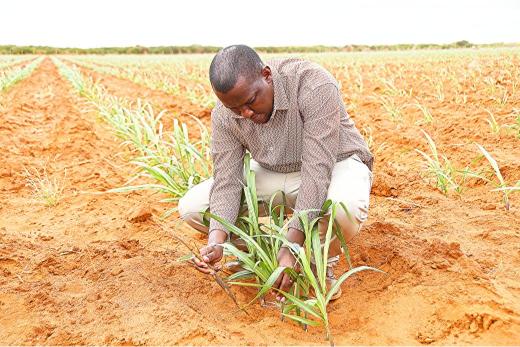
 State Department of Irrigation Principal Secretary Ephantus Kimotho./HANDOUT.
Kenya is mapping new areas for irrigation in arid and semi-arid lands (Asals) as part of a broader plan to strengthen food security.
Irrigation Principal Secretary Ephantus Kimotho said the government is identifying irrigation potential zones to unlock agricultural productivity and support climate-resilient farming systems.
“We are mapping irrigable land across Asal counties to unlock their agricultural potential and support sustainable food production,” Kimotho said during a stakeholders’ meeting on the Farmer-Led Irrigation Development (FLID) Pathway.
The government has prioritised the development of 50 strategic dams, 41 of which include irrigation components.
According to the State Department for Irrigation, the dams have the potential to expand irrigation by more than two million acres nationwide.
Kimotho said the government aims to put over one million acres under irrigation through mega and medium dams supported by the National Infrastructure Fund.
Under the programme, 18 priority multipurpose dams are expected to unlock irrigation for about 1.59 million acres, generate 935 megawatts of hydropower and improve water supply for nearly 1.8 million households.
Flagship projects include High Grand Falls on the Tana River spanning Kitui, Tharaka Nithi, Tana River and Garissa counties; Daua Dam in Mandera county; Thuci Dam in Embu county and Galana Dam in Tana River and Kilifi counties.
Others include Magwagwa Dam in Nyamira and Kisumu counties; Radat Dam in Baringo county; Isiolo/Basilinga Dam in Isiolo and Samburu counties; Soin-Koru Dam in Kericho and Kisumu counties and Thwake Dam serving Makueni and Kitui counties.
The projects are at various stages, from feasibility studies to implementation.
Beyond construction, the programme will focus on mapping irrigable land, strengthening irrigation service delivery, establishing tariff frameworks and improving data management systems.
In northern Kenya, mapping has already identified significant irrigation potential. In Mandera county, about 400,000 acres have been mapped, while Turkana county has nearly 500,000 acres suitable for irrigation through underground water exploration.
In Wajir county, the government is promoting mini-dams and water harvesting to support feedlots and strengthen pastoral livelihoods.
In Tana River county, about 271,000 acres have been opened to private investors for large-scale production of sugarcane, rice and maize.
“So far, 200,000 acres in the Galana-Kulalu irrigation project have been opened up to private investors,” Kimotho said.
The recently launched National Irrigation Sector Investment Plan (NISIP) aims to mobilise 61 per cent of irrigation financing from the private sector, signalling a shift towards blended financing and private sector-driven growth.
Data from the State Department for Irrigation shows that land under irrigation increased from approximately 664,000 acres in 2022 to about 762,000 acres by mid-2025, a 15 per cent growth driven by flagship projects and farmer-led initiatives.
The data further show that during the same period, 50 community irrigation projects were completed and 86 are ongoing.
Some 66 micro-irrigation schemes were completed; 143 community water pans and small dams were completed and 65 are ongoing; and 8,724 household water pans were completed.
In addition, water harvested for irrigation rose from 128.6 million cubic metres in 2022 to over 170.5 million cubic metres by June 2025, significantly improving water availability.
According to the State Department for Irrigation and the Ministry of Agriculture, irrigation expansion is already improving national food production.
Kenya’s paddy rice output has increased from 193,000 tonnes to about 305,000 tonnes, helping to narrow the national deficit.
“With continued rehabilitation and modernisation of irrigation schemes, Kenya has strong potential to progressively eliminate reliance on rice imports,” Kimotho said.
Improved water availability from investments such as Thiba Dam and modernisation of schemes including Mwea, Ahero, Lower Kuja, Bunyala, West Kano and Bura is enabling double cropping and improving farmer incomes.
The Galana-Kulalu Food Security project is expected to produce up to 14 million 90kg bags of maize annually at full commercialisation, helping to bridge Kenya’s maize deficit estimated at about 10 million bags.
Meanwhile, expansion of the Bura Irrigation Scheme is expected to strengthen domestic sugar production, reduce imports and support rice, sunflower and pulses.
“Irrigation is evolving from public infrastructure provision towards commercially viable agricultural ecosystems driven by private investment,” Kimotho said.
Experts say irrigation expansion will be critical in cushioning Kenya against climate shocks while ensuring stable food supplies and rural economic growth.