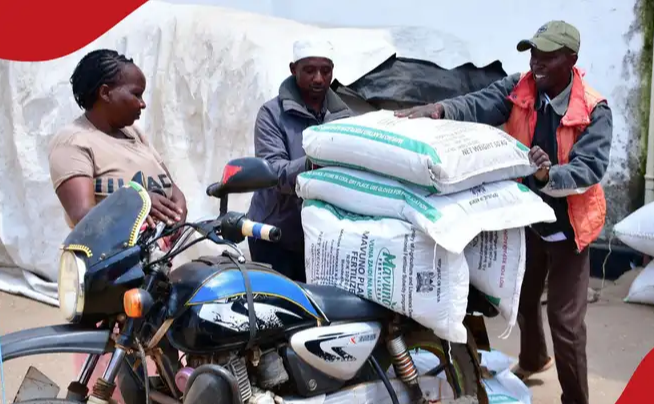
As the long rains approach and farmers prepare their land for planting, the government has stepped up efforts to shield growers from a repeat of the fake fertiliser scandal that rocked the country in 2024.
The planting season, particularly in the North Rift and Western regions where maize planting runs from March to April, has in recent years been overshadowed by painful memories of substandard inputs that left thousands counting losses.
The circulation of fake fertiliser not only eroded farmer confidence but also jeopardised national food security following poor harvests.
This year, the Ministry of Agriculture says it has put in place new measures to curb the illegal trade.
In its Kilimo Weekly Newsletter, the ministry has rolled out clear guidelines to help farmers identify counterfeit fertiliser and avoid falling prey to unscrupulous traders.
“Vigilance is key in the fight against counterfeit fertilizers. Here’s how you can help,” the ministry advised.
The advisory outlines three critical steps farmers should follow before purchasing fertiliser.
Farmers are urged to examine packaging carefully and ensure it bears the official seal of the National Cereals and Produce Board (NCPB).
“Check the Seal: Look for the official NCPB seal on your fertilizer. If it seems off, it’s best to avoid it,” the ministry stated.
Broken or missing seals, tampered packaging, or suspicious labeling should immediately raise red flags. Genuine fertiliser bags are expected to have intact, tamper-proof seals that assure buyers of authenticity.
The ministry has also emphasised the importance of verifying product codes via SMS before use.
“Verify the Code: Use the SMS product code to confirm the authenticity of the fertilizer. A quick text can make a difference!” the advisory reads.
Farmers are encouraged to check the verification code printed on the bag through the official SMS service to confirm whether the product is legitimate. Invalid or unverifiable codes are strong indicators of counterfeit goods.
Equally important, the ministry says, is buying fertiliser only from accredited agro-dealers.
“Buy Certified: Ensure you purchase from accredited dealers. If you’re unsure, don’t hesitate to verify first,” the ministry added.
Unauthorised roadside vendors and unregistered distributors have often been conduits for fake inputs. By sticking to certified dealers, farmers significantly reduce the risk of purchasing substandard products.
In cases of suspicion, the ministry has urged farmers to take immediate action.
“If you suspect counterfeit products, please reach out to the Ministry’s hotline at 0800 724 891,” the statement said.
“Your input is valuable in protecting our farming community and ensuring food security. Together, we can make a positive impact!”
The renewed advisory follows the 2024 fake fertiliser scandal, commonly referred to as “Fertile Deception,” which exposed the distribution of substandard agricultural inputs through the government’s subsidised fertiliser programme.
Thousands of bags, described in some cases as containing sand, stones, or diatomite, were reportedly sold to unsuspecting farmers during a critical planting window.
The Kenya Bureau of Standards (KEBS) later confirmed that fake subsidised fertiliser branded as GPC Plus Organics and packaged in 25kg bags had infiltrated the market.
The confirmation came after an exposé by Africa Uncensored, an independent investigative journalism firm.
KEBS admitted that the counterfeit fertiliser had been sold to farmers through the NCPB at the height of the planting season, triggering public outrage and investigations.
Recent events suggest that the problem has not entirely been eradicated.
Only last week, police in Uasin Gishu County busted a suspected fertiliser syndicate targeting farmers ahead of the planting season.
Acting on a tip-off, a multi-agency team raided Kotut Balers Agro Feeds at Naiberi shopping centre in Ainabkoi Sub-county, arresting seven suspects and recovering hundreds of bags allegedly being repackaged.
At the scene, officers recovered 490 bags of counterfeit DAP, 250 bags of fake NPK, and 10 bags of bogus Urea under repackaging. They also seized 500 empty bags labelled OCP fertiliser, 500 empty DAP branded bags, 500 empty wheat bags, three sewing machines, a weighing scale, a moisture meter machine, 10 kilogrammes of Nova drying agent, and 10.3 kilogrammes of iron oxide.
Police believe the Naiberi incident is only the tip of the iceberg, warning that a wider network could be distributing fake fertiliser across the North Rift and Western regions.
Uasin Gishu Governor Jonathan Bii also warned unscrupulous dealers that the government will take firm action to protect farmers.
He emphasised that the crackdown is part of broader efforts to ensure only quality fertiliser is sold.
“The government will not allow the exploitation of our farmers through the sale of fake fertiliser. This move is to protect the farmers and safeguard the region’s agricultural productivity,” Governor Bii said.
In March 2025, two people were arrested in Molo and Kuresoi North subcounties for repackaging fake fertiliser, with 233 bags seized.
In another case, police in Baringo county found fertiliser bags mixed with gravel, animal waste, and other inappropriate materials, raising alarm among farmers.
These incidents have heightened concerns about the impact of counterfeit fertiliser on crop yields and food security, particularly as farmers in the country’s grain basket prepare for the new planting season, which typically begins in March and April.