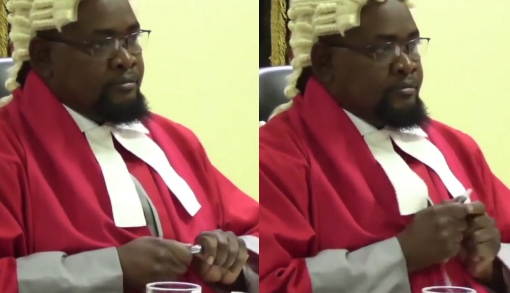
 Justice Kizito Magare breaks pen after handing a death sentence to a man who defiled and murdered a seven-year-old on February 29 /SCREENGRAB
When Nyeri High Court Judge Kizito Magare pronounced the death sentence against Nicholas Macharia on Thursday, cameras captured a moment that quickly drew public attention.
Immediately after delivering the judgment, the judge broke his pen.
To many observers, the gesture appeared dramatic, symbolic and unusual.
Why would a judge break a pen? Is it required by law? What does it mean?
The act is neither theatrical nor accidental.
It is an old judicial tradition rooted in symbolism, history and the solemnity of capital punishment.
Understanding the gesture requires examining its origins, its meaning in modern courts and the broader legal context, particularly in Kenya, where the death penalty still exists in law but is rarely carried out.
The case that led to the ultimate sentence
Macharia, 35, was convicted of the murder of seven-year-old Tamara Blessing Kabura, an offence the court described as premeditated and executed with utter disregard for human life.
Court records showed that on May 24, last year, the Grade 1 pupil went missing from Nyeri Town open-air market, where her mother, Susan Wanjiru, operated a small business.
At about 6pm, the child encountered Macharia, a man known to her family.
Trusting and unsuspecting, she followed him to his house in Witemere.
There, the court heard, he sexually assaulted her, killed her and buried her body beneath his bed in an attempt to conceal the crime.
After a frantic two-day search, CCTV footage from a nearby spare parts shop captured Macharia walking with the child.
He was arrested on May 26 and led detectives to his house, where the body was recovered.
A postmortem conducted at the County Referral Hospital confirmed that the minor had suffered multiple injuries and had died after being assaulted and suffocated.
Macharia later recorded a confession with detectives admitting to the crime.
Evidence and victim impact
While delivering the judgment, Justice Magare said the prosecution had presented overwhelming evidence, including clothing recovered from the scene, CCTV footage, forensic analysis from the Government Chemist, cybercrime reports, photographs, a confession statement and medical assessment reports.
The court also considered the victim impact statement from the child’s mother.
Earlier in the proceedings, Wanjiru rejected an apology from the accused, describing the emotional devastation suffered by her family and the community.
Justice Magare noted that the crime had caused deep trauma beyond the immediate family.
Macharia was charged with murder contrary to Section 203 as read with Section 204 of the Penal Code.
Although he eventually pleaded guilty, the court ruled that the admission did not lessen the gravity of the offence.“Though you pleaded guilty, that plea of guilty does not by itself remove the seriousness of the sentence,” the judge said.
“It is a good thing to save judicial time, but the mere fact that time was saved in the hearing of this matter does not shorten the sentence. It may be useful in smaller cases, but for murder, that does not count.”
During mitigation, defence lawyer Mahugu Mbarire urged the court to consider a lesser sentence, arguing that the accused had no previous capital offence record and was capable of reform.
“He informs me that he is a proper candidate for rehabilitation and in need of counselling,” counsel submitted. “Essentially, the accused is not beyond reform and therefore the death sentence is not merited.”
The court was unmoved.
“In view of the circumstances and having considered the law and the objectives of sentencing, the ultimate penalty remains available and applicable,” Justice Magare ruled.
“Therefore, accordingly, I find that you are hereby sentenced to death,” he pronounced.
The prisons Act provides this was,” when any person is sentenced to death, he shall be hung by the neck until he is dead and the sentence shall be carried out in a manner as the commissioner shall direct.”
A death warrant shall be transmitted to the competent authority for signing and carrying out of the sentence after 30 days stay of execution.
“The sentence must reflect the offence, denounce the conduct in the strongest terms, protect society and serve as a deterrent measure.”
“You are hereby sentenced to death. A death warrant will be transmitted to the competent authority for execution within 30 days,” the judge ordered, while granting the convict 14 days to appeal.
The sentence was delivered in a packed courtroom and was received with relief by the victim’s family.
Twists before conviction
The case took several turns before conclusion.
When Macharia first appeared in court in June last year, he pleaded guilty.
However, the court declined to record the plea immediately, ordering a mental assessment and remanding him for 46 days to ensure he understood the implications of admitting to a capital offence.
In July, he changed his plea to not guilty, prompting preparations for a full trial.
He later reversed his position again in January and entered a fresh guilty plea, paving the way for sentencing.
Macharia had earlier told the court that his actions were driven by the devil, a claim the judge dismissed.
The moment that drew attention
After pronouncing the death sentence, Justice Magare broke his pen, a rare gesture in Kenyan courts.
The act is not required by law. Instead, it is a centuries-old judicial tradition used in some jurisdictions after delivering a death sentence.
Legal historians say the practice dates back to European courts, where judges would snap a quill to symbolise the finality and gravity of the decision.
The broken pen represents several ideas.
It carries several meanings:
1. Finality of the decision
Breaking the pen represents the irreversible nature of the sentence. Just as the pen cannot be used again, the judgment cannot be undone by the trial court.
2. No further writing in the case
The judge symbolically declares that the court’s role is finished. The matter is concluded at that level, except for any appeals.
3. Gravity and solemnity
Capital punishment is the most serious penalty a court can impose. The gesture underscores the weight of the decision and the loss of life involved.
4. Emotional distance from the act
Some interpretations suggest the broken pen represents the judge’s wish never to use that pen for such a sentence again, a symbolic rejection of the act, even while fulfilling a legal duty.
Lawyer Erastus Orina confirmed that the practice is not provided for in Kenyan law, but is borrowed from other jurisdictions around the world.
He termed it a symbolic gesture meant to underscore the gravity and finality of the court’s decision.
“It does not exist in our statutes or criminal procedure. It is purely ceremonial and symbolic, meant to signify that the pen which has written the ultimate sentence should not be used again for such a purpose," Orina said.
He said the act reflects the solemn responsibility borne by a judge when imposing capital punishment.
“It communicates that the court has reached the highest and most severe sanction available under the law. It also symbolises the conclusion of the trial court’s role in that matter,” Orina said.
In some traditions, the gesture also reflects a personal wish never to write such a sentence again.
The practice dates back several centuries and is associated mainly with European judicial traditions.
In medieval and early modern Europe, particularly in Germany, France and parts of Eastern Europe, judges presiding over capital cases would break a quill after pronouncing a death sentence.
The symbolism varied by region but generally conveyed the finality of justice, the moral weight of the decision and the idea that the judge’s authority in the matter had ended.
In some traditions, judges would say words equivalent to: “This sentence is final and cannot be altered.”
From Europe, the custom spread into colonial legal systems, including those that later influenced Commonwealth jurisdictions.
Although modern courts rely on written judgments, digital records and appellate systems, the symbolic act occasionally survives as a reminder of the historical gravity attached to capital punishment.
In Kenya, the practice is uncommon. Most judges simply deliver the sentence and sign the necessary orders.
However, the death penalty remains part of Kenyan law for murder and other capital offences, although executions have not been carried out for decades.
Following the 2017 Supreme Court decision in the Muruatetu case, courts now have discretion when sentencing in murder cases, meaning the death penalty is no longer mandatory.
Even so, judges may still impose it in cases considered exceptionally grave.
Legal analysts say symbolic acts like pen-breaking highlight the extraordinary nature of capital punishment.
“It reflects the moral and legal weight of the decision,” said a Nairobi-based criminal law practitioner. “A death sentence is the most serious order a court can make.”
Despite its symbolism, the broken pen does not end the legal process.
Macharia has the right to appeal, and death sentences in Kenya are frequently reviewed or later commuted to life imprisonment.
Still, the conviction brings closure to a case that deeply affected Nyeri residents and left a family mourning a child who never returned home.
As Justice Magare observed, the sentence was intended not only to punish but also to send a strong warning.