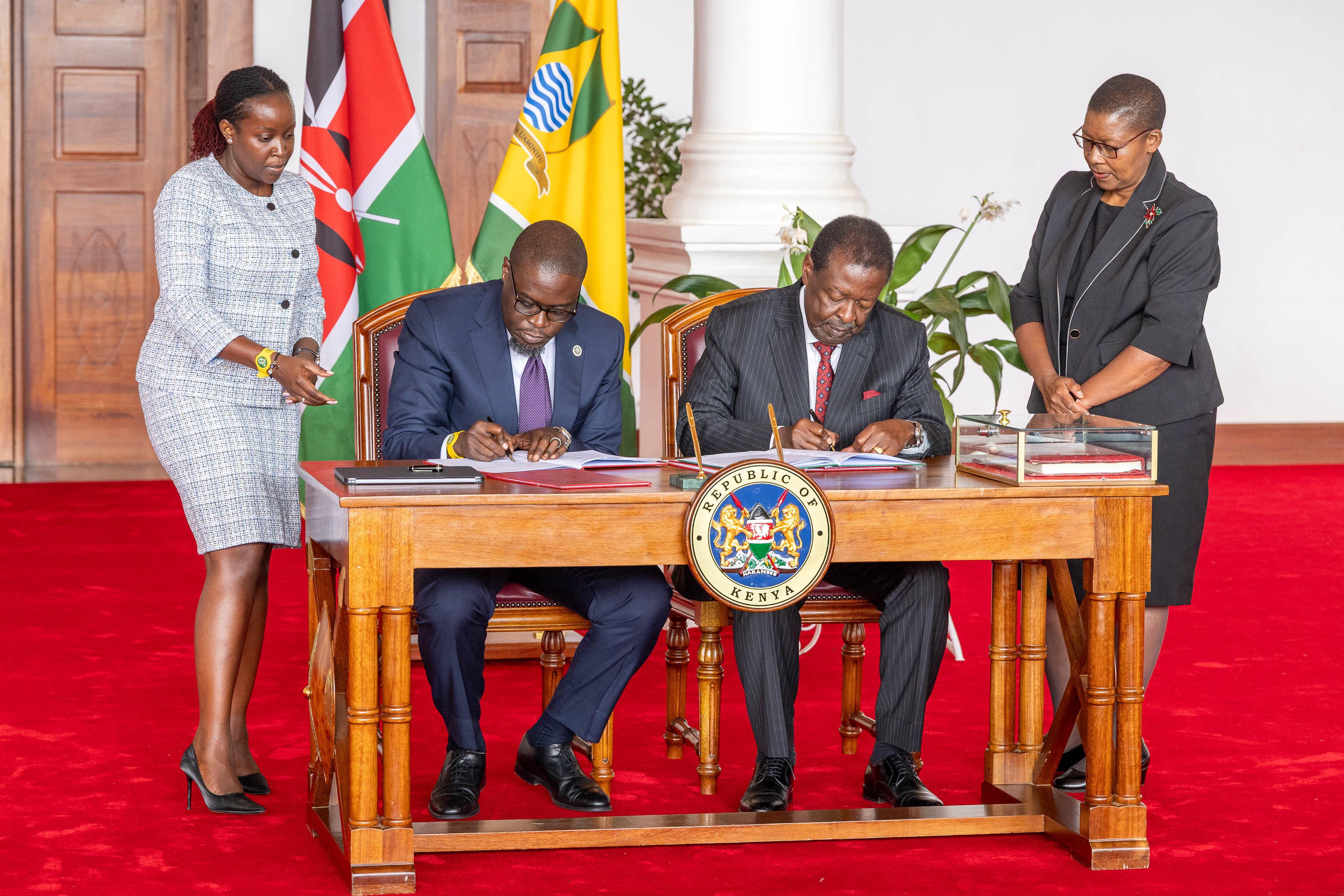
The cooperation agreement between the National Government and Nairobi City County aimed at transforming the capital will have to wait a little bit longer before full implementation, despite being signed.
This is because it must first undergo public participation as required by the Constitution and other laws governing public projects.
President William Ruto and Governor Johnson Sakaja have affirmed that the agreement will be subjected to public consultation to ensure residents have a voice in the planning and execution of the multi-billion urban development programme.
The pact signed Tuesday at State House outlines joint interventions in key sectors including roads, water, sanitation, housing, street lighting and solid waste management.
It provides that both the framework and all projects arising from it must undergo public participation before implementation begins.
The requirement is anchored in the Constitution, which makes public participation a fundamental principle of governance and decision-making.
Clause Six of the agreement explicitly provides for public input, a move seen as a safeguard to address any concerns or gaps that may arise from the deal.
“This Agreement shall be subjected by the Nairobi City County to public participation as per the applicable laws,” the document states.
It further provides that the agreement, together with any amendments arising from public participation, will constitute the final and binding framework between the two levels of government.
“Both parties acknowledge that they have not entered into this agreement in reliance wholly or partly on any statement or representation made by the other except as contained or referred to herein,” the clause adds.
The agreement also makes it mandatory that all projects and programmes undertaken under the framework be subjected to public participation in accordance with the law.
The emphasis on citizen involvement comes against the backdrop of the defunct Nairobi Metropolitan Services (NMS), which critics said was not subjected to adequate public participation.
The Kenya Kwanza administration later transferred the functions back to the county government.
Legal provisions under the Urban Areas and Cities Act and the Intergovernmental Relations Act also require citizen involvement in intergovernmental arrangements and urban development initiatives.
Officials say the consultation process will allow Nairobi residents, businesses, civil society and other stakeholders to review the agreement, raise concerns and propose changes where necessary.
Any proposals arising from the process will be incorporated into the final implementation framework.
“This process ensures that Nairobi’s transformation reflects the needs and priorities of the people who live and work in the city,” a government official involved in the process said.
The agreement establishes a two-tier governance structure comprising a Steering Committee and an Implementation Committee.
Both bodies are expected to align their work with public input.
The Steering Committee, chaired by the Prime Cabinet Secretary with Governor Sakaja as Vice-Chair, will provide policy direction and oversight.
At the operational level, the Implementation Committee, chaired by the Governor, will handle technical and administrative execution of projects across sectors.
However, the agreement has already attracted legal and political scrutiny.
Nairobi Senator Edwin Sifuna has claimed he was not consulted and termed the process unconstitutional.
Sifuna argued the agreement undermines constitutional principles and the role of the Senate in protecting devolved units.
“My office was neither involved nor consulted before this decision was taken. Indeed, the so-called Cooperation Agreement itself acknowledges that no public participation was conducted prior to the signing yesterday, a violation of the Constitution too egregious to ignore,” Sifuna said.
Sifuna claimed the agreement was rushed, noting that it is set to take effect within 14 days, while public participation is scheduled only after the signing.
“It is not only disrespectful to the people of Nairobi but the clearest indication that it is anything but what we are being told it is. One wonders whether any meaningful public participation can be had in such a short period,” he said.
A petition has also been filed in court challenging the agreement.
Petitioners Bernard Peter and Christine Gathoni argue that the arrangement may already be in force, raising concerns that public funds could be committed without approval from the Nairobi County Assembly or oversight by the Senate.
In a ruling delivered Wednesday, Justice Bahati Mwamuye certified the case as urgent, noting that it challenges the legality of the February 17, 2026 agreement.
The court directed that the matter be heard and determined on a priority basis.
The petitioners warn that continued implementation could alter the constitutional allocation of functions between the national and county governments before the court determines its legality, raising broader concerns about the protection of devolution.
President Ruto has maintained that public engagement is central to the initiative.
“By engaging residents, we are ensuring that Nairobi’s transformation is not imposed but co-created with the people,” he said.
The consultation process is expected to take place through public forums, stakeholder meetings and other legally recognised channels organised by the Nairobi City County Government.
Once completed, the agreement, together with any changes arising from public participation, will form the final framework guiding implementation.
With public participation at its core, the government says the process will enhance transparency, build public trust and ensure Nairobi’s transformation reflects the priorities and expectations of its residents.