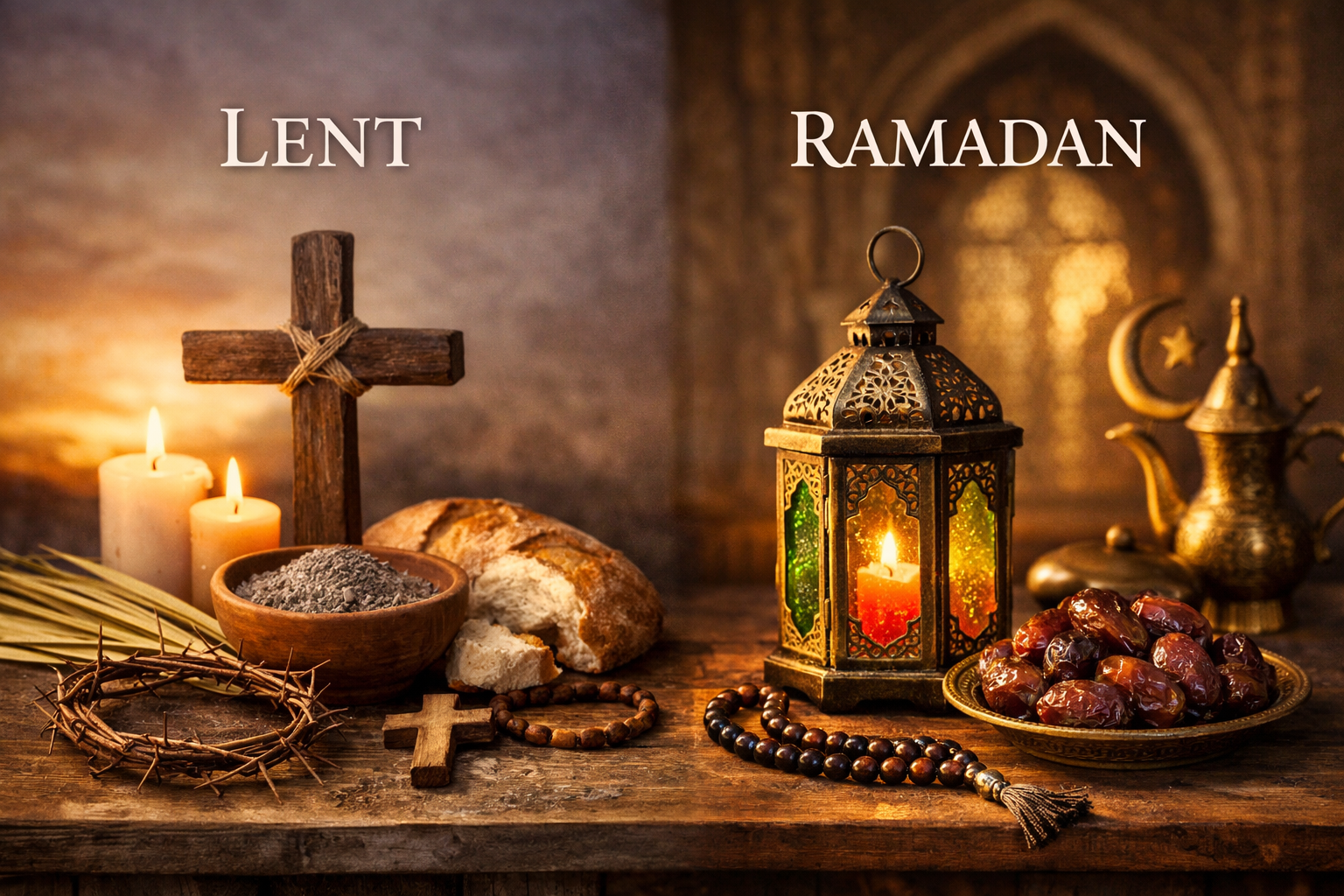
In a rare alignment this year, two of the world’s most significant religious fasting periods — the Christian season of Lent and the Muslim holy month of Ramadan—begin on the same day.
For millions of believers, the coincidence has sparked curiosity about how two major faith traditions, guided by entirely different calendars, end up marking the start of their sacred seasons at the same time.
The answer lies not in coincidence alone, but in the complex ways religious calendars track time and how those systems shift each year.
The main reason Lent and Ramadan sometimes overlap is that Christianity and Islam follow different calendar systems.
Most Christian churches determine their religious seasons using the Gregorian calendar, the solar calendar used in everyday life.
However, the date of Easter, and therefore Lent, is not fixed but instead calculated based on a combination of solar and lunar cycles.
Easter falls on the first Sunday after the first full moon following the spring equinox (March 21).
Once Easter is set, Lent begins 46 days earlier, starting on Ash Wednesday.
Although the Lenten fast traditionally lasts 40 days, Sundays are not counted, bringing the total period from Ash Wednesday to Easter to 46 calendar days.
Islam, on the other hand, follows the Hijri calendar, which is purely lunar.
The Islamic year has 12 lunar months, each beginning with the sighting of the new moon.
Because a lunar year is about 354 days — roughly 11 days shorter than the solar year — Islamic months shift earlier each year in the Gregorian calendar.
Ramadan begins with the sighting of the crescent moon that marks the start of the ninth month of the Islamic calendar.
The month lasts 29 or 30 days, depending on the lunar cycle.
Because one calendar is solar-based and the other strictly lunar, the timing of Ramadan moves backwards by about 10 to 11 days each year relative to the Gregorian calendar.
Over a cycle of about 33 years, Ramadan passes through all seasons, from the heat of summer to the cool months.
The overlap of Lent and Ramadan occurs when the moving Islamic lunar calendar happens to coincide with the period leading up to Easter.
Since Lent shifts slightly each year depending on the lunar calculation for Easter, and Ramadan shifts more significantly each year due to the shorter Islamic calendar, the two periods occasionally line up.
Such overlaps are not common but are not unprecedented either.
Because Ramadan cycles through the entire solar year every three decades or so, there will be periods when it falls close to the late February–April days when Lent typically occurs.
Religious scholars describe the overlap as a natural outcome of calendar cycles rather than a rare astronomical event.
What fasting means in each tradition
Despite the calendar differences, Lent and Ramadan share a common spiritual theme: fasting, reflection and renewal.
During Lent, many Christians practise fasting, prayer and acts of charity as a way of preparing for Easter, which commemorates the resurrection of Jesus Christ.
Religious leaders have urged Christians and Muslims to use the season of Lent and the month of Ramadan to foster peace and unity among Kenyans across regions and the nation.
“While remaining faithful to our distinct traditions, these sacred seasons remind us that spiritual renewal must be reflected in how we treat one another and care for our nation, beginning with the daily choices we make,” Coast religious leaders from both faiths said in a joint statement Tuesday.
Fasting practices vary by denomination and individual choice.
Some believers abstain from certain foods, such as meat, while others give up personal comforts or habits.
The season lasts from Ash Wednesday to Holy Saturday, ending with Easter Sunday, the most important celebration in the Christian calendar.
For Muslims, Ramadan is a month of strict daily fasting from dawn to sunset.
During daylight hours, adult Muslims abstain from food, drink, smoking and marital relations.
The fast is broken each evening with a meal known as iftar, and many observe additional night prayers called Taraweeh.
Ramadan is also a time for increased charity, community gatherings and spiritual discipline, culminating in the celebration of Eid al-Fitr.
Muslims believe Ramadan is the month when the first verses of the Quran were revealed to the Prophet Muhammad more than 1,400 years ago.
Ramadan Mubarak and Ramadan Kareem are the most common greetings exchanged during this period, wishing the recipient a blessed or generous month, respectively.
What comes after
Both fasting seasons end with major religious celebrations.
For Christians, Lent concludes with Holy Week, which includes Good Friday, marking the crucifixion of Jesus, and culminates in Easter Sunday, celebrating his resurrection.
Easter is widely associated with themes of hope, renewal and new life.
For Muslims, the end of Ramadan is marked by Eid al-Fitr, a festive day that begins with special prayers and is celebrated with family gatherings, charity to the needy (Zakat al-Fitr) and communal meals.
The festival marks the successful completion of a month of fasting and spiritual growth.
How long each period lasts
Lent: 46 calendar days (40 fasting days excluding Sundays)
Ramadan: 29 or 30 days, depending on moon sighting
While Lent spans a longer period, Ramadan involves more intensive daily fasting, making the experiences distinct even when the timelines overlap.
A shared moment of reflection
For interfaith observers, the simultaneous start of Lent and Ramadan offers a unique moment of shared spiritual focus.
In many communities around the world, including in Kenya, faith leaders see the overlap as an opportunity to promote understanding and dialogue.
Both seasons emphasise self-discipline, compassion for the less fortunate, prayer and generosity — values that resonate across religious traditions.
Religious scholars note that such alignments can serve as reminders of the shared human search for meaning, even within different faith frameworks.
While the overlap may feel special, experts say it is simply the predictable result of calendar mathematics.
As Ramadan continues its steady shift earlier each year, there will be periods when it aligns with Lent, and others when the two fall far apart.
Still, for believers observing both seasons at the same time this year, the convergence offers a powerful symbol: two global faith communities entering periods of sacrifice, reflection and renewal together.
Whether seen as a coincidence or calendar science, the alignment underscores a universal rhythm — one that calls millions of people across traditions to pause, reflect and recommit to their spiritual lives.