Nairobi may have missed an opportunity to expand its infrastructure and services due to its failure to exploit the legal provisions for cooperation with the National Government.
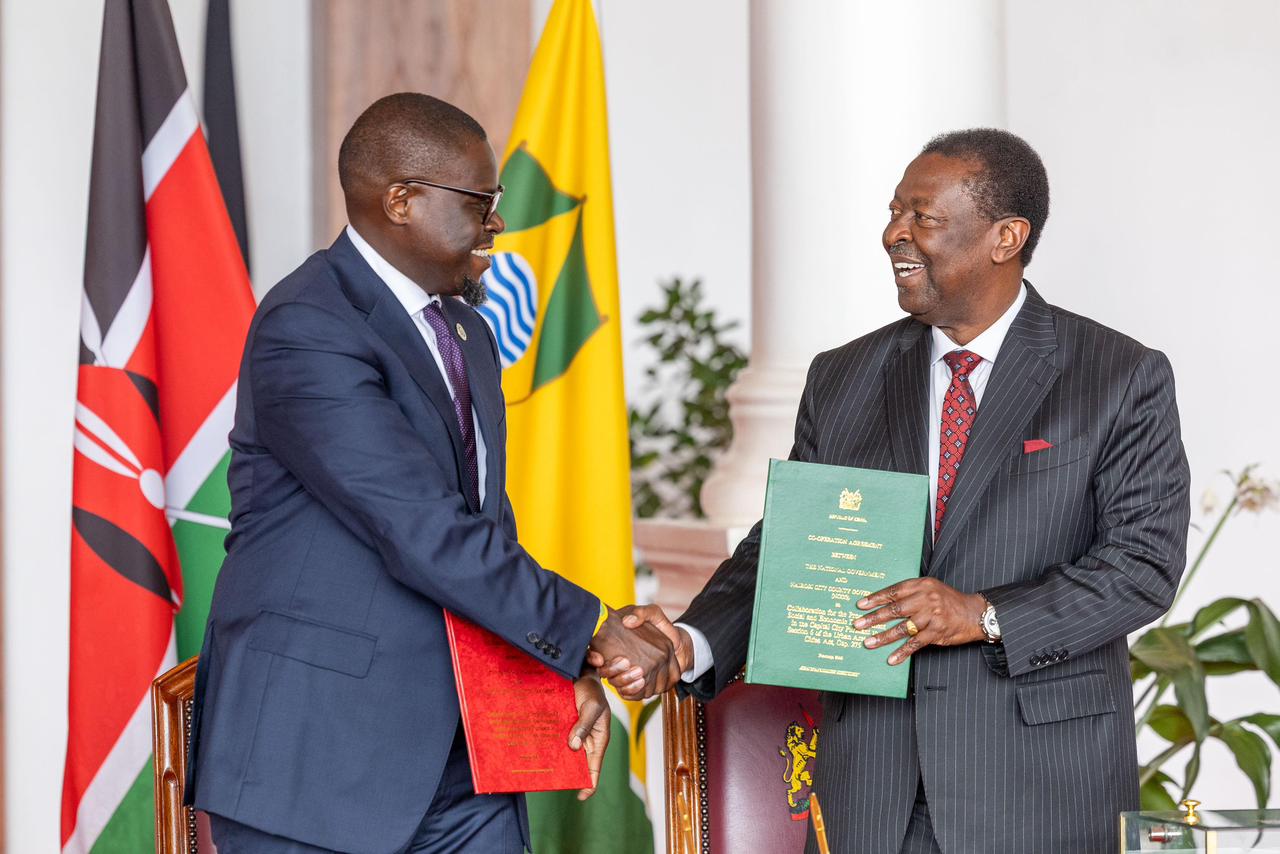
President William Ruto and Nairobi City Governor Johnson Sakaja on Tuesday said it was regrettable that although there is a legal framework to support the pact, the route was not pursued for 14 years now.
While unveiling the Sh80 billion deal, the two leaders acknowledged that resources provided to Nairobi through the revenue sharing formula and own source were insufficient to develop the city and thus required the national government to complement the budget.
Article 189(2) of the Constitution requires the two levels of government to cooperate, assist, and consult each other, while the Intergovernmental Relations Act provides mechanisms for formal coordination agreements.
The Urban Areas and Cities Act 2012 recognise the special status of the capital city of Nairobi and provides the framework for joint cooperation.
Under Section 6 of the Urban Areas and Cities Act, the National and County Governments are permitted to enter cooperation agreements for the management and development of urban areas.
“Indeed, since the enactment of the Urban Areas and Cities Act of 2012, this cooperation agreement is fourteen years late. It should have been in place with the advent of devolution,” Ruto said at State House, Nairobi.
Sakaja added, “In the 13 years of devolution, Nairobi City County has not had an opportunity to leverage and benefit from its unique position as a capital city… This agreement is 13 years overdue.”
And to address constitutional and legal requirements for public participation and oversight by the County Assembly, the President said the deal of cooperation will be tabled before the City MCAs for discussion and endorsement.
There has been speculation that the County was surrendering some of its functions to the National Government, but both Sakaja and Ruto reiterated that the pact is different from the defunct Nairobi Metropolitan Services (NMS).
Prime Cabinet Secretary Musalia Mudavadi, while hailing the pact, said there will be a lot of opposition in its implementation, but hailed the move as the right direction.
A two-tier governance structure for implementing the agreement was unveiled; a steering committee chaired by Mudavadi, with Sakaja as deputy, to set policy direction and an implementation committee led by the governor to oversee project execution.
“There’ll be mudslingers all over the corners, but at the end of the day, without this initiative, we are in trouble. “There’ll be mudslingers all over the corners, but at the end of the day, without this initiative, we are in trouble,” he said.
Nairobi, unlike other counties, has a special status as the country’s capital, thus requiring both levels of government to collaborate in its infrastructural and service delivery to both residents and visitors.
“Nairobi is not merely another devolved unit; it is our capital, the seat of the Republic, and the nerve centre of national administration,” Ruto said, adding, “It is home to two United Nations agencies. Nairobi is the only UN headquarters presence in the Global South, and it stands as a commercial, financial, and innovation hub of our region.”
On his side, Mudavadi warned that Nairobi is facing intense competition as a hub from other African capitals, such as Addis Ababa, Kampala, Luanda, and Lusaka, that have seen infrastructural transformation.
The PCS said leaders must act decisively to retain the city’s status as East Africa’s commercial and diplomatic hub.
“We must break away from the comfort zone. And if we have to retain the hub status that we have always held, then the leadership that we are seeing today is absolutely important,” he said.