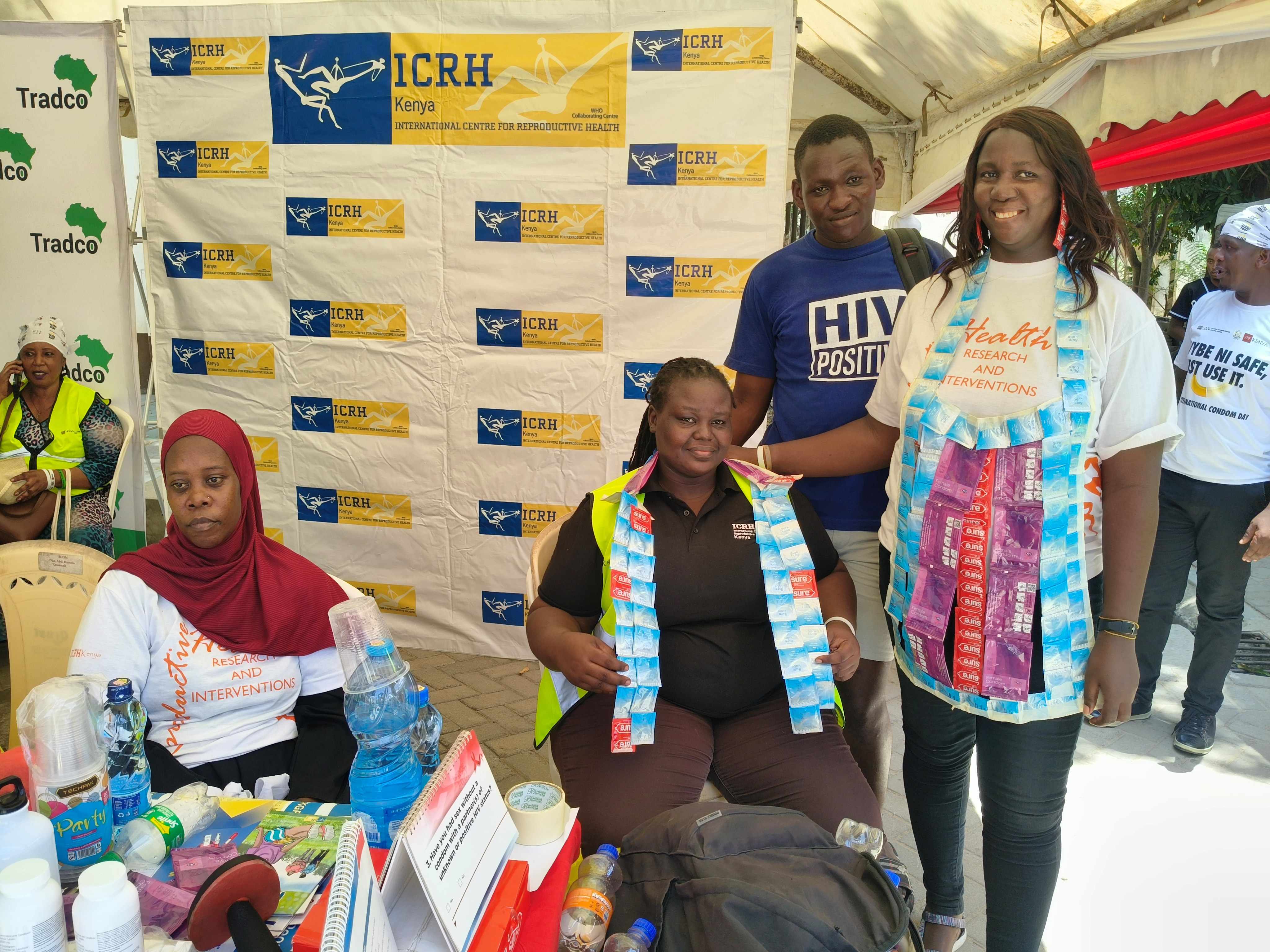
 Condom advocates Julia Awuor [2nd L] and
Cynthia Dayo [R] at TUM on Friday /BRIAN OTIENO
Condom advocates Julia Awuor [2nd L] and
Cynthia Dayo [R] at TUM on Friday /BRIAN OTIENO Brian Barasa [R] going through the paces of condom
use at Tum on Friday /BRIAN OTIENO
Brian Barasa [R] going through the paces of condom
use at Tum on Friday /BRIAN OTIENO
For HK, a student at the Technical University of Mombasa, two months ago brought the kind of news that no young man wants to hear.
“She called and said she had missed her periods. I just froze. My world broke,” he recalls.
“I could handle STDs—they can be treated—but a pregnancy? That’s life-changing.”
HK is not alone.
PA, also a TUM student, says when his girlfriend once told him she had “bad news”, his first thought was pregnancy.
“I know her cycle, so that fear hit immediately. STIs didn’t even worry me; I had dealt with that before,” he explains.
CW, a female student, says, “I’ve never really worried about STIs. What scares me is pregnancy. Some boys aren’t responsible. They may even leave you if you get pregnant.”
Health experts say this anxiety is common among Kenyan youth.
National Syndemic Diseases Control Council (NSDCC) director of health promotionStephen Ndolo says most young people fear pregnancy more than infections.
The problem is made worse by a critical shortage of condoms.
In 2024, 74 per cent of new HIV infections occurred among Kenyans aged 15–34, according to NSDCC chairman Ibrahim Abass.
Ndolo adds in Mombasa alone, one-third of new infections were among youth aged 15–24—mostly students.
“The limited availability of condoms contributes to rising rates of STIs, including gonorrhoea, syphilis and chlamydia,” he says.
Hamza Bulhan of the Aids Healthcare Foundation warns that the shortage is a real risk.
“We need 400 million condoms [annually] to cover the sexually active population. We currently have only 150 million. That gap leaves too many young people exposed,” he says.
Joan Muema, a TUM student leader, says it’s felt most in schools and colleges.
“Condoms used to be available on campus. Now, they are gone. Young people are sexually active—telling them to abstain isn’t realistic,” she says.
University leaders are also weighing in. TUM vice chancellor Leila Abubakar encouraged students to make informed choices.
“The best protection is abstinence, but if you are sexually active, at least use a condom. Your decisions today affect your health and future,” she said.
Mombasa deputy county commissioner Robinson Gakuru said, “Young people must have accurate information and access to services to protect themselves and realise their potential.”
For students like HK, PA and CW, these are more than statistics. It’s real life, real fear, and real decisions—the kind that can shape their futures in an instant.
Recent studies and health reports in Kenya indicate the fear of pregnancy often outweighs the fear of contracting HIV and other STDs, especially among adolescents and young women in informal settlements. This is driven by the social stigma, shame, and immediate life-altering consequences associated with teenage pregnancy, such as school dropout and abandonment.