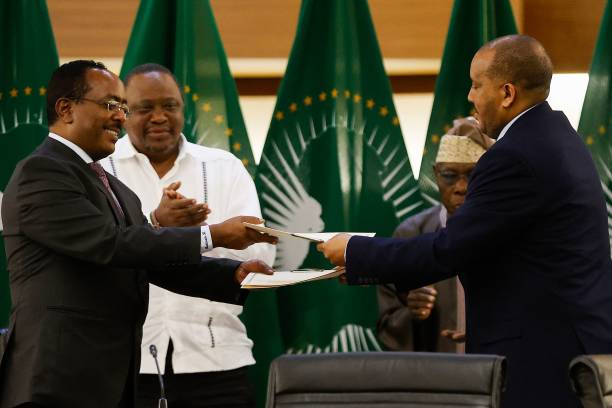
The Pretoria Agreement Implementation Report headlined Three Years into the Pretoria Agreement: Where does it stand? warns that Ethiopia is only enjoying fragile calm sustained by the absence of open warfare rather than the presence of durable political settlement.
The report by the Pan African Agenda evaluates the situation in Ethiopia three years after the signing of the Pretoria Agreement, effecting the Cessation of Hostilities Agreement between the Ethiopia government and the Tigray People’s Liberation Front.
The November 2022 accord halted one of Africa’s deadliest conflicts in recent history, and allowed humanitarian access to gradually resume as well as basic services such as banking and telecommunications in of Tigray.
However, according to an assessment by the Pan African Agenda, the systematic failure to fully implement core provisions of the deal has left deep fault lines unresolved.
This raises concerns that the Horn of Africa could once again slide into instability, especially at a time tensions between Ethiopia and Eritrea are increasing.
Tensions between the two states have escalated dramatically this year, shifting from the 2018 alliance to a severe risk of renewed conflict.
Addis Ababa has demanded the immediate withdrawal of Eritrean forces from occupied border areas, accusing Asmara of aggression and supporting rebel groups.
Among the contentious issues include territorial disputes, fallout from the 2020-22 Tigray war, and Ethiopia's desire for Red Sea access.
The Pretoria Agreement required disarmament of Tigrayan forces, restoration of constitutional order and resolution of contested territories, particularly Western Tigray.
The report, however, notes that while significant progress has been made on the cessation of hostilities and partial disarmament, other politically sensitive elements have stalled.
“The evidence reveals a stark dichotomy: the Agreement delivered negative peace (cessation of hostilities) while positive peace (restoration of constitutional order, justice, reconstruction, and sustainable reconciliation) remains elusive,” the report says.
In this situation, respondents described the resulting peace as “fundamentally fragile, conditional, and vulnerable to collapse”.
“The majority of participants characterized the current situation as negative peace – a condition where active fighting has ceased while the root causes of conflict remain unresolved,” it says.
Participants repeatedly warned that unresolved territorial disputes, widespread insecurity stemming from a governance vacuum, persistent lawlessness, and the proliferation of organized crime continued to threaten the sustainability of peace.
Notably, insecurity in border zones was frequently cited as evidence of deteriorating conditions.
“The ceasefire is maintained not through the resolution of underlying grievances but because of exhaustion and international pressure – conditions that could rapidly deteriorate if circumstances were to change,” the study finds.
Western Tigray remains under the control of Amhara regional forces, despite calls for constitutional resolution of the territorial dispute. The continued displacement of tens of thousands of Tigrayans from the area has become one of the most combustible unresolved issues in the peace framework.
Within Tigray itself, divisions have deepened. The interim administration established after the war has faced internal political contestation, weakening unified leadership at a time when coordinated recovery is essential.
Reconstruction has lagged, youth unemployment remains high, and many war-affected communities continue to depend on humanitarian assistance. While international partners initially rallied behind the peace deal, funding gaps and shifting global priorities have slowed recovery momentum.
The fragility of the Tigray peace process is unfolding against a wider backdrop of instability in Ethiopia.
Armed confrontations in the Amhara region have intensified over the past year, while tensions in Oromia persist.
This broader security environment complicates full implementation of the Pretoria commitments. Analysts argue that without a stable national political consensus, localized peace arrangements remain vulnerable.
The deterioration in Ethiopia–Eritrea relations has also alarmed regional observers and international non-state actors calling for renewed interest in the situation.
Reports indicate Ethiopia’s National Defence Forces are deploying reinforcements to the Tigray region as tension escalates.
Ahead of the 39th meeting of heads of state and governments in Addis Ababa, Human Rights Watch said Ethiopia’s human rights situation was worsening, amidst the unravelling of the fragile peace in the country’s Tigray region.
“Tigray’s population is still reeling from the 2020-2022 armed conflict and a man-made humanitarian disaster.
“The United Nations secretary-general, AU leaders, and international partners attending the summit should speak out about the threats to the population unfolding in the host country,” HRW said in a statement on Friday.
Asmara was not a direct signatory to the Pretoria Agreement, a structural gap that analysts say has complicated its implementation.
If relations between the two capitals further deteriorate, Tigray’s fragile stability could become collateral damage.