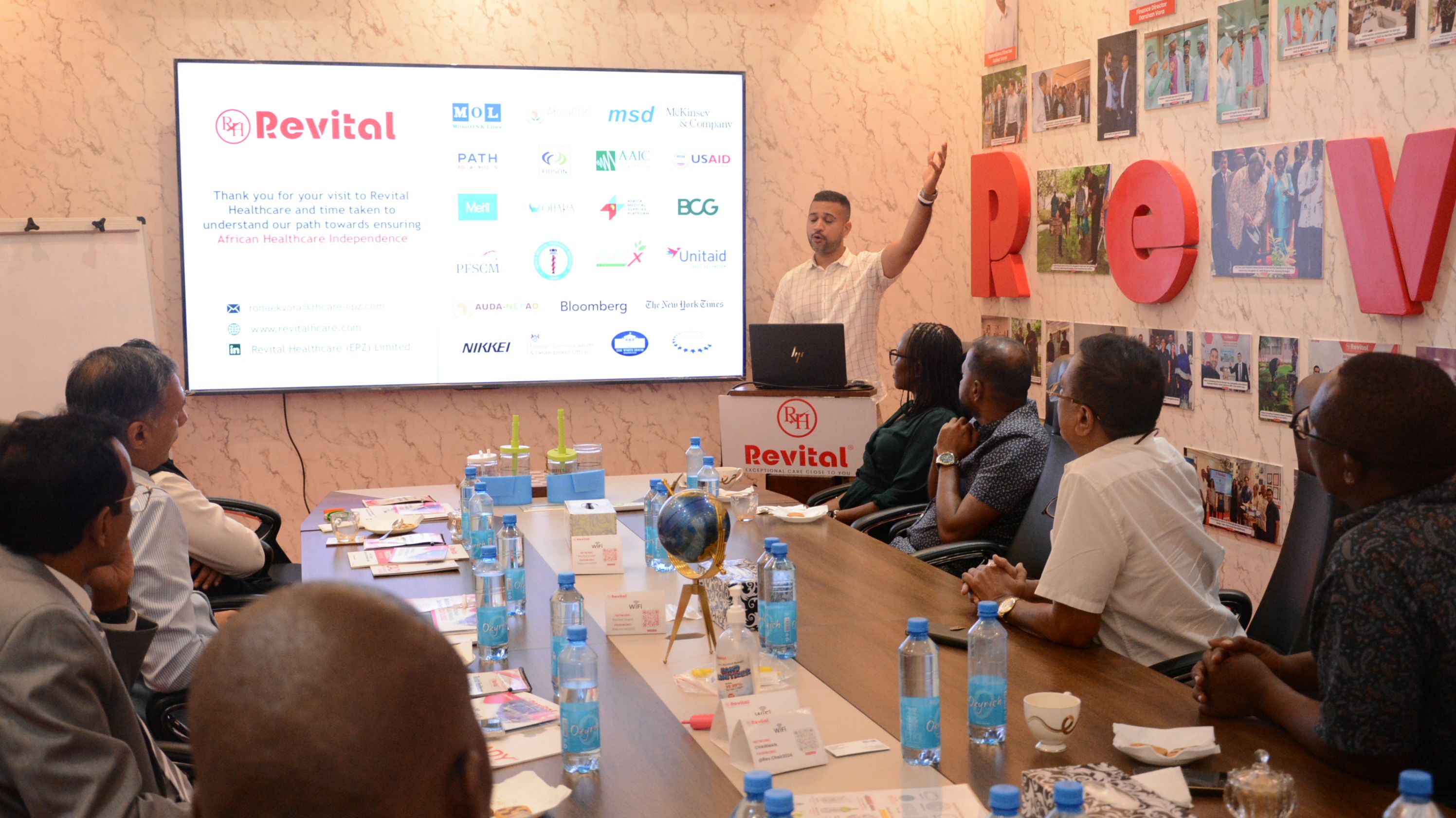
Revital Healthcare EPZ director of sales Roneek Vora makes a presentation at their facility in Kilifi on Thursday / BRIAN OTIENO
Read Also
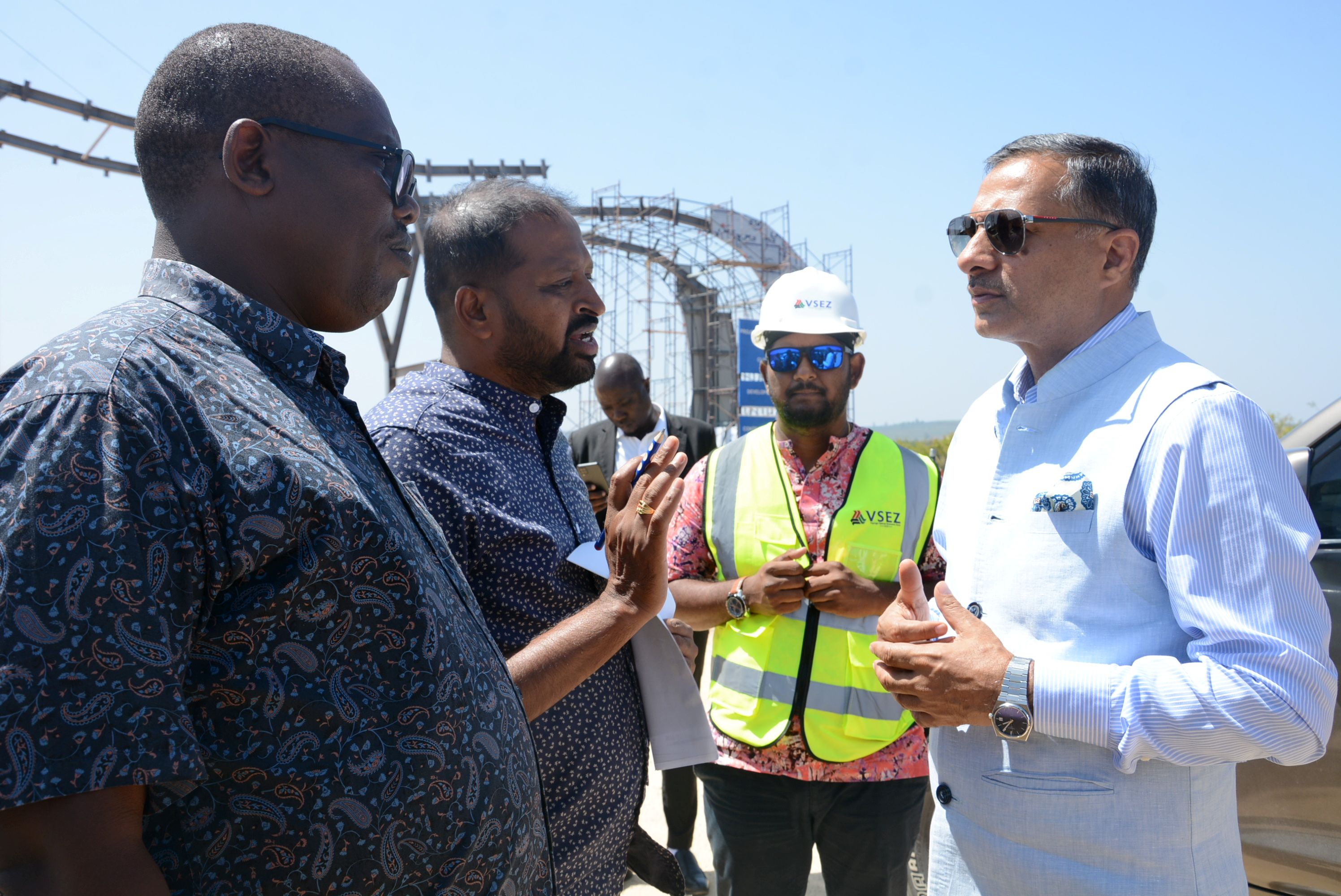
SEZA CEO Kenneth Chelule [L] and Indian High Commissioner to Kenya Adarsh Swaika at Vipingo Special Economic Zone in Kilifi county on Thursday / BRIAN OTIENO
Revital Healthcare EPZ, Africa’s largest medical device manufacturer, is seeking collaboration with Indian manufacturers to expand production in Kenya.
The Kilifi-based company is eyeing an additional 20 acres at the Dongo Kundu Special Economic Zone in Mombasa to set up an expanded facility.
Revital has a production capacity of two billion devices and manufactures more than 45 medical products. These are exported to 45 countries worldwide, including India.
Director of Sales Roneek Vora said while Kenya is known for producing tea, coffee and avocados, it is now also recognised for manufacturing high-quality medical devices, placing the country firmly on the global map.
“India is a fortress when it comes to medical products, including vaccines, pharmaceuticals and other life-saving equipment.
“We want to explore how we can collaborate so that we manufacture their value-added products in Kenya,” Vora said.
He spoke at the Kilifi facility during a visit by Adarsh Swaika, the Indian High Commissioner to Kenya.
“If we, from Kilifi, can export devices to India, Pakistan, Sri Lanka, Nepal and Uzbekistan, as well as Europe and Brazil, we can also join hands with Indian companies to manufacture other devices,” Vora said.
Swaika expressed pride that a Kenyan company founded by Kenyans of Indian descent is excelling in manufacturing.
“Prime Minister Narendra Modi said ‘Make in India, Make for the World’. These are not mere words. This plant demonstrates that vision,” he said.
He noted that 80 to 90 per cent of the machinery at Revital Healthcare EPZ is made in India.
“This is a win-win partnership between India and Kenya, with machinery made in India and employment generated in Kenya,” he said.
He praised the capital investment by a Kenyan of Indian origin and the use of state-of-the-art equipment with minimal human interference to produce high-quality devices for export, including to India.
Swaika said Revital Healthcare EPZ is in the process of partnering with Indian companies for future ventures.
According to Vora, the company also supplies devices to seven governments in East and Central Africa. In total, it serves more than 500 million people across East, Central and Southern Africa.
“That is why we are seeing many companies from India, China and Europe coming to Africa to set up factories. There is demand and there is capacity,” Vora said.
Special Economic Zone Authority CEO Kenneth Chelule said the government is pleased to see a home-grown company thrive as an EPZ.
“Soon they will expand into the SEZ with a bigger facility. Here they occupy five acres, but in Dongo Kundu they will expand to 20 acres.
“That will provide a platform to reach more global markets through their partnership with MOL, a Japanese company,” Chelule said, describing it as good news for the country.
“This is an example that other Kenyans should emulate,” he added.
Kilifi Governor Gideon Mung’aro said the county welcomes partnerships that deliver value, skills and opportunities for local people.
“Our discussions focus on practical cooperation in skills development, investment, cultural exchange and strengthening education and healthcare partnerships,” he said.
“We also explored ways to unlock opportunities in tourism, agriculture and special economic zones to create jobs and grow our local economy,” he added.
At the Dongo Kundu SEZ, Swaika also visited an LPG storage facility set up by Taifa Gas, another Indian developer. He said the facility will boost Kenya’s LPG supply.
More than 200 Indian companies operate in Kenya across sectors such as telecommunications, banking and automobiles.
“Indian companies view Kenya’s investment climate positively, particularly with the upcoming SEZs and EPZs. Dongo Kundu is one of the prime SEZs that the Government of Kenya is focusing on,” Swaika said.
He noted that the SEZ’s proximity to the Port of Mombasa makes it even more attractive. He added that Indian firms are interested in textiles, pharmaceuticals and other industries.
“We will seek ways to increase Indian investment in Kenya. We are already among the top investors in this country, with which we share deep-rooted historical ties,” he said.
Chelule said the Coast region is one of Kenya’s prime investment destinations. The authority plans to intensify awareness campaigns among Indian investors to attract more investment to Dongo Kundu and the wider Coast region under the SEZ programme.
“You will see more Indian companies here. We plan a major campaign through the Kenya National Chamber of Commerce and Industry,” he said.
The Dongo Kundu SEZ covers 3,000 acres. Of this, 500 acres have been allocated to Arise, an Indian company that will develop infrastructure, including warehouses and related amenities.
Taifa Gas has taken three acres, Revital Healthcare around 20 acres and Milly Glass 15 acres. All are Indian companies.
More than 100 companies have expressed interest in the SEZ. However, vetting and mobilisation take time.
“So far, four companies have been vetted and approved to begin construction,” Chelule said.
He added that by the end of the year, one or two more companies could be approved, subject to due diligence.
“We want quality investment,” he said.