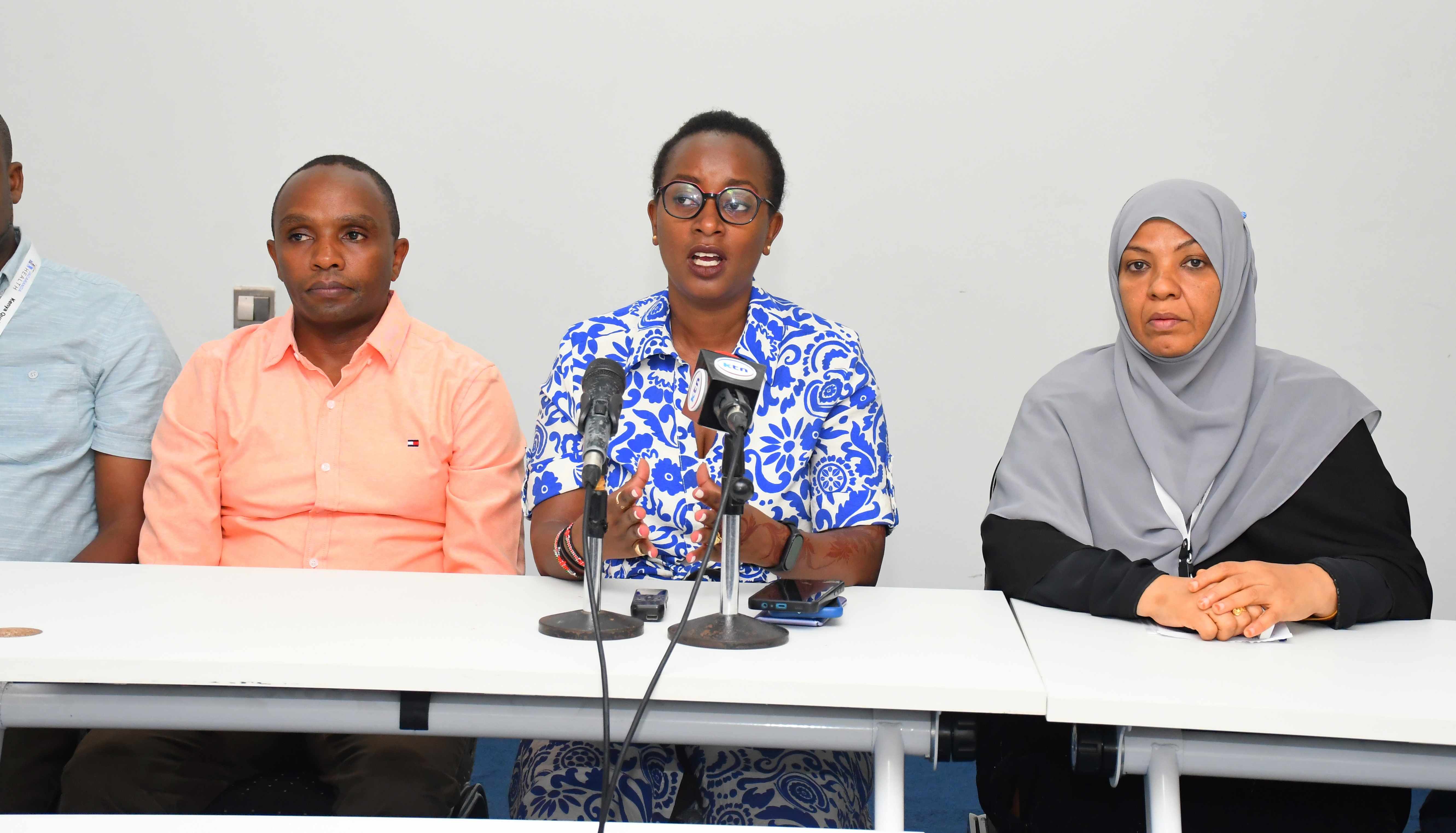
 Makueni county director of curative and promotive health
services Stephen Mwatha, Jacaranda Health co-executive director Cynthia Kahumbura and Mombasa county director of public health Salma
Swaleh at Sapphire Hotel in Mombasa on February 11, 2026 /BRIAN OTIENO
Makueni county director of curative and promotive health
services Stephen Mwatha, Jacaranda Health co-executive director Cynthia Kahumbura and Mombasa county director of public health Salma
Swaleh at Sapphire Hotel in Mombasa on February 11, 2026 /BRIAN OTIENOMaternal and newborn mortality has reduced in Mombasa, Kisii and Makueni counties over the last three years following interventions that ensure early detection of any complications.
Data from the Kenya Quality Ecosystem project shows there has been a significant shift in maternal and newborn survival rates in the three counties.
The three biggest indicators that lead to neonatal mortality are asphyxia, prematurity and sepsis.
“One of the biggest solutions is early identification. That means the nurse or the midwife needs to be trained on how to identify the early signs. Then we look at treatment,” Jacaranda Health co-executive director Cynthia Kahumbura said on Wednesday.
Treatment, she said, involves the nurse or midwife being able to perform resuscitation techniques or take care of the neonate.
“That is captured in the training we provide. Then they need to ensure that continuous care is being provided. This goes with having the right equipment,” Kahumbura said.
KQE is a partnership between Jacaranda Health, Health Systems Insight and the three county governments that implements targeted investments in data and mentorship.
The project, launched in 2023, focuses on turning health data into immediate clinical action.
In Kisii, for instance, there has been a 34 per cent drop in maternal mortality over the last three years.
The facility maternal mortality ratio dropped from 159 to 104 per 100,000 live births (a 34.5 per cent reduction), following the adoption of emergency obstetric response tools and other investments.
Richard Okware, the Kisii county director of health, said there are many successes that have come with the Jacaranda Health and Health Systems Insight partnership.
“As late as 2025, Kisii county was able to reduce maternal deaths from 29 the previous year to 22 in 2025,” he said.
“Our biggest referral hospital, the Kisii Teaching and Referral Hospital, which receives mothers from other counties, was able to have zero maternal deaths in the last quarter of 2025, and we expect to sustain that this year.”
Kahumbura said their aim is to ensure a world where every mother delivers safely and with dignity, and every newborn gets a safe start in life.
She spoke at the third county cross-learning event at Sapphire Hotel in Mombasa.
Kahumbura said this has been done over the last 10 years through products such as Prompts, a two-way enabled SMS service that reminds expectant mothers of key dates and actions, including clinic visits and nutrition.
Last year, this service reached more than 600,000 women across the country.
“Through our EMOC [Emergency Obstetric Care] training, we last year trained more than 3,000 nurses and midwives. Through those two programmes, a foundation of digital tools and data has been established, data which is critical in decision making,” Kahumbura said.
Mombasa county director of public health Salma Swaleh said through the partnership, the county has established two newborn units at Port Reitz hospital in Changamwe and Mrima hospital in Likoni.
“Within this period, we have managed to admit more than 500 babies. We are in the process of setting up a dispatch centre for ambulances so we can improve our referral services,” Swaleh said.
She said the county is also establishing a satellite blood bank.
“One of the biggest challenges is blood for mothers when they are at the stage of complications during delivery,” Swaleh said.
Makueni county director of curative and promotive health services Stephen Mwatha said they have established a functional blood bank.
“We have also improved our emergency system. We have an emergency operation centre and now, through the support of one of our partners, we are establishing a dispatch centre to ensure all our ambulances are tracked as well,” he said.
Mwatha said the newborn units are now fully equipped through KQE and there is a newborn Intensive Care Unit within the county referral hospital, which has been a big plus, especially for the pre-terms.
“That reduces the referral cost for both the client and the caregivers who bring their children, especially when they have a pre-term baby,” he said.
Pre-term babies account for 18 per cent of the total newborns in Makueni county.
Makueni has an average of 20,000 to 22,000 deliveries a year, and 18 per cent represents about 3,600 to 3,960 pre-term babies delivered each year.
Health Systems Insight country director Felix Murira said their main support to the three counties is to help them improve their planning processes in terms of financing.
“When they are developing their budgets, we take key note of the data that they can apply to allocate resources better to mother and child health services,” Murira said.
HSI also helps the counties participate better in social insurance programmes like SHA, he said.
“These three counties have done very well in ensuring their patients participate in social health insurance programmes, and that brings in money that they can re-invest in improving maternal and neonatal services,” Murira said.
He said they have also worked well with Makueni county on innovations like results-based financing, which targets specific maternal health services by incentivising how those services are financed to improve quality outcomes.
These innovations will also be cascaded to Mombasa and Kisii counties.
Mombasa county clinical services director Mohamed Hanif said the new 25-cot newborn unit at Port Reitz hospital and the new 15-cot newborn unit at Mrima subcounty hospital have been a blessing to Likoni and Changamwe mothers.
“We have been able to decentralise these services due to the efforts, advocacy and goodwill of our leadership,” he said.