The European Union has reiterated the centrality of human rights and democracy in its relations with Kenya, maintaining the theme during high-level meetings in Nairobi.
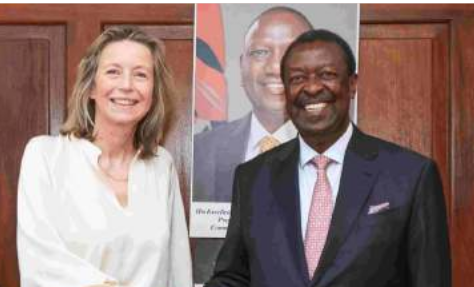
EU's Special Representative for Human Rights Kajsa Ollongren met Prime Cabinet Secretary and CS for Foreign Affairs Musalia Mudavadi, Interior CS Kipchumba Murkomen, electoral observers and human rights stakeholders where she reiterated the importance of human rights, governance, accountability and credible elections.
The EU said Ollongren’s three-day visit, her first to Sub-Saharan Africa in the role, “underlines that human rights are an important part of our partnership”.
Foreign Affairs department said the meeting with Mudavadi focused on strengthening collaboration under the Kenya–EU partnership framework. This was with particular emphasis on human rights, institutional governance, and emerging challenges in the digital information space.
Ollongren proposed the establishment of a dedicated human rights pillar within the Kenya–EU Strategic Dialogue to enhance structured engagement.
The 2021 Strategic Dialogue is currently anchored on three pillars, which are political and security cooperation, development cooperation through Global Gateway and trade and investment.
Mudavadi reiterated Kenya’s commitment to the promotion and protection of human rights, as enshrined in the Constitution of Kenya.
He highlighted the critical role of independent institutions, including the Independent Policing Oversight Authority, an autonomous Judiciary, and a vibrant civil society, in upholding the rule of law, accountability, and democratic norms,” Foreign Affairs Ministry said.
On elections, Mudavadi underscored Kenya’s commitment to conduct free, fair, and transparent general election in 2027 with the full reconstitution of the IEBC.
While the meeting with CS Murkomen also covered discussion on the Refugee Shirika Plan implementation, the two also discussed accountability and the protection of civic freedoms, which she noted remain central to the EU-Kenya partnership. .
Electoral processes featured prominently in the discussions with election observers and civil society on voter education, transparency, and ensuring every Kenyan’s voice counts.
The EU maintained that free, fair, and credible elections are the cornerstone of any democracy.
The visit come on the backdrop of killings, abductions and detentions that followed the 2024 Gen Z protests, the anniversary in 2025 and Saba Saba demonstrations.
At the same time, the EU and a network of election observers last year raised the alarm at the slow-paced preparations for the 2027 elections, particularly the reconstitution of the IEBC.
While the IEBC is now fully constituted, it is already facing scrutiny following the resignation of CEO Hussein Marjan Hussein, and the controversy surrounding the alleged renewal of the Smartmatic electoral technology support contract.
The EU Election Follow-up Mission last year also raised issue with delayed voter registration, warning it would affect voting in 2027.