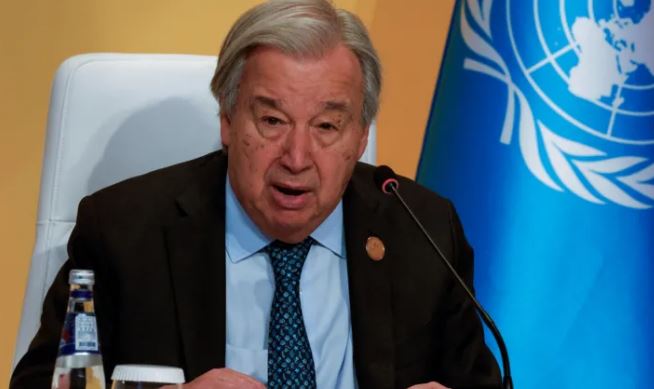
UN Secretary General António Guterres will this week address the African Union (AU) Summit in Addis Ababa for what is expected to be his final appearance before African leaders as head of the United Nations, ahead of the end of his term later this year.
African heads of state and government are converging in the country from February 14-15 for the 39th ordinary session.
Several leaders have already started arriving in the country ahead of the summit.
President William Ruto is among the leaders who will attend.
Guterres was expected to arrive in Addis today for several engagements ahead of the anticipated key address.
As he prepares to deliver his farewell address to the continental body, attention is increasingly shifting to the high-stakes global process to select his successor, a race that will determine the next leader of the world’s most influential multilateral institution at a time of mounting geopolitical tensions and growing demands for UN reform.
Guterres’ second five-year term ends on December 31, 2026, bringing to a close a decade marked by global crises ranging from pandemics and climate emergencies to geopolitical conflict and humanitarian strain.
Following his re-appointment, Guterres vowed to use his second term to work towards ensuring “the blossoming of trust between and among nations” and to engage in confidence building.
He said he will also seek to inspire hope that things can be turned around, or that the impossible might be made possible.
“The attitude is never to give up,” he said on June 18, 2021.
“This is not idealistic or utopian but grounded in knowledge of history when big transformations occurred and guided by the fundamental belief in the inherent goodness of people. That breakthroughs are possible when we expect it the least and against all odds. That is my unwavering commitment.”
The process to select his successor is already underway, with nominations open and early candidates emerging for a position often described as the world’s most impossible job.
HOW THE UN SECRETARY GENERAL IS CHOSEN
Under Article 97 of the UN Charter, the Secretary-General is appointed by the General Assembly upon the recommendation of the Security Council.
In practice, this makes the Security Council, and particularly its five permanent members, the decisive power brokers.
Any candidate must first survive a series of informal “straw polls” within the 15-member Council.
A single veto from any of the permanent members, the United States, Russia, China, the United Kingdom, or France, is enough to end a candidacy.
Once the Council agrees on a name, the General Assembly formally approves the appointment, typically by acclamation.
The current selection cycle was formally launched on November 25, 2025, through a joint letter by the Presidents of the General Assembly and the Security Council inviting member states to nominate candidates.
Countries have been asked to submit nominations by April 1, 2026, ahead of public interactive dialogues scheduled for late April.
In recent years, reforms have made the process more transparent.
Candidates must submit vision statements, curricula vitae, and disclosures on campaign financing, and they will participate in webcast question-and-answer sessions with member states.
TENURE AND CONVENTIONS
The Secretary-General serves a five-year term, renewable.
Although there is no formal term limit, modern practice has established a two-term convention, followed by most recent office holders.
The role combines administrative leadership of the UN Secretariat with political responsibilities as a global mediator, crisis manager and diplomatic “honest broker” between nations.
Over time, several unwritten rules have shaped the selection.
Candidates are generally expected to come from countries outside the five permanent members of the Security Council and to have extensive diplomatic or political experience.
Regional rotation is also an important consideration, with member states seeking geographic balance over time.
There is also growing pressure to address gender imbalance.
In the UN’s nearly 80-year history, no woman has served as Secretary General, a fact that has prompted increasing calls for a historic breakthrough in the current cycle.
WHO IS IN THE RACE
Early nominations suggest the contest is taking shape around experienced international figures, particularly from Latin America, which diplomats say is widely seen as the region “next in line” for the post.
Among the candidates publicly confirmed so far:
Michelle Bachelet (Chile)—A former president of Chile and former UN High Commissioner for Human Rights, nominated by Chile with backing from Brazil and Mexico.
Rafael Grossi (Argentina)—Director General of the International Atomic Energy Agency, nominated by Argentina.
Rebeca Grynspan (Costa Rica)—Head of UN Trade and Development and a former Vice President of Costa Rica, nominated by her government.
More candidates are expected before the April deadline, and diplomatic lobbying is likely to intensify throughout the year.
While regional rotation is an established practice, it is not binding.
Previous contests have produced compromise candidates from outside the anticipated region when major powers failed to agree.
WHAT QUALIFICATIONS MATTER
There is no formal checklist for the job, but decades of practice have established a profile for viable candidates.
Successful contenders typically have senior political or diplomatic leadership experience, deep knowledge of international relations and multilateral institutions and a reputation for neutrality and consensus-building.
They also have fluency in major UN working languages and ability to command trust across geopolitical divides.
Historically, most Secretaries General have been career diplomats or former heads of state or government from middle-sized countries, seen as less threatening to major powers.
Equally important is political acceptability.
Analysts note that the eventual winner is often not the most high-profile figure but the candidate least objectionable to all five permanent members.
A DEMANDING ROLE IN A DIVIDED WORLD
The next Secretary General will take office on January 1, 2027, at a time when the UN faces mounting challenges, from great-power rivalry and conflicts in multiple regions to climate change, debt distress in developing countries, and growing skepticism about multilateral institutions.
The office itself has evolved with each holder.
While the Charter defines the Secretary-General as the UN’s chief administrative officer, the position has increasingly become a platform for global advocacy, crisis diplomacy, and moral leadership.
Guterres, a former prime minister of Portugal and UN refugee chief, has used the role to push for climate action, humanitarian access and reforms to global financial systems.
His successor will inherit both the expectations and the constraints of an office that depends largely on persuasion rather than power.
Global politics, quiet diplomacy
Much of the decisive bargaining will take place behind closed doors in New York, where permanent Security Council members will weigh geopolitical interests alongside personal credentials.
Despite the more open public process, diplomats say the outcome will still hinge on traditional power politics, regional balance, gender considerations and the delicate art of compromise among rival global powers.
For Africa, the AU Summit appearance by Guterres serves as a reminder that the continent remains central to the UN agenda, from peacekeeping operations to climate vulnerability and development financing.