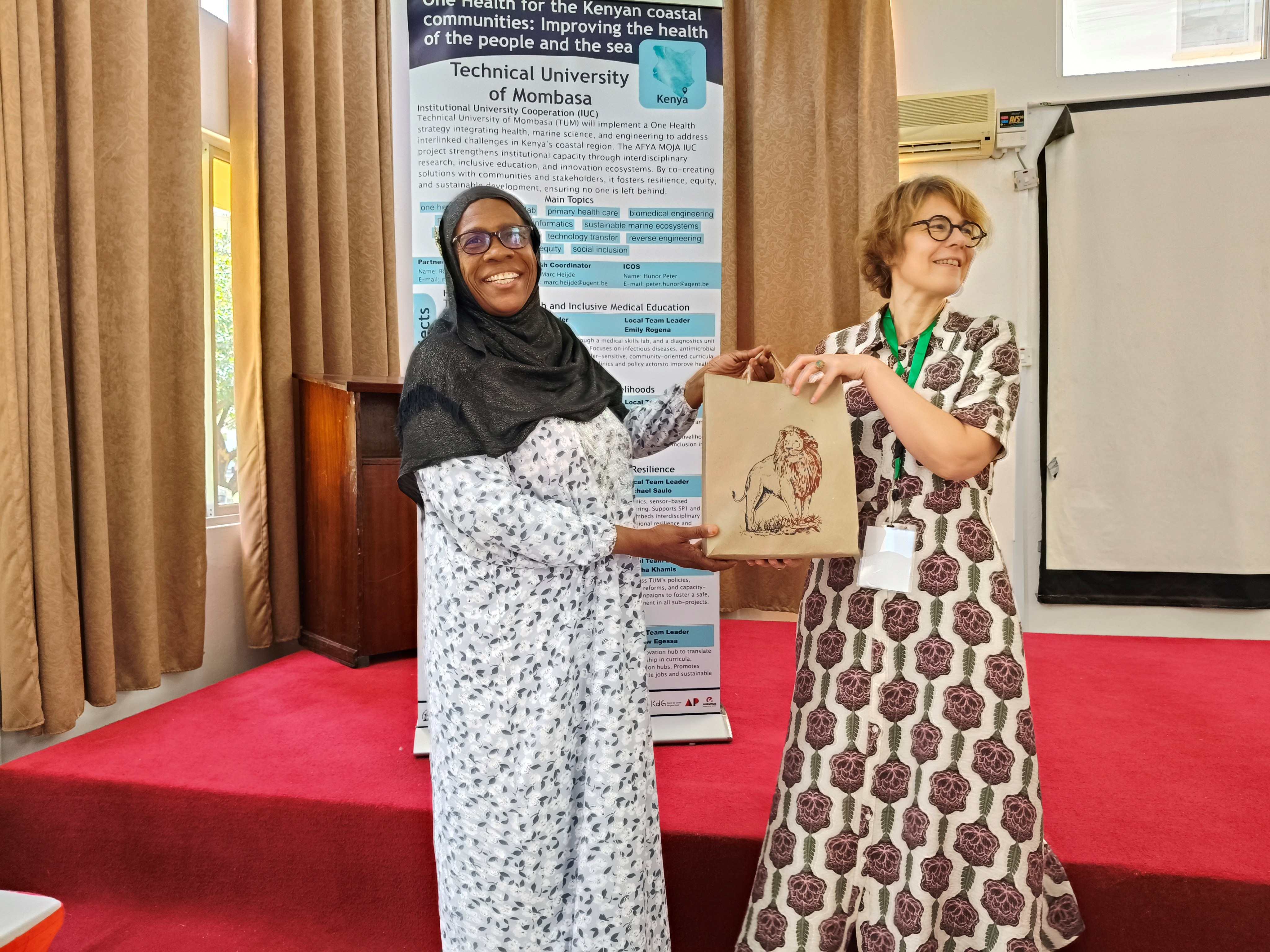
TUM vice chancellor Leila Abubakar and VLRIUOS global partnerships manager Geraldine Mabbe at TUM on Tuesday /BRIAN OTIENO
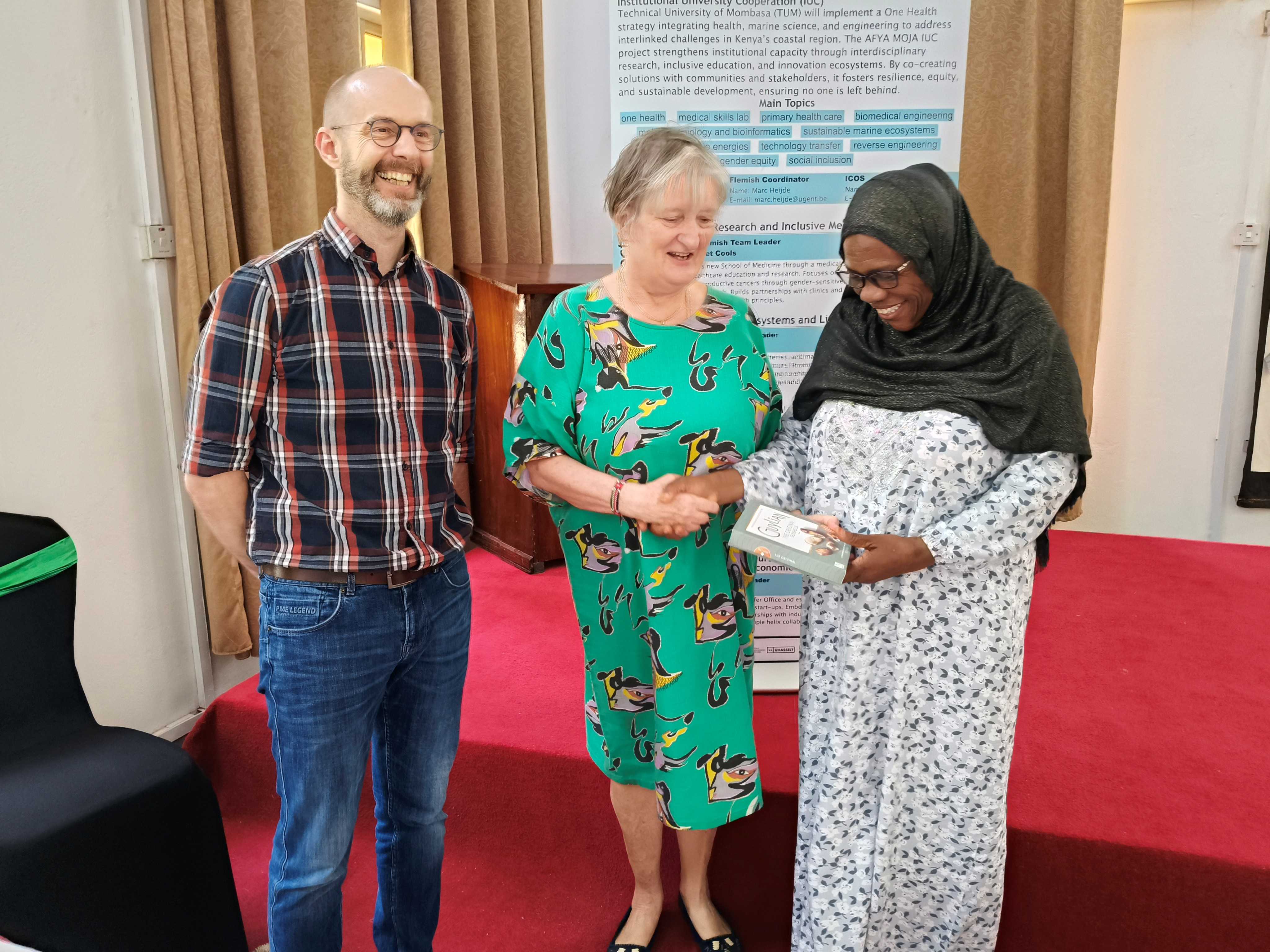
Afya Moja project coordinator Marc Heijde, Prof Marleen Temmerman and TUM vice chancellor Leila Abubakar on Tuesday /BRIAN OTIENO
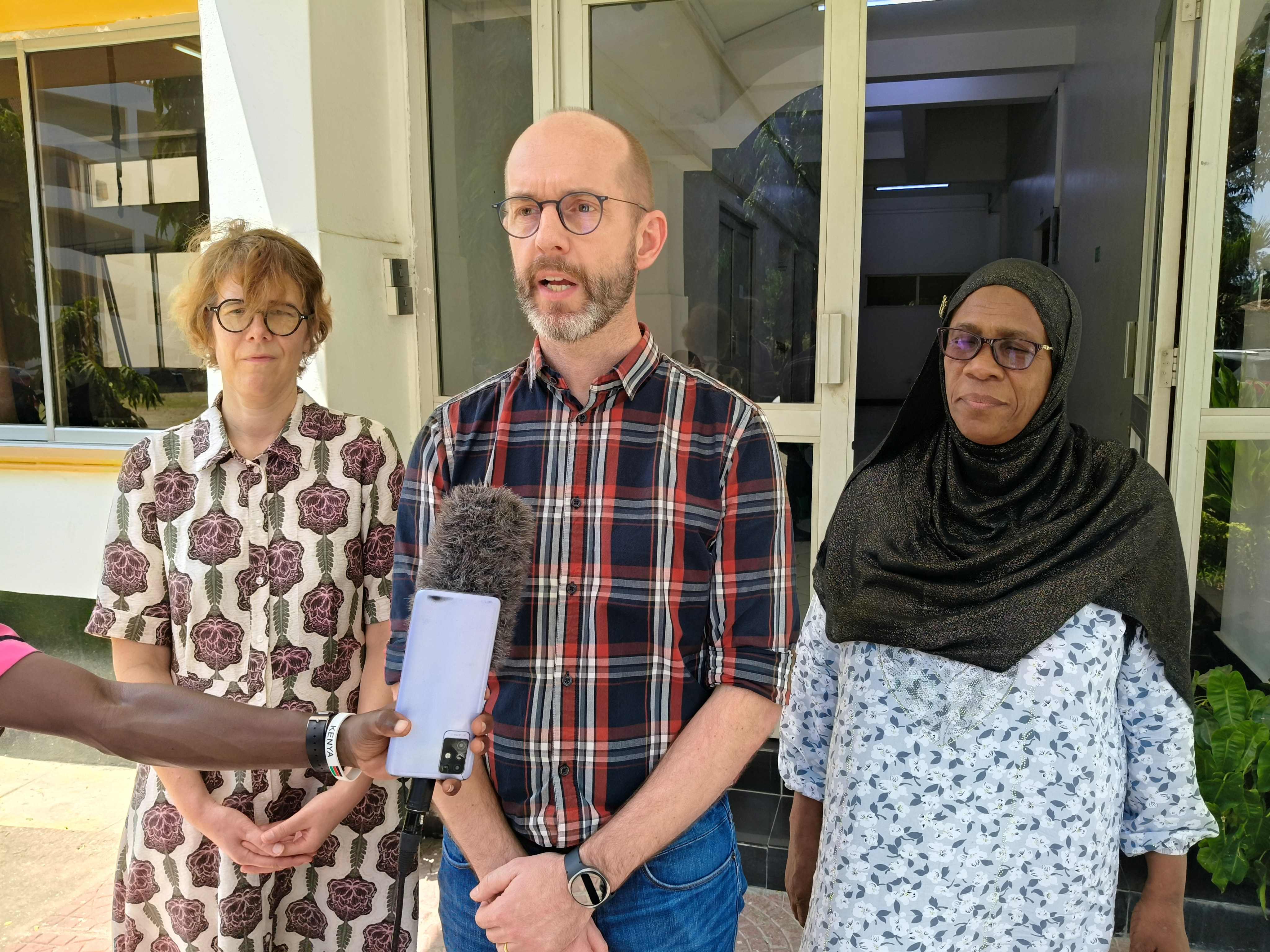
Vliruos global partnerships manager Geraldine Mabbe, Afya Moja project coordinator Marc Heijde and TUM vice chancellor Leila Abubakar at TUM on Tuesday /BRIAN OTIENO
The Technical University of Mombasa has started implementing a multi-faceted project that seeks to promote health, innovation, entrepreneurship, technological advancement and the blue economy.
The project, funded by Vliruos to the tune of €5.5 million (about Sh844.7 million), will be implemented over 10 years.
Vliruos is the leading funding organisation for scholarships and partnerships between academics from Flanders and partner institutions in Africa, Latin America and Asia, with a focus on global sustainable development.
Marc Heijde, the Afya Moja project coordinator, said this is a unique project compared to many others, which usually last three to five years.
He is from Ghent University in Belgium.
“We are working at different levels. The programme aims to work on health systems and the blue economy, and to develop engineering solutions to support these two scientific themes, while also having a gender-inclusive approach at the level of the whole university,” Heijde said.
“In the end, what we want to achieve is to ensure that the innovations being created at TUM are taken up, adopted and used by the community so that the project can ultimately bring welfare to the whole coastal region.”
Heijde said last week that a team from the project had been collaborating with TUM staff to develop elements of the project in order to achieve maximum impact. He spoke at TUM on Tuesday during a project planning meeting.
“We are now at the stage of developing the deliverables. The end users, for example, when we talk about health, will be the patients, the hospitals and healthcare providers.
“When we talk about the blue economy, we are not talking about the scientists only, but also the fishers and the post-harvest community who then transform the produce. We are trying to leave no one behind, including young people, women and all others who might be in the minority,” he said.
Ghent University has a long-term collaboration framework with TUM.
However, Heijde represents nine institutions in the project, including four universities and five schools of applied sciences.
Vliruos global partnerships manager Geraldine Mabbe said they fund collaborations between Flemish universities and university colleges and partner countries.
In Kenya, she said, they have three long-term partnerships with Jomo Kenyatta University of Agriculture and Technology, Jaramogi Oginga Odinga University of Science and Technology and TUM.
“In these Institutional University Cooperations (IUCs), we aim to develop the capacities of the institutions and, of course, we want to see change at the level of society,” Mabbe said.
She said the Afya Moja project will be implemented in two phases, including the first five-year phase, funded to the tune of €3 million (about Sh460.8 million). The next five-year phase will be funded to the tune of €2.5 million (about Sh384 million).
TUM vice chancellor Leila Abubakar said TUM is the only Kenyan university that was awarded funding for the project.
A number of institutions had applied for funding and only six were funded across the globe.
Three institutions were from Africa, while three were from Latin America.
In Africa, apart from TUM, Ugandan Gulu University and South Africa’s Nelson Mandela University of Science and Technology were funded.
In Latin America, the three universities that were awarded funding were from Peru, Cuba and Ecuador.
“This is a long-term relationship that we are going to have, and the aim of the project is to change not only our capacity as a university but also the community,” Abubakar said.
TUM received its charter in 2013, and a number of lecturers still need to obtain their PhDs.
Through the project, these lecturers will receive scholarships.
“Government funding has been dwindling, so at least now we will be able to have staff who will be funded for their research work. The most expensive component of any PhD requirement is the research element. With this project, they will be able to carry out their research,” Abubakar said.
She said the project will be evaluated after the first five years before continuing.
“The community will be stakeholders, partners and beneficiaries in this project. We know the issues, the gaps and the questions that exist, but we will need them to identify other gaps that we might have missed,” the Vice-Chancellor said.
She said the project will seek to identify what ails fisherfolk in their quest to catch fish at sea, what challenges tropical diseases pose to society at the Coast, and what entrepreneurship skills are lacking in society, among other issues.
“We need to have strategies to ensure there are no post-harvest losses for our farmers and fishermen,” Abubakar said.