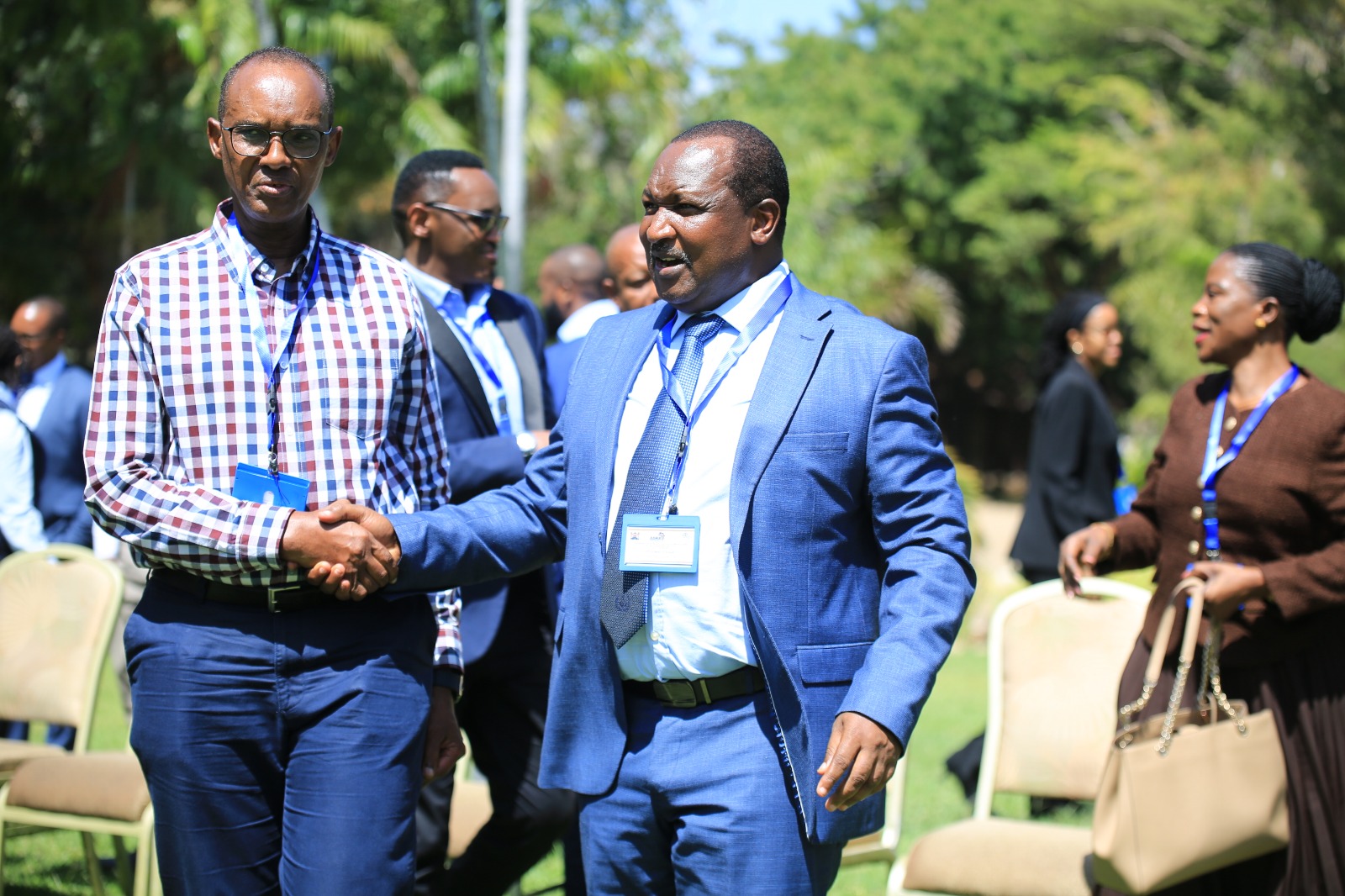
Kenya’s Special Envoy for Climate Change ambassador Ali Mohamed and Kenya Maritime Authority director general Omae Nyarandi, during the opening of the three-day African Maritime Administrators meeting in Mombasa /JOHN CHESOLI
African maritime authorities are meeting in Mombasa to forge a unified continental stance on the International Maritime Organisation’s proposed net-zero emissions framework for global shipping.
Kenya Maritime Authority (KMA) director general and chairperson of the Association of African Maritime Administrators (AAMA), Omae Nyarandi, said Africa must speak with one voice on the framework, which seeks to transition the global shipping industry away from fossil fuels by 2050.
He spoke during the opening of the three-day AAMA meeting in Mombasa.
The forum has brought together maritime administrators from 25 African countries to assess the implications of the IMO strategy, which was introduced in October last year but deferred for one year due to a lack of global consensus.
“The strategy proposes a gradual transition from fossil fuels to green energy, with phased implementation starting now through to 2030, and further milestones up to 2035 and 2050,” Nyarandi said.
“Africa will be affected by this transition, and it is critical that we understand its implications and engage from an informed position.”
He said that while some global powers, including the US and Saudi Arabia, have opposed aspects of the framework, Africa’s position remains fragmented.
Nyarandi warned that the continued use of fossil fuels by shipping lines under the framework would attract surcharges, with proceeds channelled into a global fund intended to mitigate climate impacts.
The KMA director general said the meeting aims to develop a common African understanding ahead of the IMO’s October session, when the framework is expected to return to the negotiating table.
“Our discussion here will ensure Africa's participation in global maritime governance is organised, anticipatory and coherent. In the coming months, the world will make decisions that will shape the shipping transition pathway. Our responsibility is to ensure that Africa's contribution to those decisions is informed, aligned and consequential,” he said.
Nyarandi said the rules governing fuels, emissions performance and compliance are no longer theoretical drafts.
“They are becoming the language of markets, shaping what cargo owners demand, what financiers fund, what insurers price and what ports must offer,” he said.
Nyarandi said if the transition is shaped without Africa’s realities in mind, it could quietly raise logistics costs, reduce trade competitiveness and narrow options for the ports and corridors that power the region’s economies.
Kenya’s Special Envoy for Climate Change, ambassador Ali Mohamed, said the government, through the Executive Office of the President, fully supports the initiative, noting its alignment with President William Ruto’s climate leadership agenda.
“We are here to understand how shipping decarbonisation presents risks and opportunities for Africa,” he said.
“The President chairs the Committee of Heads of State and Government on Climate Change, and Kenya has positioned itself as a global and continental champion of climate action.”
Mohamed highlighted Kenya’s clean energy credentials, noting that 93 per cent of the country’s energy is derived from renewable sources.
He said Kenya is keen to maximise the use of clean energy across sectors, including shipping and port operations.
Mohamed cited recent policy developments, including the launch of Kenya’s electric vehicle policy, as part of the country’s broader green transition, which also encompasses green shipping and green ports.
Last year’s IMO discussions exposed divisions among African states, with countries voting differently on the net-zero framework.
Mohamed described this lack of consensus as unfortunate and stressed the need for Africa to approach the October negotiations with a shared position.
“To make informed decisions, African countries must fully understand what the framework means for the continent,” he said.
“That is why we have brought together senior officials from coastal and port states, alongside experts from institutions such as the University of Nairobi, the University of London and various think tanks.”
Mohamed expressed optimism that Africa would ultimately support the adoption of the net-zero framework, describing green industrialisation and green development as the future.
“Africa is the most vulnerable continent to climate change. We must therefore be at the forefront of solutions,” he said, adding that Kenya strongly supports the framework and hopes this will become the collective African position when negotiations resume later this year.