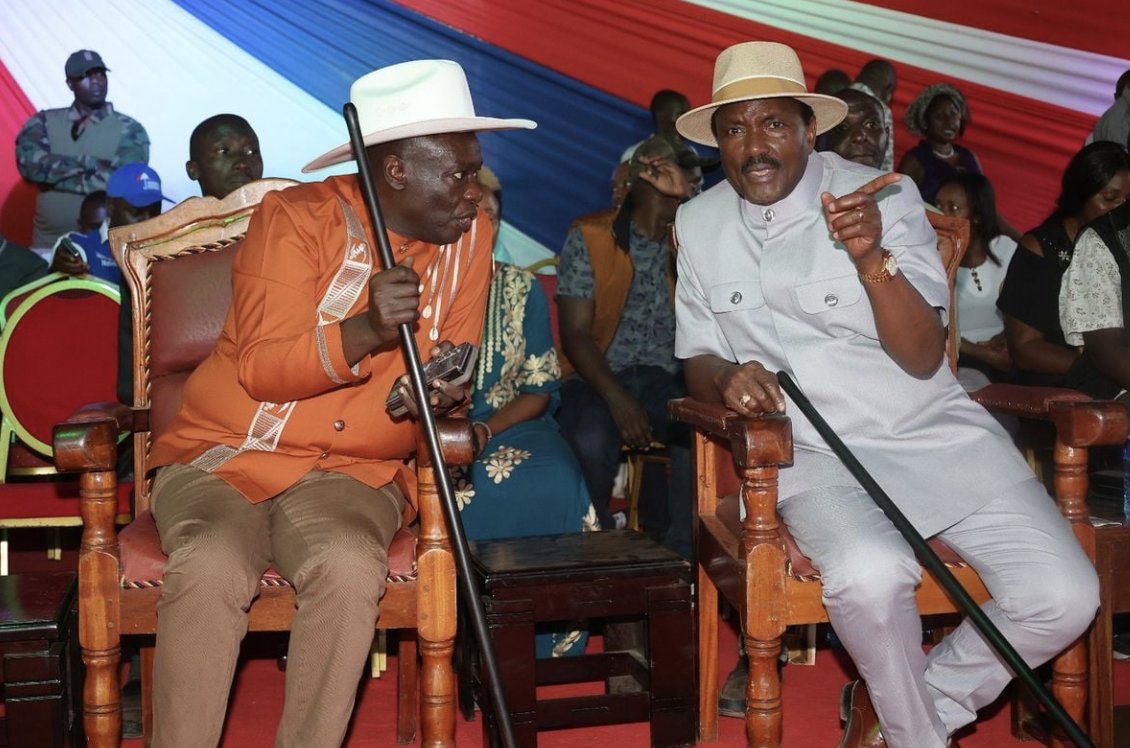
 Democracy for Citizens Party leader Rigathi Gachagua and Wiper Leader Kalonzo Musyoka/FILE
The nascent attempts to cobble together a United Opposition face its make-or-break moment this week, with the principals hoping to pick their presidential candidate and a running mate.
After months of behind-the-scenes negotiations and horse trading, a team of handpicked experts will table a formula the group hopes could smoothly get over the hurdle of competing ambitions to take on President William Ruto in August next year.
The opposition heavyweights hope the retreat scheduled for Thursday and Friday at a venue yet to be made public will debate a list of proposed names, which will form a major branding platform that can effortlessly capture the imagination of the public and ease their marketing jitters.
The summit comes barely a month after former Deputy President Rigathi Gachagua arrogantly dismissed his would-be partners as lethargic and lucking in drive and initiative, creating the impression the group was doomed without his divisive leadership.
But opposition insiders planning the retreat, which starts only days after Wiper supremo Kalonzo Musyoka jets back from a fundraising tour of the United States, speak of a well organised and rock solid plan to create a compatible political force.
The meeting will see Kalonzo (Wiper), Rigathi (Democracy for Citizens Party), Fred Matiang'i (Jubilee), Eugene Wamalwa (Democratic Action Party-Kenya), Justin Muturi (Democratic Party) and Martha Karua (People's Liberation Party) pore over legal challenges of formalising and registering the coalition, establishing internal structures, mobilise resources, identify a brand name and ready to hit the ground running.
“As a coalition, we are going for a retreat to set our structures, form our committees, agree on the name of our coalition, and settle on the formula for picking our flagbearer,” Eugene told the Star.
Sources familiar with the process say a technical team tasked with drafting the coalition’s instruments has completed its work and will present the final documents at the retreat.
“That team is doing very well. Its progress is beyond the expectation of any of us,” Kitui Senator Enoch Wambua, a close ally of Kalonzo, said.
The team has already developed a tentative coalition name, a draft constitution, theme colours and other branding tools.
It has also proposed a committee structure to oversee critical areas such as resource mobilisation, communication, campaign strategy and election logistics.
Each of the committees will be headed by a principal.
Significantly, the team has also identified at least two possible combinations for the opposition’s presidential ticket.
The Wiper chief is said to have emerged as the preferred presidential candidate in internal, low-key opinion sampling conducted by the team, with Matiang’i proposed as his running mate.
However, sources say the reverse pairing—Matiang’i as presidential candidate with Kalonzo as deputy—has also been fronted as a viable option, reflecting delicate power-balancing within the opposition.
“Any of these principals, including my party leader Kalonzo Musyoka, is fit for purpose,” Wambua said, playing down speculation of rivalry.
Despite the progress, insiders admit the process has not been without friction.
One of the main sticking points has been the timing of formally unveiling the coalition and, more controversially, naming its presidential flagbearer.
While some principals pushed for an early public launch this year, others strongly opposed the idea, arguing that premature exposure would hand Ruto a strategic advantage.
“It has not been an easy exercise because of issues here and there, but we have made good progress. When the principals are ready, we are ready,” a member of the technical teamsaid.
Another source said the process had stalled briefly after the leaders failed to agree on timelines.
“We were hoping to complete this process this month, but it has been put on hold because they did not agree,” the source said.
Gatanga MP Edward Muriu appeared to confirm the decision to slow down, arguing that patience was now a central plank of the opposition’s strategy.
“We have a lot of time. We have more than one and a half years until the election. Even DCP itself has not been launched. There is no hurry; otherwise, we will fall into Ruto’s trap,” Muriu said.
He pointed to what he described as increased pressure on political and religious leaders critical of the government.
“We have all seen what has happened to our leaders in church and elsewhere. What will happen if we unveil our candidate now?”
The debate over timing has publicly exposed differences between Kalonzo and Gachagua.
In his end-of-year address on December 30 last year, Kalonzo argued for an early declaration, proposing that the coalition name its presidential candidate by the first quarter of 2026.
He said an early announcement would signal unity and seriousness, and allow the opposition to function as a “government-in-waiting.”
“I make this commitment to you: by the first quarter of 2026, the name of our presidential candidate will be made known to Kenyans. The United Opposition is not just a coalition; it’s your government-in-waiting,” Kalonzo said.
Gachagua swiftly poured cold water on the proposal, warning that an early declaration would expose the nominee to harassment, intimidation and state pressure.
Drawing parallels with the 2002 election, the former deputy president argued that the opposition should wait until closer to polling day—just as Mwai Kibaki was named as the opposition candidate barely two months before the vote.
“If we announce our candidate too early, Kasongo (meaning Ruto) will confuse him completely. We will declare our flagbearer a few months before the election so we can face Ruto head-on,” Gachagua said.
However, Wambua dismissed claims of a rift over the preferred candidate amid reports of a push and pull that has delayed the unveiling of the candidate.
“There have been attempts to divide us through state-sponsored propaganda. But we want to tell Kenyans that we are united to the end,” he said.
Allies of the opposition principals insist the delay is tactical, not a sign of disunity.
“The naming of the candidate will happen when it is convenient for us. We are within our timeline. One thing we are sure of is that we will field one candidate to defeat Ruto,” Wambua said.
Muriu said the upcoming retreat would not culminate in naming a flagbearer, adding that the opposition was focused on consolidating its regional bases first.
“Our focus now is to divide ODM. We know Ruto has taken part in it, but we also want Kalonzo to play a role,” he added.
He added that the principals had already fanned out across key regions, with Gachagua concentrating on Mt Kenya, Kalonzo in Ukambani and allies such as Cleophas Malala and George Natembeya anchoring Western.
Behind the scenes, the opposition believes the slow-burn approach—build first, reveal later—offers its best shot at dismantling Ruto’s political machine when the real contest begins.
INSTANT ANALYSIS:
Kalonzo Musyoka and Rigathi Gachagua are quietly rebuilding a United Opposition ahead of the next general election through structured, strategic planning rather than early public declarations. It highlights efforts to formalise the coalition, set up committees, agree on branding and identify possible presidential tickets, while exposing internal tensions over timing. Kalonzo favours early candidate declaration to project readiness, while Gachagua urges caution to avoid state pressure. The analysis shows a calculated, slow-burning opposition strategy focused on unity, regional consolidation and surprise.