For generations, bulky banana stems were left on farms to rot after harvest, seen as nothing more than waste.
But women and young people in Nyamira county are turning them into fibre products, creating new income opportunities.
When members of the Wefahson Banana Cooperative Society were first told that banana stems could be turned into fibre, many were sceptical.
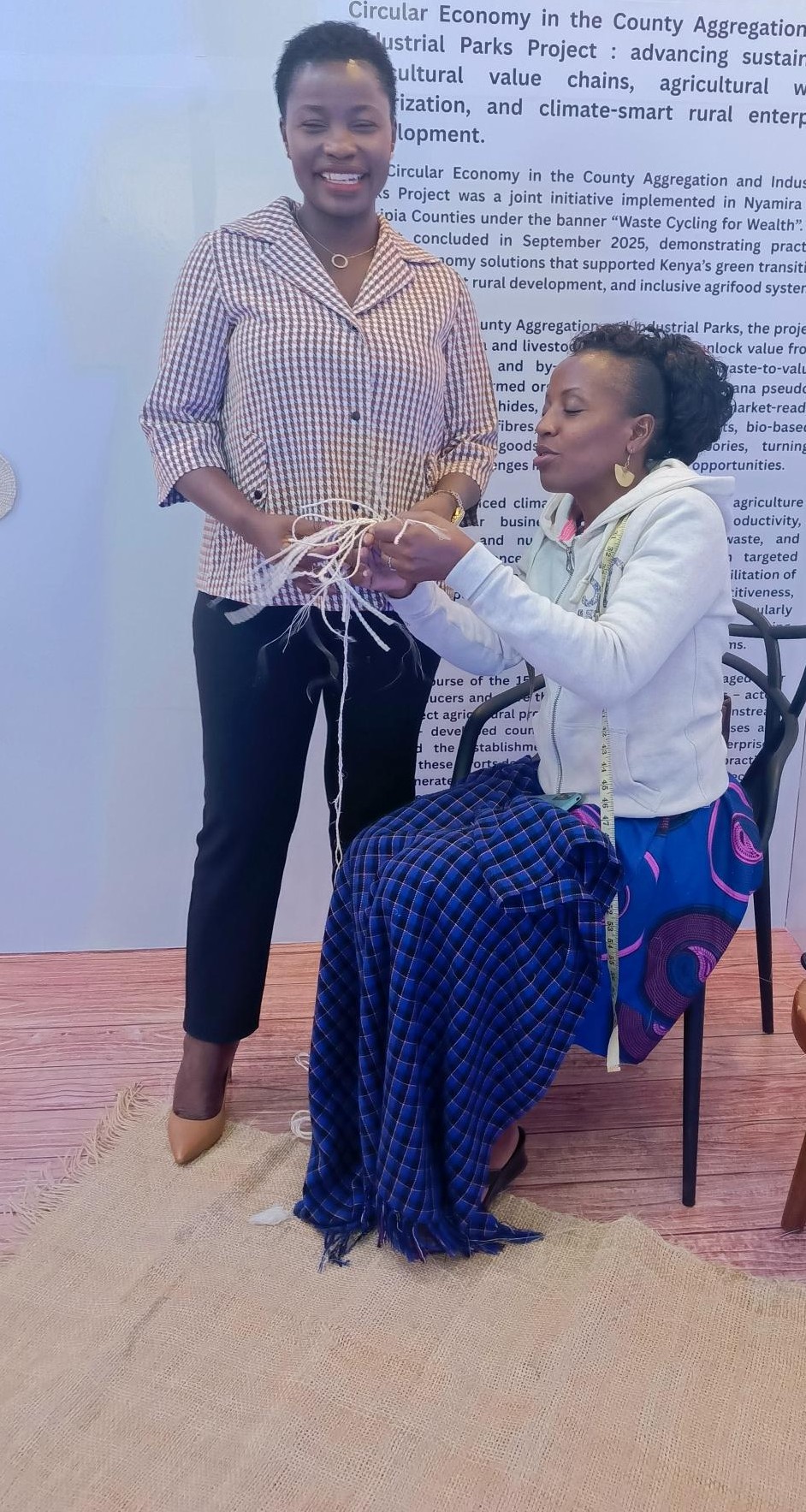
From the once-discarded stems, they now produce baskets, mats and hair braids that are finding ready markets locally and beyond. They can barely keep up with demand.
The transformation is part of a wider pilot initiative by the Food and Agriculture Organization, the United Nations Industrial Development Organization, the International Organization for Migration, the United Nations Office at Nairobi and the International Trade Centre, with support from the SDG Multi-Partner Trust Fund in Kenya.
Implemented in Nyamira and Laikipia counties, the project aims to strengthen circular economies by reducing waste and reusing agricultural by-products across value chains.
Micro, Small and Medium Enterprises Development PS Susan Mang’eni said the initiative aligns closely with the government’s priorities. She spoke during a recent stakeholders’ meeting in Nairobi on building a case for an alternative fibres circular economy.
“The national government has identified nine priority value chains, and textile and apparel is one of them,” she said.
“Banana fibre, together with sisal and cotton, is part of the raw material base that can power this sector.”
Kenya’s banana production has expanded significantly in recent years, driven by the deliberate promotion of tissue-cultured seedlings. Yet until now, attention has largely focused on bananas as food.
“For a long time, nobody really cared about the banana stem,” Mang’eni said.
“What this pilot has shown is that banana can actually become an anchor value chain in counties where its farming is already strong.”
Nyamira is one such county. Bananas are grown in nearly every homestead, making raw material readily available without additional land or inputs.
Mang’eni said this creates a solid foundation for scaling fibre production to commercial levels.
The pilot has also revealed opportunities across several alternative natural fibres, many of which command high prices in international markets.
“This becomes another cash crop that can reach global markets,” the PS said.
Central to the government’s approach is job creation, particularly for young people and women in rural areas.
Mang’eni said traditional value chains such as bananas offer familiarity, but commercialisation requires new skills, from quality control and standardisation to product design and marketing.
To support this shift, the government is rolling out county aggregation and industrial parks to help small producers achieve economies of scale.
These hubs are designed to attract investors, support processing and reduce post-harvest losses.
Cold storage facilities are also being established in key production zones, including Kisii, which serves farmers in Nyamira and neighbouring counties.
The facilities are expected to reduce losses from perishables such as bananas, while providing aggregation points where farmers can deliver produce directly to off-takers.
“Farmers are good at farming, but they should not be forced to wait months for payment. We want a model where they deliver produce, get paid, and investors and young entrepreneurs take over value addition.”
Nyamira Governor Amos Nyaribo said the banana fibre initiative comes at a critical time, as the county grapples with high youth unemployment.
“Our young people have energy and skills, but they lack opportunities,” he said.
“This is one of the avenues that can engage them and help them earn a living.”
While the county initially focused on fruit production, Nyaribo said fibre could eventually become a major value chain.
Banana by-products can also be processed into paste, which has demand in pharmaceutical and food industries in Europe and other markets.
“Through this value chain, young people will be taken off the streets and mothers in villages will finally get value for their effort,” he said, adding that the county plans to invest in ICT hubs to complement production with digital skills and online work.
Migori agriculture executive Peris Mong’are said the county produces about 170,000 tonnes of bananas annually, generating an estimated 7,000 banana pseudostems from an average production area of 3,200 hectares (7,907 acres).
“With roughly 200,000 homesteads, almost every household has at least one banana plant,” she said.
At the policy level, FAO agricultural value chains expert Caroline Kosgei said the shift towards alternative natural fibres is part of a global move to reduce waste and protect the environment.
“The banana value chain is close to zero waste,” she said.
“We have demonstrated proof of concept, and now we want to move from aid to trade by bringing in the private sector, government and development partners.”
The project initially targets banana, sisal, pineapple and cotton, with the potential to expand into animal-based natural fibres such as silk.
Kosgei said agri-food systems contribute about 31 per cent of global greenhouse gas emissions, making waste reduction and resource efficiency increasingly urgent.
“When you convert waste into a resource, you extend product lifespans, reduce pressure on natural resources and lower carbon footprints,” she said.