The government is facing growing accusations of dragging its feet on the implementation of the National Dialogue Committee (NADCO) recommendations.
Opposition leaders and civil society groups have warned that delays and perceived half-hearted implementation risk undermining the very purpose of the dialogue, which was meant to ease political tensions and address deep-rooted governance concerns after turbulent protests.
For President William Ruto, however, NADCO may prove decisive in shaping his political fortunes ahead of the 2027 General Election.
Delivering on the agreed reforms is increasingly seen as a key pathway to winning over a skeptical section of the Orange Democratic Movement (ODM) base and attracting support from other opposition parties.
The strongest criticism has come from ODM Secretary General and Nairobi Senator Edwin Sifuna, who has accused the committee tasked with implementing the 10-point agenda and the NADCO report of doing little since its formation.
Speaking on February 3, 2026, during an interview with Citizen TV, Sifuna said the Committee on Implementation of the 10-Point Agenda and the NADCO Report has just 30 days left to meet its March 7 deadline, warning there would be no justification for an extension.
“A deadline of March 7 was given to the committee for it to submit its final report. I am here to sound the alarm that the committee has 30 days to give us a final report on the memorandum of understanding. It’s been six months, and so far they have done absolutely nothing,” Sifuna said.
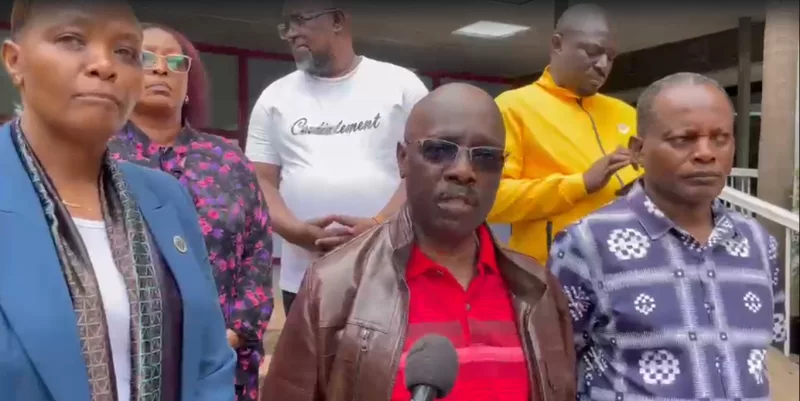
Responding to the accusations NADCO chairperson, Dr Agnes Zani emphasised the importance of not politicising the report’s implementation.
Zani explained that compiling and analysing the submissions required significant time and effort.
"We have already engaged stakeholders, some in person and others through submitted memoranda. All this is being processed," she said.
She added that consolidating the views involved a detailed review of each item on the 10-point agenda.
Committee member Fatuma Ibrahim, an ODM nominee to the team, has castigated Sifuna over his criticism.
Fatuma said Sifuna could easily get in touch with the committee to understand its progress before making public statements.
“I’m an ODM nominee to this committee. My secretary general, Edwin Sifuna, said that this committee is not working and I was a bit disturbed by his statement. We are five members in this committee. Three are from ODM. He should have come to ask us our progress,” she said.
Political analyst Joseph Mutua said NADCO is shaping up as a critical test of Ruto’s outreach to opposition-leaning regions.
Mutua said the success or failure of the implementation of recommendations is likely to determine whether Ruto’s administration can translate dialogue into political goodwill.
“Full implementation would signal sincerity in addressing long-standing grievances on issues such as the cost of living, electoral reforms and inclusivity, potentially softening resistance in areas traditionally hostile to the government. However, any delays, selective application or perceived backtracking risk reinforcing scepticism that NADCO was merely a political truce rather than a genuine reform agenda,” Mutua explained.
The 10-point agenda and the NADCO process were born out of violent nationwide protests that rocked the country between March and July 2023.
The demonstrations were sparked by the rising cost of living, demands for electoral justice, and broader governance concerns.
According to the Independent Policing Oversight Authority (IPOA), dozens were killed during the protests, and many more injured or arrested.
In the wake of the unrest, Ruto and the late opposition leader Raila Odinga agreed to initiate structured talks, leading to the formation of the National Dialogue Committee.
The NADCO report, later adopted by Parliament in February 2024, outlines a five-point plan for constitutional, legal and policy reforms touching on electoral justice, the cost of living, political party fidelity, and the law governing multiparty democracy.
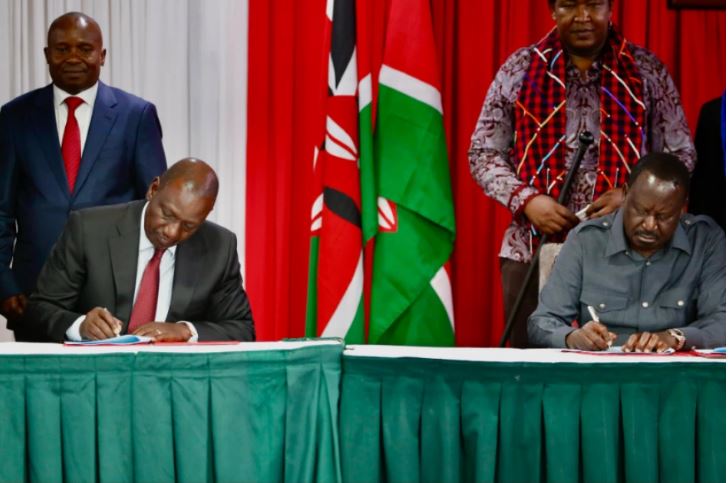
On March 7, 2025, Ruto and Raila signed the 10-point agenda aimed at fostering national unity and addressing governance challenges.
The agreement commits the government to implementing the NADCO report and includes proposals such as the creation of the Office of the Official Opposition Leader and the reinstatement of the Prime Minister’s position.
It also addresses inclusivity in public life, the protection and strengthening of devolution, promotion of youth livelihoods, upholding the right to peaceful assembly, tackling national debt, fighting corruption and protecting the sovereignty of the people.
Despite these commitments, opposition leaders argue that progress on implementation has been slow and uneven.
Ruto, for his part, has been increasingly vocal about the political stakes involved.
He has openly declared that he is targeting a decisive victory in the 2027 General Election, saying he wants to win by a margin of between two and three million votes through a possible coalition with ODM.
The President has argued that broadening his political base is essential for national unity and for consolidating gains made under the broad-based government.
Ruto has also called for the expedited implementation of the NADCO report, urging both Houses of Parliament to fast-track the process.
He has repeatedly emphasised his administration’s commitment to ensuring that the Committee on the Implementation of the Ten-Point Agenda (COIN-10) and the NADCO report delivers on its mandate.
“We are supporting the Committee on the Implementation of the Ten-Point Agenda and the National Dialogue Committee Report (COIN-10) to fully deliver on its mandate,” Ruto said on January 21, 2026, when he received a briefing and progress update from the committee at State House, Nairobi.
According to the President, the implementation process is intended to heal political divisions and restore public confidence in state institutions.
“This process is designed to unite Kenyans through inclusive national dialogue and restore trust in public institutions by fostering transparency and accountability,” he explained.
Ruto has indicated a strong willingness to see the 10-point agenda and the recommendations of the NADCO report acted upon before the 2027 General Election.
The urgency is seen to be driven by Ruto's desire to woo Raila Odinga’s traditional support bases and to neutralise critics who have used delays in implementation as political fodder against his administration.
In a renewed push to revive momentum, Ruto has called for a joint Parliamentary Group meeting bringing together legislators from the United Democratic Alliance (UDA) and ODM to review progress made in implementing the 10-point agenda and the NADCO recommendations.
The meeting, expected in the coming weeks, will follow up on the inaugural joint sitting held on August 18, 2025, which was attended by Ruto and the late Raila.
Beyond the political class, senior government officials have also sought to reassure the public about the administration’s commitment to NADCO.
Head of Public Service Felix Koskei described the NADCO report as a critical framework for Kenya’s transformation, with a strong focus on governance, economic growth and national unity.
“NADCO remains a critical framework for Kenya’s transformation, with a strong focus on governance, economic growth, and national unity,” Koskei said after a meeting with the committee overseeing the implementation of the 10-point agenda and the NADCO report on January 28, 2026.
Koskei said plans were underway to engage all Principal Secretaries as key delivery agents, noting that the team would present a status report and explore ways of better aligning government departments to drive NADCO’s objectives forward.
He has reaffirmed the government’s commitment to facilitating the effective implementation of the recommendations.
As the 2027 election draws closer, NADCO is shaping up as a defining test of Ruto’s outreach strategy.
Implemented fully, it could soften opposition resistance and reshape political alliances. If it stalls, it risks deepening mistrust and reinforcing the narrative that dialogue without delivery cannot heal Kenya’s political wounds.