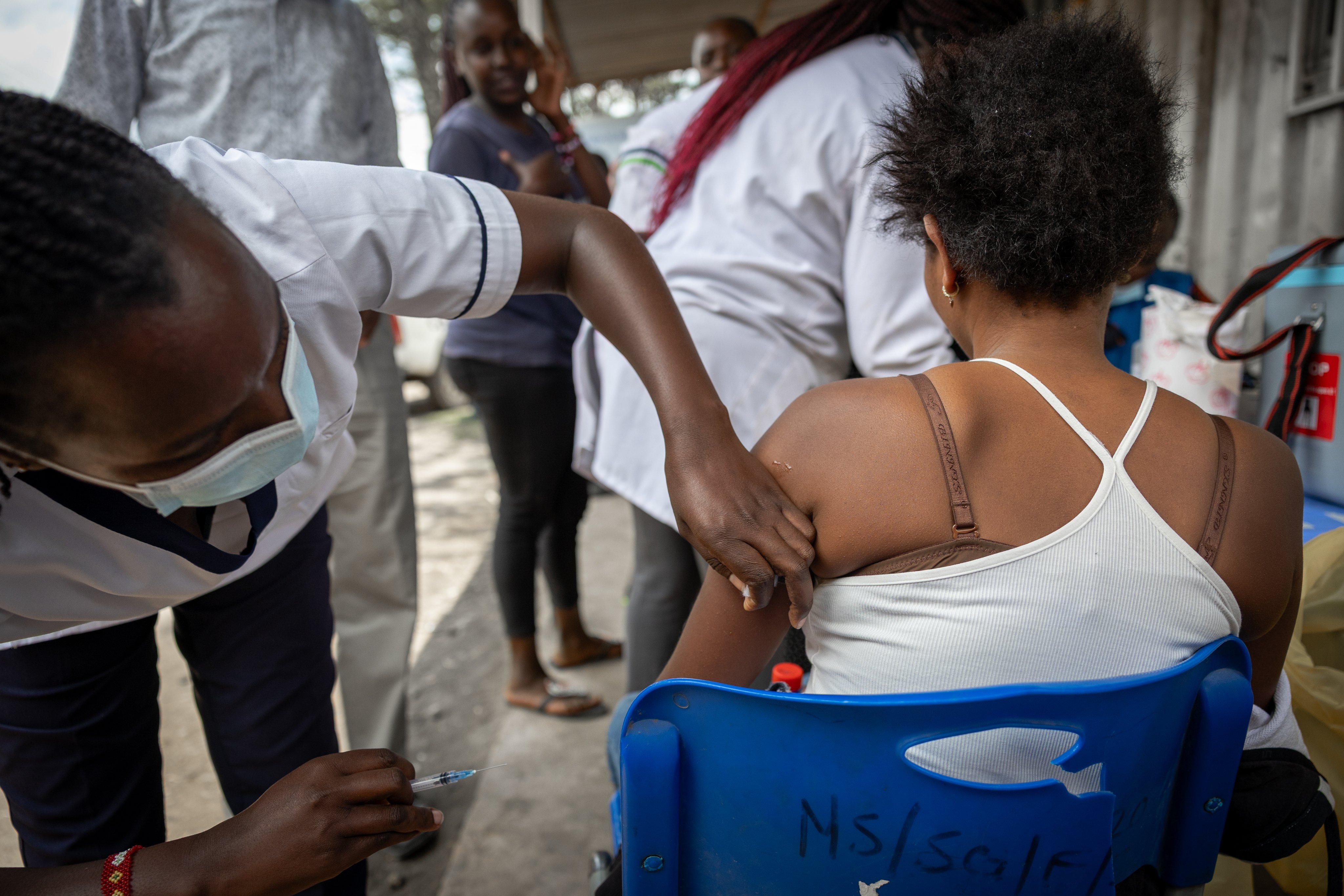
 Cuts from the US and multilateral partners leave essential programmes exposed. /WHO
Kenya is staring at a Sh72 billion hole in health financing after external support plunged sharply in the current financial year, threatening to undo years of progress against HIV, tuberculosis and malaria.
A December 2025 summary report by the Center for Epidemiological Modelling and Analysis (CEMA) at the University of Nairobi shows that total external health funding fell from Sh126 billion in the 2024/25 financial year to Sh54 billion in 2025/26.
The drop coincides with the withdrawal of United States government funding, historically the largest single contributor to Kenya’s health sector.
The decline comes even as the Ministry of Health’s overall budget rose modestly to Sh138 billion in 2025/26, up from Sh127 billion the previous year.
Of this, Sh119 billion is government funding, Sh19 billion is on-budget external support routed directly through the ministry, Sh12.3 billion flows through the National Treasury, and Sh26 billion is off-budget donor financing.
External resources therefore still account for a large share of total health spending, but the scale has shrunk dramatically.
“The annual trend in total external funding shows a clear upward trend prior to FY 2025/26. However, in FY 2025/26, the total external funding has severely declined to Sh54 billion down from Sh126 billion in the previous year largely due to the withdrawal of funding by the US government in 2025 and the decline in Global Fund and World Bank support,” the CEMA analysis states.
The most severe contraction was in off-budget funding, which fell from Sh87 billion to Sh26 billion.
The report notes that US support has primarily flowed through these off-budget channels, meaning the withdrawal hit fast and hard.
Off-budget funding also poses another problem: the government has limited control over how those resources are deployed, making it harder to redirect money to emerging priorities.
On-budget external support dropped as well, from Sh39 billion to Sh28 billion, driven largely by cuts from the Global Fund amounting to Sh11.6 billion and Sh1 billion from the World Bank.
For decades, Washington had anchored Kenya’s health financing. The US government accounted for more than 50 per cent of total external funding on average before 2024/25.
Its exit therefore leaves a gap few donors can quickly fill. The disruption follows the United States’ formal withdrawal of funding and membership from the World Health Organization on January 22, 2026, after an executive order signed on January 20, 2025.
The move ended 78 years of membership, halted hundreds of millions of dollars in annual contributions, and recalled US personnel.
The decision cited dissatisfaction with the WHO’s handling of the Covid-19 pandemic and governance reforms.
Programmes reliant on multilateral channels, including immunisation initiatives supported by Gavi, the Vaccine Alliance, have already required emergency reallocations.
CEMA warns that the shock will be felt most in Kenya’s strategic disease programmes, which are heavily donor dependent.
“All the three strategic disease programmes budgets, HIV, TB, and Malaria, have declined in both the total external funding and from government funding. This decline in funding, if not addressed soon, will likely reverse the gains made over the years in these disease programs. For example, the sustained low level of HIV incidence in different groups can be reversed,” the report cautions.
The numbers illustrate the strain. HIV faces a Sh14.47 billion gap against a resource requirement of Sh27.11 billion, with only Sh7.94 billion coming from the Global Fund and Sh4.59 billion from the government.
Tuberculosis has a Sh13.81 billion shortfall against a Sh17.75 billion requirement. The Global Fund provides Sh3.24 billion while the government contributes Sh700 million.
External funding for TB from the Global Fund alone dropped from Sh4 billion to Sh1.74 billion. Malaria, with a Sh3.81 billion requirement, faces a Sh410 million gap.
Global Fund support declined from Sh4.25 billion to Sh1.53 billion, with the government adding Sh990 million.
The cumulative effect is a commodity funding gap of Sh34.655 billion across programmes.
By contrast, reproductive, maternal, neonatal, and child health attracted 32 per cent of all external funding.
The RMNCH programme received Sh5.85 billion in external support, up from Sh2.82 billion, boosted by a Sh3.8 billion grant from the Susan Thompson Buffett Foundation.
The Gates Foundation is now the largest overall external contributor. Yet even here, government funding fell from Sh1.04 billion to Sh540 million, suggesting what the report calls a “crowding out effect."
Loans would ordinarily offer a cushion for on-budget financing, but this would add pressure to public debt and offer little immediate economic return from healthcare investments.
Given this scenario, the funding shift creates a delicate balancing act for Kenya, where more grants are preferred, but the country’s lower middle-income status limits access.
Meanwhile, cuts from the US and multilateral partners leave essential programmes exposed.
Without swift replacement financing or increased domestic allocations, the report signals that hard-won gains against the country’s biggest infectious diseases may not hold.