President William Ruto has dismissed efforts by his predecessor Uhuru Kenyatta to breathe life into the Azimio coalition party ahead of the 2027 general elections.
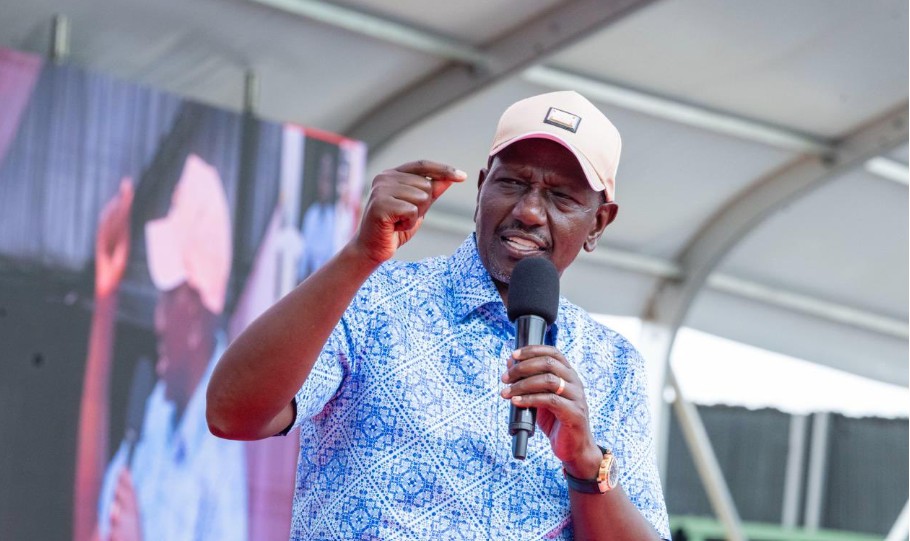
Addressing a roadside rally after attending a church service at AIC Pipeline in Embakasi, Nairobi, Ruto yesterday said he had already decisively defeated the opposition outfit in the 2022 polls.
“Now I hear they are reviving Azimio. We beat Azimio so early in the morning in 2022,” the President said to a mammoth crowd outside the church.
He downplayed the coalition’s prospects, asserting that without the support of ODM —the anchor party in the alliance—Azimio has no chance of mounting a credible challenge.
“Azimio without ODM is dead on arrival. Isn’t Azimio without ODM dead on arrival? Isn’t that true?” Ruto said, emphasizing the coalition’s dependence on ODM’s leadership, organisational, and numerical strength.
The President’s remarks come days after Uhuru, in a bid to reinvigorate the coalition, instigated changes to Azimio’s leadership, a move widely interpreted as an attempt to purge members aligned with Ruto.
During a council meeting that he chaired last week, the former president replaced the late former Prime Minister Raila Odinga with Wiper Party leader Kalonzo Musyoka as the coalition’s new party leader.
Suba South MP Caroli Omondi was named secretary-general, replacing Suna East MP Junet Mohamed, pending ratification by the Registrar of Political Parties.
However, ODM has rejected the changes, arguing that they contravene the Azimio Deed of Agreement.
In a letter to Registrar John Lorionokou, ODM executive director Oduor Ong’wen said the party was neither consulted nor involved in the purported decisions.
Addressing the issue, Ruto said Azimio, already weakened by its internal rifts, was even less capable of challenging his re-election without ODM.
He also aimed at the opposition’s political tactics, accusing them of promoting tribalism, division, and hatred.
“Let me ask you, the people of Nairobi, when you are electing leaders, are you electing them because they have worked or because of their faces? Is it work or face? Is it work or tribe?” Ruto asked.
He urged the city residents to prioritise competence over ethnicity or popularity.
Nairobi Governor Johnson Sakaja, who accompanied the President, reinforced this stance, warning that leaders who preach division would not be accepted in the capital.
“Those are leaders who belong to the village, and we shall not accept them in Nairobi,” Sakaja said.
Earlier during the service, Ruto highlighted his administration’s economic achievements and reassured Kenyans that the government is firmly on course to easing the cost of living.
He said the country is now reaping the benefits of difficult economic decisions made earlier in his tenure, which included stabilising key macroeconomic indicators.
“We made sacrifices earlier. Today, we are beginning to reap the benefits. Housing is going on, health is going on, and our roads are going on.”
“We can now reduce taxes, and that is how we will transform our nation,” the President said, stressing that reforms are being implemented gradually but deliberately to ensure long-term impact.
“One step at a time, one programme at a time. I am very confident that we have set our eyes on moving Kenya from a Third World country to a First World country,” he added.
Ruto credited the government’s current economic recovery to prioritising stability at the start of his administration.
“All the things we can do now are because we did first things first. We stabilised our economy. That was the biggest problem we had—the stability of our economy,” he said.
The President noted that economic stability now allows the government to focus on development and relief measures for ordinary Kenyans.
The President said the government has cleared all pending bills related to road construction projects up to December 2025, a move that has unlocked resources for new development initiatives.
“We now have the resources to drive our development,” he said.
As part of efforts to manage the rising cost of living, Ruto announced plans to reduce the tax burden on workers, noting that proposals would soon be tabled in Parliament.
Under the proposed changes, low-income earners will receive significant relief, with those earning Sh30,000 and below fully exempt from PAYE.
Employees earning up to Sh50,000 will also benefit, with deductions reduced by 5 per cent.
“A total of 2 million will benefit so that we can carry everyone along and begin to manage the cost of living,” Ruto said.