
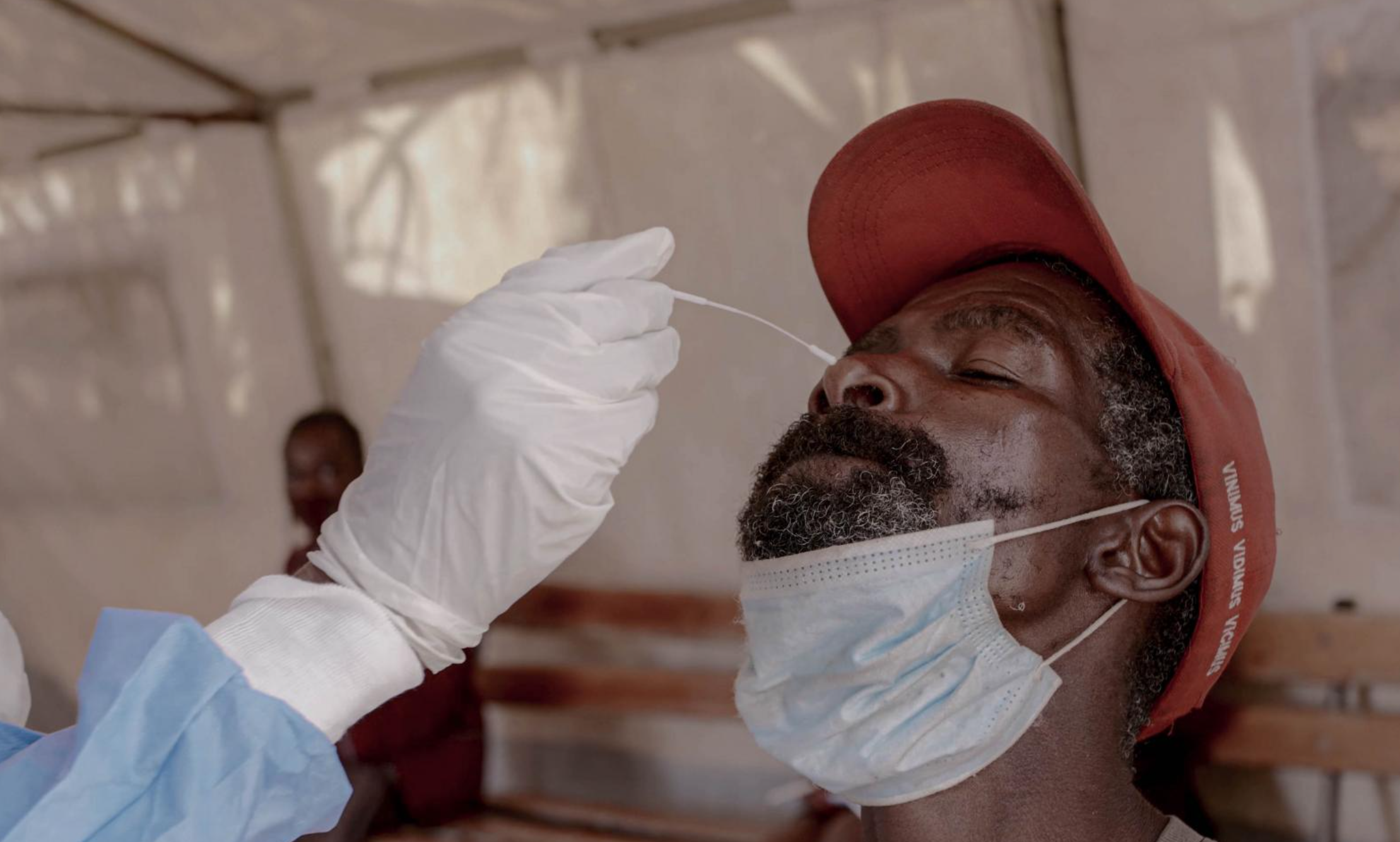
 Covid-19 testing /FILE
Ugandan researchers say the Covid-19 virus that killed at least 3,620 people likely originated from Kenya before spreading throughout their country.
The finding is contained in a new genetic study that traces how the virus moved across East Africa during the first two years of the pandemic from 2020.
The study, titled ‘Genetic diversity and transmission dynamics of SARS-CoV-2 in East Africa’, was conducted by scientists from Makerere University and was published in Scientific Reports last month.
They added: “Cross-border movements,
especially by truck drivers and refugees, played a significant role in the
spread.”
The researchers said Kenyan truck drivers were exempted from the country’s strict lockdown rules and are likely to have taken the virus to Uganda.
They also said that “porous land borders, especially among Uganda, Rwanda, South Sudan, and the DRC, played a critical role in sustaining viral flow.”
The researchers caution that the findings should be read as a lesson, not an accusation.
“These realities challenge the efficacy of unilateral lockdowns and call for harmonised regional approaches to border health management,” the paper read.
It continued, “Our findings underscore the importance of coordinated regional responses, especially in border surveillance, data sharing, and sequencing investment.”
Kenyan scientists have not responded to the study.
The study set out to understand how Covid-19 moved within Uganda and between countries in East Africa to help inform better public health strategies and preparedness for future pandemics.
The researchers used genetic data rather than relying on case reports or border records alone.
In total, 11,865 high-quality viral genome sequences from East Africa were analysed. Kenya contributed the largest share.
“Kenya had the highest number of sequences, followed by the DRC,” the paper read.
Tanzania had no data, while Burundi and South Sudan had few sequences.
Ugandan sequences appeared in clusters dominated by Kenyan samples, “indicating eithershared lineage ancestry or cross-border transmission events,” the researchers said.
The statistical confidence behind the study findings is high.
According to the study, “Those with a posterior probability of 0.5 or higher are statistically significant,” and the Kenya-to-Uganda transmission link had a posterior probability of 1.0, the highest possible level of support in the model used.
Many other infectious diseases, such as Mpox, are thought to originate from DRC and Uganda because they have weaker health systems. But Covid-19 appears to have broken that pattern.
The World Health Organization, which did not comment on the study, separately said it is committed to working with all countries to strengthen preparedness.
“The pandemic taught all of us many lessons ¾ especially that global threats demand a global response.”